
FEUILLETON Rambouillet - ultimatum for the bombing (7): The Secretary of State imposes bombing
Writing for Kosovo Online: Dragan Bisenic
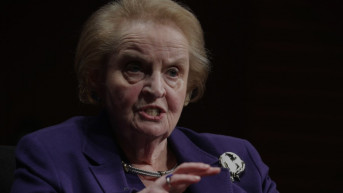
Soon, the solution presented itself to her - bombing.
"The National Security Council and the Pentagon felt uncomfortable with my statements and determination. The administration did not want to engage in another confrontation involving the threat of force. The Department of Defense, which had yielded regarding the deployment of US troops in Bosnia, was not eager to contemplate further missions in the Balkans. As a result, to my astonishment, the administration ceased to reaffirm the Christmas warning from 1992. I felt it was urgent to reopen the possibility of bombing," Madeleine Albright wrote.
So, even though no one wanted a new military confrontation, Albright seems to proudly emphasize that she was "alone against all". Although she emphasized that her policy and judgment on the Kosovo conflict were based purely on "moral motives", she recalls the "Christmas warning" in which there is no mention of moral motives, only strategic ones, the possibility of the conflict spilling over into neighboring countries and the relations between NATO members - Greece and Turkey.
Here's how it looked and what the main argument for the bombing was in the debate with other perspectives.
"In the afternoon of April 23, Bob Gelbard, Strobe Talbott, and I sat in the west wing of the White House with Sandy Berger. I warned that the steps we were taking were not enough. Kosovo was heading for a major confrontation unless there was a political agreement, which would not happen until Milosevic felt threatened - which would not happen until the use of force was on the table. Our current stance was 'nothing is off the table'. This sounded weak because it was weak. It was a clear step back from our previous position and a replay of our earlier concerns about Bosnia," Albright explained.
During the further course of the meeting, Gelbard reiterated her comments, saying that "we must use the threat of force to persuade Milosevic to negotiate". To make this credible, it was "essential" for NATO to begin "elaborating plans for a bombing operation". At that moment, Berger reacted angrily.
"You can't just talk about bombing in the middle of Europe. What targets would you like to hit? What would you do the next day? It's irresponsible to make threatening statements without a coherent plan. The way you at the State Department talk about the bombing, you sound like lunatics".
This angered Madeleine Albright. "I always taught my students at Georgetown not to interrupt; now I am, saying: 'I'm tired of this. Every time someone talks about the use of force, they're subjected to ad hominem attacks. Five years ago, when I proposed the use of force in Bosnia, Tony Lake never let me finish my arguments. Well, now I'm the Secretary of State, and I will insist that we at least have this discussion".
As seen, Albright concluded the debate by saying that she was "Secretary of State" and that she insisted on discussing the bombing, just because others thought it was an inadequate idea and to defend herself from "ad hominem" attacks.
For every argument Milosevic presented, Albright responded: "Milosevic is a born liar" or just a "liar". This is a characteristic that is almost always found next to his name.
In early May, she called the Ambassador to Skopje, Christopher Hill, and asked if, in addition to his duties as Ambassador to Macedonia, he could also take on the role of a full-time Kosovo Envoy, so the United States got its first Envoy for the Kosovo issue.
The June exercise "Determined Falcon" wasn't just a possible preparation for a new situation or a show of force on the Yugoslav borders. It meant that NATO was actually preparing plans for bombing Serbia from that moment on. When this proposal was in effect, its strong supporter was the former Assistant Secretary of State, Ambassador to Turkey, and President of the Carnegie Endowment for International Peace, Morton Abramowitz.
What was even more important, almost crucial, was that Morton Abramowitz was a long-time friend and confidant of Madeleine Albright, and at the Rambouillet negotiations, he advised the Albanian delegation. In a conversation we had before leaving for Aviano on June 12, 1998, Abramowitz clearly stated, "Either Milosevic cooperates or he will be overthrown". "If the West is not prepared to realistically threaten or, if necessary, use force to stop the fighting, Milosevic must promise to cooperate in efforts to solve the problem, or the West will do everything possible to remove him from power, including, if necessary, supporting and arming the Kosovo Liberation Army," Abramowitz said.
According to his proposal, Kosovo should be resolved within a year, and in that case, sanctions will be lifted against Serbia. Other proposals include Kosovo remaining part of Serbia, and violence must cease within 72 hours. The key part of the proposal, elaborated in accordance with the ideas of Madeleine Albright, is that the Serbian police and special forces must withdraw from Kosovo within 6 months, the same applies to the army, although the army could remain at the border. The Serbian population must be protected as well as all historical and religious monuments.
To guarantee this, NATO should deploy peacekeeping forces. The newly elected parliament would take over the administration of Kosovo within one year, and the West would assist in the formation of police forces. NATO units would immediately be deployed in Macedonia.
"Kosovo's independence is a mortal threat to the stability of Macedonia, the Bosnian peace agreement, and the entire southern Balkans. That is why the West insists that Kosovo remain in Serbia," Abramowitz emphasized. And, when asked if the West would militarily attack Serbia, Abramowitz confidently predicted, "I believe that Western forces can immediately destroy Serbian forces. I do not believe that this is an attractive solution, but it may be forced. The use of force may be the only way to stop the violence".
Two days later, on June 15, while I was still in Aviano, I published the entire interview with Abramowitz. Abramowitz believed that negotiations between the Serbian and Albanian sides could not continue unless the violence was stopped. However, he also believed that these negotiations could not be "endless talks" between one "very strong" (Serbian) and "very weak" (Albanian) side. This meant that the US needed to strengthen the "weaker side" (Albanians). He saw the solution in the "cooperation between President Milosevic and NATO forces, which would be in Kosovo on a peacekeeping mission to protect the Serbian and Albanian populations".
Since this "cooperation" implied the removal of Serbian police and military from Kosovo and their replacement with NATO troops, it was quite likely that Milosevic would not agree to such ideas, which would de facto mean taking Kosovo out of Serbia. Abramowitz reiterated that he was "concerned" whether the West was even ready to use force to prevent violence. If they were prepared to do so, they would have to "give some ultimate deadline", something they had "so far refused to do," Abramowitz assessed.
He hoped that the West was preparing to present Milosevic with a choice - either cooperate or Serbia's military capabilities would be destroyed, and he removed. "Western forces can immediately destroy a large part of the Serbian forces," Abramowitz estimated, adding that "it's not, of course, a desirable thing to go to war with Serbia", but "Milosevic thinks the same". He believed that NATO was the most important on the Western side, not the Americans.
Abramowitz opposed calling the KLA "terrorist", noting that nobody in the world referred to them as such except in Serbia. When asked how he would refer to them, he said they were "essentially a separatist organization that uses military and violent methods to attack the Serbian police". While distancing himself, he stated that "nobody in the West is eager to use force and violence", if it did not stop in Kosovo, "we will have a constant deterioration of the situation leading to the destruction of Serbia and the entire Balkans". Abramowitz concluded that it was necessary to "stop the violence and create a new political situation, with NATO presence".
He believed that there would be a "surge of violence" that week and possible attacks on "numerous besieged towns", and that many people would be displaced. He was particularly concerned about Djakovica and the surrounding area. He knew that at that time Milosevic was preparing to travel to Moscow for a meeting with Yeltsin, where he would be told to end the violence. "He will promise to do so, but these are all games we've seen before, and they will last two to three weeks".
To be continued tomorrow: Milosevic and Yeltsin statements from Moscow
0 comments