
FEUILLETON Rambouillet - ultimatum for the bombing (5): Kosovo 1999 - introduction to today's collapse of the international system
Writing for Kosovo Online: Dragan Bisenic
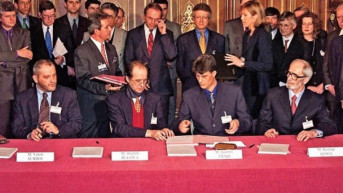
Memoirs of Madeleine Albright, "Madam Secretary" were published in 2003. Today, when read in a changed international context and in the new dynamics of world events, the dubious value of the logic that led to the attack on Serbia is more clearly seen, and how the events of 1999 inevitably led to the degradation of international relations, right up to today, when they have faced absolute collapse. In the light of Russia's war, when similar conflicts exist on the matrix of the Kosovo conflict in other regions, after September 11, 2001, Afghanistan, Iraq, Georgia, the Arab Spring, Libya, Syria, the Islamic State, Yemen, African states, the bombing of 1999 becomes the beginning of this chain of events and the logic that led to them. All of these, to the greatest extent, are the offspring of the Kosovo bombing. What we still do not see is whether diplomacy, including negotiations in Rambouillet, was just a mask for a decision already prepared for the bombing and whether there were any sincere intentions to reach a diplomatic solution.
There is no doubt that Madeleine Albright also wanted to achieve goals, if possible, without the use of force. Before that, we need to remind ourselves what would be that "diplomatic solution" that was negotiated in Rambouillet. It was a proposal for all security forces to leave Kosovo, for 28,000 NATO soldiers to come to Kosovo instead, and for the final status of Kosovo to be determined after three years, with the explicit possibility of independence not being rejected. If Serbia did not accept this proposal, bombing would follow. In fact, the only real purpose of the negotiations in Rambouillet was to enable NATO to deploy 28,000 soldiers in the province.
Due to such conditions, many have called this a war ultimatum, as Henry Kissinger did. Walter Isaacson called the bombing "Madeline Albright's private war". When everything is read, when summed up and subtracted, Madeline Albright actually says, "There was bombing because I wanted it". There is no dispute that she was the architect of the policy towards Serbia and Kosovo and the events that resulted from that policy. And then the whole administration followed her lead. That is true, but it is also oversimplified. The bombing was wanted by the entire neoconservative group organized into various pressure groups, gathered around several magazines, and outspoken in public appearances. Madeline Albright was a representative, not the leader of that faction within the administration. How and why she ended up there, what neoconservatives are, and who they actually represent and advocate for, is not the topic of this paper, but we can notice that they have had long-term consequences and that they are the root of such deep and, until recently, unimaginable divisions that exist in the world today, as well as in the US society itself.
Ambassador Christopher Hill, who joined Holbrooke as the US Envoy for Kosovo, noticed this alliance between neoconservatives and liberal interventionists. In his book "Outpost - a Diplomat at Work", published in 2015, he wrote, "Our diplomacy was seen only as an extension of our raw power. In Washington, a coalition of liberal interventionists and neoconservatives demanded action. At one meeting, I found myself in front of Paul Wolfowitz, who rarely encountered a problem in the world that couldn't be solved by dropping a few bombs, and Morton Abramowitz, the former head of the Carnegie Foundation who rarely encountered a village in the Balkans that didn't want to be turned into an independent state. They combined forces to pressure the US Government, although they philosophically came from very different perspectives.
The triumphalist mood in the United States in the 1990s was palpable. No problem, no matter how difficult and entrenched in decades or centuries of wretched and dirty history, was beyond our ability to solve, usually by force. Those who were not subscribed to this worldview were supposedly trapped in the past, unable to understand the new paradigm of the "new American century".
From that standpoint, it seems worthwhile to establish and specify how the idea of conducting an air war developed within Albright herself, how it became dominant within the administration, what diplomacy served, and what the key events were in the evolution of this war, from concept to execution.
On the international stage, the only constant agreement came from British Prime Minister Tony Blair, who readily supported the plans of the Secretary of State to carry out a bombing in Europe. However, we will see later that even British enthusiasm was not always sufficient to satisfy Albright with that support. In a way, the rudimentary way of reasoning and the dogmatic thinking system of Madeleine Albright on matters of war and peace is surprising, which is so uncharacteristic of the US Secretaries of State, a narrow view of global issues, selective choice of facts to be considered, and stubborn defiance towards anyone who questioned her resolute concept of military action and willingness to use force. Some may see this as a picture of determination, but it is not, because Madeline Albright herself sought to later change this image and give it a much broader context in her "Memoirs". For example, in the book "The Mighty and the Almighty - Reflections on Power, God, and World Affairs", published three years after the "Memoirs", she addresses the favorite neoconservative theme, religion, and the relationship to God, where, instead of undeniably emphasizing personal pride as the main and ultimate actor in the strategy of bombing Serbia from the "Memoirs", she now shifts the emphasis and perception of her own role, saying that she "tried every possible way to reach a diplomatic solution" throughout an entire year.
She admits that "Serbia did not threaten to attack another country, so there was no basis for a preventive attack", but that we "had a duty to defend others who were weaker". Albright later tried to turn this into a whole doctrine and canonize it as the "responsibility to protect", but it did not succeed, nor did it receive any significant resonance.
In addition to this, Albright admits that the administration made special efforts to demonstrate the righteousness of its goals since it did not have a UN mandate for military action. Overall, in this book, Albright shows much more historical understanding than she did during her time as the head of the US diplomacy. She sees the causes of the conflict in Kosovo in the religious history of the region. "Explaining Serbian reasons, Milosevic once told me that his people had been defending 'Christian Europe' for centuries. Serbian national history is based on the Battle of Kosovo, the fight against the Turks at the Kosovo Field in 1389. According to legend, a prophet appeared before the Serbian prince Lazar on that fateful day. He offered him a choice between an earthly empire and a heavenly empire. The prince chose the heavenly empire. This is an inspiring story that played a role in the Serbian decision to resist the Nazis during World War II. She then quotes the entire radio address of Patriarch Gavrilo Dozic after March 27, 1941. For her, the problem now was that "Serbs now wanted to avenge the defeat at Kosovo more than 600 years ago, motivated by a fierce sense of nationalism and a belief in their special relationship with God".
What would former Czech President Vaclav Havel have to say today, who stood unquestionably with Madeleine Albright during moments of her wartime endeavor and wrote probably irreplaceable sentences that no one else will write, and perhaps even Havel himself would not write again, which Albright quotes in full, "If anyone can say that every war is ethical or waged for ethical reasons, then that is true for this war. Kosovo, unlike Kuwait, has no oil fields to protect; no member of the alliance has territorial claims, and Milosevic does not threaten the territorial integrity of any member country. But NATO is at war. It is fighting out of concern for the fate of others. It is fighting because an honorable person cannot stand aside and watch the systematic and government-led killing of other people. This war places human rights above the rights of states," stated this once great writer who found the highest morality in waging a war through NATO that determines the moral superiority and hierarchy of nations over one another and establishes an order in the morality of their opposing demands, aspirations, and goals.
To be continued tomorrow: How to resort to the use of force
0 comments