
FEUILLETON Rambouillet - ultimatum for the bombing (8): The Moscow statements of Milosevic and Yeltsin
Writing for Kosovo Online: Dragan Bisenic
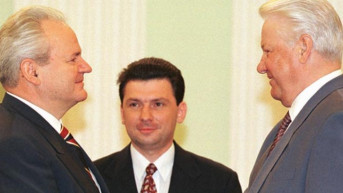
While in Moscow, Milosevic met with President Yeltsin and Foreign Minister Yevgeny Primakov on June 16, holding press conferences with them, and ultimately signing a Joint Statement with the Russian President.
During the press conference, after talks with Russian Foreign Minister Primakov, the President of Yugoslavia stated that he was in favor of a peaceful resolution to the Kosovo problem, emphasizing that there was no ethnic cleansing in Kosovo and no withdrawal of the Yugoslav Army as the province was a part of Yugoslav territory.
Yeltsin and Milosevic signed a Joint Statement on Kosovo, consisting of 9 points, emphasizing the preservation of the territorial integrity and sovereignty of the Federal Republic of Yugoslavia and condemning all forms of terrorism and separatism. Through this statement, Milosevic committed to resolving the Kosovo issue through political means and continuing negotiations with Kosovo Albanian leader Ibrahim Rugova.
In the joint statement signed with President Boris Yeltsin, and even more explicitly during the press conference, Milosevic made it clear that he was in favor of a peaceful resolution to the Kosovo conflict, denying ethnic cleansing in Kosovo and stating that only terrorism was being suppressed. He reiterated that there would be no withdrawal of the army as Kosovo was a part of Yugoslav territory, and that special police forces would only be withdrawn from the field in proportion to the reduction in terrorist activities. This stance was indirectly confirmed by Russian Foreign Minister Yevgeny Primakov at the press conference, stating that the Moscow talks between Presidents Yeltsin and Milosevic were creating opportunities for a peaceful resolution of the conflict and the situation surrounding Kosovo. "The ball is now in the court of the Kosovo Albanians," Primakov said, to which Milosevic added "Spasibo" (Thank you).
Russian President Boris Yeltsin expressed hope that his talks with Milosevic would contribute to ending the crisis in Kosovo. "I think the task entrusted to us regarding talks with Milosevic will be accomplished," Yeltsin said. Yeltsin and Milosevic talked for an hour privately at the presidential residence in the Kremlin, with Milosevic's brother, Bora Milosevic, acting as translator. They were later joined by Foreign Minister Yevgeny Primakov, Defense Minister Igor Sergeyev, and the head of foreign intelligence, Vyacheslav Trubnikov.
After an hour-long meeting with Yeltsin, Milosevic held a three-hour discussion in two rounds with Primakov, attended by Defense Minister Marshal Igor Sergeyev, Intelligence Service chief Vyacheslav Trubnikov, and Yeltsin's foreign policy advisor, Sergey Prikhodko.
Trubnikov's participation in the talks surprised journalists, as he had never before appeared in a group of Yeltsin's associates who typically attend meetings with foreign leaders. The presence of the "man with an exceptionally intelligent face", as Trubnikov is often described, is seen in informed circles in Moscow as an indication that the Kremlin employed some "non-standard approaches, which are not usually openly used in talks with foreign statesmen", in discussions with Milosevic.
In their joint statement, the two presidents affirmed the need to preserve territorial integrity and respect the sovereignty of the Federal Republic of Yugoslavia (Serbia is not mentioned), condemning all forms of terrorism, separatism, and military actions affecting civilian populations. In the interest of stabilizing the situation in Kosovo, Milosevic expressed readiness to resolve all issues through political means and to continue negotiations with the Kosovo Albanians without delay, which, the statement emphasizes, would include autonomy in accordance with prevailing international standards. It is emphasized that no repressive actions will be taken against the peaceful population, which, of course, does not include the Kosovo Liberation Army forces.
The two presidents advocate for strengthening confidence-building measures between the authorities in Belgrade and the local population. Full freedom of movement will be ensured throughout the entire territory of Kosovo, and there will be no restrictions for foreign diplomats and representatives of international organizations. One of the key points of the statement guarantees the return of refugees without any obstacles and that the state will provide assistance in rebuilding damaged houses and settlements. The most important point, directly related to the position taken by the Contact Group in London, concerns the actions of special police forces. These forces will withdraw from the territory outside their permanent bases in proportion to the cessation of terrorist activities. As for the return of the OSCE Mission, Milosevic announced that he was ready to begin negotiations that would simultaneously cover the return of both the mission and Yugoslavia to the organization. It was said that the negotiations had been open and substantive.
Since later the foreign ministers of European countries referred to this statement, it is likely that it was previously coordinated within the Contact Group, and that the Russian side took it upon itself to present it in its most important aspects to the President of Serbia, who was supposed to promise renunciation of violence, leaving reservations that Russia otherwise had in its overall approach to this issue.
In Aviano, I also separately spoke with NATO aviation commander General Michael Short, who was clearly involved in planning the attacks. He even announced that "NATO is increasingly turning towards Southeastern Europe" and that the "future of NATO is linked to this region", noting that "NATO is not a trifling matter".
He pointed out that "NATO as a political and military alliance has great capabilities", and that his responsibility was "to prepare the military command to execute military options", noting that he could not assess "what NATO leadership will choose to do" because that belonged to "a political level that is much more involved" than him. As he spoke, General Short was interrupted by the noise of fighters descending onto the runway. "The sound of freedom", the general said, turning towards the planes that had landed.
While the NATO exercise was ongoing, the KLA made a gesture on its part and called for general war. The main headquarters of the illegal "Kosovo Liberation Army" (KLA) called on "all healthy Albanian political forces to serve the homeland and the liberation war". The statement also called on these forces to "distance themselves from the politics of deception and division within the nation and anarchy, which, in the name of fictitious institutions, attempt to eliminate true national institutions and the KLA". "Through maneuvering methods, certain political circles are trying to jeopardize the interests of the homeland and the goals of the liberation war, but the KLA warns that this will be condemned and punished," the statement said.
The main KLA headquarters, calling itself the "General Staff", called on the Albanians to "mobilize and be ready to finally face the enemy" and not to abandon their ethnic hearths, and all those who want to help the KLA, especially compatriots abroad, contribute to the 'Homeland Calls' fund.
Great Britain was most decisively on the side of Madeleine Albright. NATO military intervention in Kosovo will occur in the coming weeks "if President of the Federal Republic of Yugoslavia Slobodan Milosevic ignores very strong warnings" from the Contact Group and the international community to cease violence there, British Foreign Secretary Robin Cook said. Cook then revealed that NATO had been preparing and refining plans for bombing Serbia for two weeks.
In a detailed interview with the British TV station BBC, Cook said that potential intervention in Kosovo "cannot be compared in any way" with the "appropriate and proportionate response to terrorism" that Great Britain had applied in quelling violence in Northern Ireland. According to him, police-military forces under the control of President Milosevic had committed "ethnic cleansing" by "expelling over 50,000 civilians" from villages and towns. "Even if some of them were associated with the Kosovo Liberation Army, that does not justify action against terrorists”.
This is clearly ethnic cleansing aimed at driving people from the area and preventing their return," Cook said. He assessed that this kind of Milosevic's policy was "completely counterproductive" and that the so-called Kosovo Liberation Army "is now even stronger than before", and the Albanian community had become even more radicalized. He added that during a meeting in London last Friday, Kosovo Albanian leader Ibrahim Rugova had told him that he was against any violence, including that carried out by the KLA.
"The sole objective of preparations for possible military intervention is to stop violence, and NATO commands have been working on plans for that for two weeks now. We are carefully considering how we can intervene if President Milosevic ignores a very strong warning," Cook said.
Cook also revealed that the issue of the mandate for military action was among the dilemmas of the Europeans, so he conveyed that "the latest meeting of EU foreign ministers and the Contact Group clearly indicates that the UN Security Council should approve a mandate for such military intervention". When further asked to clarify whether this meant that "nothing will be done without a resolution of the UN Security Council", he replied that "Great Britain has already begun and leads efforts to obtain agreement for a resolution, recognizing that Kosovo poses a threat to international security and that there is an international necessity and right to ensure that such things do not happen because they can endanger regional security". "I must say that we are receiving strong support from both permanent and non-permanent members of the Security Council," Cook said.
To be continued tomorrow: Tight room "3 on 3"

0 comments