
FEUILLETON Rambouillet - ultimatum for the bombing (9): Tight room "3 by 3"
Writing for Kosovo Online: Dragan Bisenic
When asked by the host if he was sure that he would go to Kosovo in the coming weeks, if necessary, he answered:
"Yes, if necessary, and I think it is a very fair stance. Because we are not doing it because we want military intervention, but because we want to stop the violence". "We want to prevent President Milosevic from using heavy weapons and tanks in attacks on villages and civilians, as he did before. That is why it is essential that he hears this message and withdraws the forces that carried out those actions," Robin Cook said.
Milosevic "must not imagine that the international community will make the same mistake as it did in Bosnia when it decided to intervene too late. We learned that lesson from Bosnia," Cook pointed out.
The head of the British diplomacy added that he "admires the courage" of Ibrahim Rugova and that he "rejects the violence of both sides, including the Kosovo Liberation Army".
"As long as President Milosevic avoids settling and starts serious negotiations with such people, it will be increasingly difficult to do anything," Cook added.
When asked by the BBC host if the reports that British mercenaries were in the ranks of the KLA and training its members were true, Cook replied that he had no information about it, but that it "would not surprise him if that were the case".
Indeed, Great Britain sent to the UN its draft resolution for Security Council authorization for military action. However, that move was not approved by the US Secretary of State, who rejected the idea because it limits NATO, and advised Robin Cook to get "new lawyers".
"Diplomacy became more complicated when the British sent a draft of the UN Security Council resolution authorizing the use of force. This was well-intentioned but ill-conceived. I called Robin Cook, who said he had been told by lawyers that a UNSC mandate would be needed if NATO was to act. I told him he should get himself new lawyers. If the UN resolution had been adopted, we would have set a precedent that NATO required Security Council authorization before it could act. This would give Russia, not to mention China, a chance to veto NATO. If the resolution fails, it would be considered a victory for Milosevic and make NATO's movement much more difficult. The third possibility was that the resolution would be adopted, but only after enormous efforts to obtain Russian consent. "Three options - three bad outcomes; not a good plan," Madeleine Albright concluded.
Therefore, instead of the UN, respecting the norms of international law, ensuring the legality of the NATO action, and a political assessment of whether it is necessary, Albright will leave it to the decision of the Kosovo Albanians.
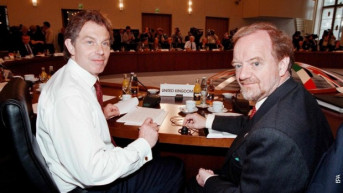
In line with this remark, British Prime Minister Tony Blair changed the British stance and announced that UN approval was not required for any military intervention. At the EU summit in Cardiff, Blair said that he believed that the mandate of the United Nations would not be necessary for every type of possible NATO military intervention in Kosovo, that is, that seeking a UN mandate would depend on the type of military intervention that would be planned. "It is clear that we would prefer to react to the events in Kosovo based on the UN mandate and we said that we needed a legal basis for any intervention that we decided on," Blair added.
Hill states that Rugova was the de facto leader of the Kosovo Albanians for more than a decade and "certainly deserved to be treated with respect", but in Washington, he was increasingly dismissed as ineffective, and as a man who did not rule over the armed guerrillas. In late May, Gelbard "stole the show" on this issue by meeting with the KLA group in Geneva at the same time that Holbrooke and Hill were meeting with Rugova.
As he was the first to call the KLA terrorists, so Gelbard was the first to legalize them in Washington. The implication was clear: Holbrooke and Hill were "stale news" while Gelbard was with the people who counted.
"But while Dick and I were traveling in the hinterland of Kosovo before he returned to the United States, we came to a small town in the southwestern part of the province called Junik, which was a scene of violence. The village elders invited us to the village house where we sat on the floor with glasses of strong, sugary Turkish tea to listen to what the 20 villagers who sat with us had to say. A few minutes into the meeting, a KLA fighter who looked like Che Guevara, in full store-bought camouflage, joined us and sat next to Holbrooke. There was very little room, and anyone looking at the wire service photo that was shown around the world the next day seemed that he was sitting on Holbrooke's lap," Christopher Hill described the encounter.
The newspaper noted that the room was "tight 3 by 3".
Holbrooke realized that while this more than evened the score with Gelbard, it could cause him the same problems with Milosevic that Gelbard had a few weeks earlier. "Holbrooke asked me to return to Belgrade the next day to meet with Milosevic and to assure him that “Che's“ entry into the room was completely unexpected," Hill explained.
Upon his arrival in Belgrade, Holbrooke met with Milosevic on Wednesday morning, June 24, and discussed the resolution of the Kosovo crisis, and the next day, Thursday, June 25, he met with journalists at the residence of the US Ambassador.
"The United States, Russia, and other members of the Contact Group want the situation in Kosovo to be resolved peacefully," Holbrooke said.
The international community accepts the fact that Kosovo is a part of Yugoslavia and is aware that both political leaders of Kosovo Albanians and armed groups seek independence. The international community cannot support this, because the change of borders by force cannot be accepted".
Holbrooke emphasized that a change in relations between the authorities in Belgrade and the Kosovo Albanians was desirable. "We do not want to interfere in the internal affairs of a sovereign state, but the situation in Kosovo represents a serious danger to the international system and stability in Europe. That is why the Contact Group, the OSCE, and the United Nations play an important role in solving the problem, just as NATO is preparing a military action if the situation worsens," Holbrooke announced.
Holbrooke emphasized that the biggest danger at that moment was the flare-up of the conflict in the village of Kijevo, where both sides had checkpoints. On the same day, for example, armed Albanians killed the principal of a school in Kijevo, Rados Spasic. On the same day, three Serbs were also kidnapped near the town of Crnoljevo from the Prizren-Pristina bus.
Holbrooke did not mention it, but later he still assessed that the "Serbian security forces" were most responsible. This contradicted the assessment of an unnamed diplomat in Pristina that "the lack of a fierce response from Belgrade in many areas where the Kosovo Liberation Army is active is puzzling, although we certainly welcome it," this official who was in Pristina at that moment said.
About the meeting with KLA members, Richard Holbrooke said: "The village of Junik, where we arrived after some confusion, was guarded by uniformed men and some without uniforms. We engaged in a conversation with them, but we came to Junik to see the facts, and by no means to negotiate. The man who introduced himself to us as a morale officer gave us his view of the situation. It was a very interesting discussion and I informed the Secretary of State about it. We also talked to the Serbs at the checkpoints on the way, because we wanted to hear as many facts as possible".
When asked if he thought it was possible to bring the KLA under political control, Holbrooke replied that he did not know. "Our conversation with these people is not an implicit recognition of this organization, nor was it a negotiation". Holbrooke compared the situation in the western part of Kosovo to the Wild West, stressing that the "lion's share" of responsibility for the escalation of violence lies with the "Serbian security forces".
On the same day, Ibrahim Rugova met in Bonn with the German Minister of Foreign Affairs, Klaus Kinkel, from whom he heard unsatisfactory news. "Ibrahim Rugova also encountered a rejection of his request for the independence of Kosovo in Bonn. We want autonomy for Kosovo and we cannot support anything else," the head of German diplomacy, Klaus Kinkel, said after talking with the leader of the Kosovo Albanians and members of his team for negotiations with Belgrade.
To be continued tomorrow: Hill and the origin of the Community of Serb-majority Municipalities

0 comments