
How and to what extent are Kosovo and Republika Srpska connected in terms of geopolitical issues?
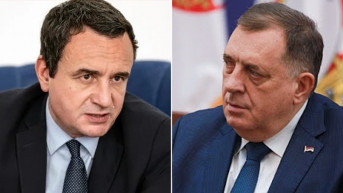
"There is one thing that even the most skilled politicians and analysts in the United States, Germany, and Great Britain cannot explain, and it concerns the rights granted by the authorities of these countries to Albanians in Kosovo - the right to self-determination and unilateral secession from Serbia as their mother country. At the same time, they deny the same right to the Serbs in Republika Srpska, which, according to the Dayton Agreement, is a separate entity within Bosnia and Herzegovina. What is going on here?"
Edited by: Milos Garic
Republika Srpska and Kosovo, besides the fact that both areas have been inhabited by the Serbs for centuries, are also connected by the fact that not so long ago, through most of the 20th century, both territories were a part of the Kingdom of Yugoslavia and later the communist SFRY until 1992 and the dissolution of that country.
In the interethnic wars of the 90s, the Serbs in Croatia and Bosnia and Herzegovina were not granted the right to self-determination, even though they had the status of a constituent nation in Yugoslavia. However, in the case of the Albanians in Kosovo and Metohija, despite being just one of many nationalities in the Republic of Serbia in the SFRY, the West established a completely different approach.
The inviolability of borders in the case of Bosnia and Herzegovina, as dictated by UN principles, is considered sacrosanct in Berlin, London, and Washington, just as it is for Ukraine. However, when it comes to Serbia, the territory of Kosovo and Metohija is forcibly taken away, allowing the Albanians to establish their second state in the Balkans. Not only that but the Serbian authorities are ultimately demanded to accept such double standards.
It is very interesting when the leader of the Albanian Self-Determination movement, Albin Kurti, today as the Prime Minister of Kosovo, vehemently rejects any thought of self-determination for the Serbs, both in Kosovo and in Bosnia and Herzegovina. Kurti is particularly disturbed by the idea of Serbian self-governance in municipalities where, despite two decades of apartheid under the temporary Kosovo authorities, the Serbs still constitute an absolute majority. The mention of the Community of Serb-majority Municipalities (CSM), envisaged by the Brussels Agreement of 2013, triggers panic attacks.
"We will not allow the right to territorialization and the creation of anything that would resemble Republika Srpska in Kosovo. We will not allow a satellite quasi-state that undermines the statehood of Kosovo", Kurti has threatened many times in the past few years regarding the CSM.
On the other hand, the President of Republika Srpska, Milorad Dodik, points out that Kurti, with the support of the West, dreams of a new "Operation Storm", this time in northern Kosovo, making the Serbs a marginalized minority that no one cares about. According to Dodik, there are similar plans in Bosnia and Herzegovina towards Republika Srpska, and he emphasizes that he does not recommend they try it. Dodik often causes unease in the West by asking - how is it possible for Kosovo to separate from Serbia while Republika Srpska has no right even to talk about it?
Republika Srpska is defended in Kosovo, and vice versa
Scientific collaborator at the Institute for International Politics and Economics, Aleksandar Mitic, speaking to Kosovo Online, states that in a geostrategic sense, this issue is linked to the West's efforts to dismantle the Serbian factor in the Balkans, and indirectly the Russian factor, to formally involve the entire region in NATO.
"This is a fundamental goal of the geopolitical West, and in order to achieve it, international law has been undermined, the UN system has been eroded, dangerous precedents have been set in Kosovo and Metohija and in the Republika Srpska, double standards, neo-colonization, military aggression, and a general hybrid war that has been ongoing for decades. Naturally, this has led to resistance not only from the Russian Federation but also from the People's Republic of China, especially since Beijing opposed the illegal appointment of Christian Schmidt as the 'high representative'", Mitic explains.
He points out that the political West lacks logical, legal, and moral justification for using blatant double standards and violating international law when pushing for the separation of 'independent Kosovo' from Serbia, while simultaneously promoting the erosion of Republika Srpska and the centralization of Bosnia and Herzegovina.
"This is why it is important that we hear less today the completely naive thesis - which has long echoed in some political circles in Belgrade and Banja Luka - that if Serbia renounces Kosovo and Metohija, it will receive a 'green light' from the West for an independent Republika Srpska. It won't. That's why Republika Srpska is defended in Kosovo and Metohija, and vice versa. Every Serbian concession to Western hybrid threats is harshly punished. This is the case with the latest pressures related to imposing the 'Franco-German plan' for Serbia to relinquish Kosovo and Metohija, as well as those related to imposing decisions by the illegal 'high representative' Schmidt to seize property and other powers of Republika Srpska", Mitic says.
According to him, if the pressure matrix on Belgrade succeeds regarding Kosovo and Metohija, Republika Srpska and the centralization of Bosnia and Herzegovina would become the next targets.
"The Serbs must not allow the legitimization of NATO aggression and the legalization of the unilateral declaration of independence of Kosovo as a unique case, as this would prevent them from pointing out the double standards that the West applies regarding the territorial integrity of Serbia and Bosnia and Herzegovina. Therefore, Belgrade and Banja Luka must strengthen institutional connections and fill in the 'cracks' in relationships, such as the issue of non-recognition of the so-called 'high representative in Bosnia and Herzegovina'. At the same time, Republika Srpska must consistently build capacities for independent foreign policy activities, in line with its own interests and, if possible, in harmony with the interests of the Republic of Serbia and the Serbs as a whole", Mitic concludes.
Different principles of the West
Professor of Sociology at the University of Belgrade, Vladimir Vuletic, assesses that in the case of Kosovo and Republika Srpska, we are primarily dealing with the two most important frozen conflicts in the Balkans that have remained after the wars for the Yugoslav legacy.
"In both cases, we are dealing with territories that operate or should operate, within the frameworks defined by special documents. In one case, it is UN Security Council Resolution 1244, and in the other, the Dayton Agreement. In both cases, the central issue is the Serbian national question and the related Albanian, or Bosniak, national question. Although not crucial, it is a line of contact between predominantly Orthodox and predominantly Muslim populations in the Balkans, leaving room for the influence of other regional powers. In both cases, there is strong insistence, primarily from Western centers of power, on solutions that do not satisfy Serbian national interests. In the case of Kosovo, there is an insistence on its independence and recognition of that independence by Serbia. In the other case, there is an insistence on Serbia abandoning support for Republika Srpska, which is asked to, contrary to the Dayton Agreement, accept the unitary concept of organizing Bosnia and Herzegovina. In this sense, in both cases, there is an insistence on modifying agreements and documents that enabled the end of the wars in these territories, potentially leading to the reopening of these conflicts if no agreement is reached", Vuletic explains for Kosovo Online.
He points out that there is a huge difference in the fact that, concerning these two cases, the West invokes opposing principles in its political efforts.
"In the case of Kosovo, the ethnic principle is invoked, which grants the majority population on a part of the territory of the Republic of Serbia the right to independence and secession, while in the other case, such a right is not granted to the Serb-majority population in Republika Srpska. Instead, there is an insistence on the territorial integrity of Bosnia and Herzegovina. Such a policy of double standards creates dissatisfaction among the Serbs as a whole and increases the distance from Western centers of power, whether it is the United States or major European countries and the EU itself. The United States and NATO do not see a problem in this lack of principle because, in their understanding, establishing a balance of power between small states in the Western Balkans region is crucial for regional stability. Therefore, they believe it is crucial not to allow the strengthening of Serbia but, on the contrary, to reduce it to a small state that lacks the strength to unite the Serbs in the region and create a Balkan hegemony seeking protection in Russia, which the West perceives as an enemy", Vuletic concludes.
Synchronized showdown with Serbs
Political philosopher Dragoljub Kojcic, who is an excellent connoisseur of international and regional affairs, reminds us that the complexity and volatility of international circumstances are consistently and expectedly reflected in our region, especially concerning the issue of Kosovo and Republika Srpska.
"Suppressed or concealed traditional inter-ethnic conflicts are now emerging before our eyes like 'skeletons in the closet'. It was predictable that, in addition to the regional players, the first global disruption of international relations would activate another concentric circle of interests for the Balkan region. Simply put, historical and geopolitical demons have assessed that our region will once again be a significant focal point where the outcome of the political or military clash of great powers will be decided. A specific peculiarity is already evident in the rattling of the weapons of the insatiable ambitions of Albanian and Bosniak leaders to realize their fantastical plans, to erase the Serbs as a factor in the pivotal vertical of the Balkans, and actually to use the political West to contribute to achieving that goal on their behalf. More precisely, to offer the West a common denominator of local small leaders with historical constants of Berlin, London, and New York interests. According to this plan, these three respectable bearers of global economic, political, and military power should, on behalf of Albin Kurti, Bakir Izetbegovic, and a few other regional political hyenas, conduct a kind of proxy war against the Serbs", Kojcic points out.
The patrons and accomplices of these ideas, he adds, have apparently concluded that this is a suitable moment to continue with the "dissolution of the Serbs that began with the breakup of Yugoslavia, which they created".
"For some segments of the executive authorities in the European Union and the United States, this year is crucial because elections before their citizens may bring significant surprises and turns. Recent elections in Slovakia and Italy, as well as public opinion polls, show that the voting public is no longer stable or predictable. If the political elites that currently determine political relations in their countries and in the world are defeated, then now is the last chance to realize their long-standing plans for the destruction of Serbian sovereignty. And, it seems, they also have obligations to their financiers and clients from some Muslim countries, as well as the masters of dirty money who, over the years, have not spared it for lubricating the visible holders of political power in the West and much broader, the so-called deep state. It would not be good to remain indebted with unfinished business for such sponsors", Kojcic notes.
According to him, the strategic algorithm of "this colorful carousel coalition" is that the Serbs must be dealt with as a whole.
"Hence, synchronized attacks on Republika Srpska, Serbian Kosovo and Metohija, as well as obstructing the democratic rights of the Serbs in Montenegro. Certainly, we should also add violence against the Serbs in Croatia, as well as the Western 'humanitarian' blind eye to their demographic disappearance and ethnic cleansing with different phases and intensity. In Serbia itself, the opposition is supported, from whose ranks we hear that we are a genocidal people, which is a prelude to the political desubjectivization and desovereignization of Serbia, with a rapid prospect of new secessions", Kojcic adds.
Furthermore, he continues, for an attack to be synchronized, it must be orchestrated.
"This means that there is a unified headquarters of political will to finally deal with the Serbs. The problem for the creators of these plans is that the Serbs, after a long time spent in the darkness of self-forgetfulness, have awakened and regrouped as a whole, respecting international political reality, signed documents such as the Dayton Agreement, and skillfully pursuing a policy that protects national interests, develops the economy, strengthens security, extends a hand of friendship, and establishes new partnerships, as seen, for example, with Hungary, Arab countries, or objective and impartial political actors in the United States and the EU. The rattling of weapons and the delivery of Javelins do not frighten the Serbs, but it is a clear signal that we must continue to develop the pillars of sovereignty and strengthen the awareness that the Serbs, wherever they live, share a common destiny. Perhaps that is why someone thinks of interrupting our thousand-year history with rockets. In reality, it just shows that the power of Serbia and the Serbs as a whole is a thorn in someone's side and an unconquerable fortress. They will have to get used to this reality", Kojcic concluded.



comments