
From “Kosovo’s George Washington” to 25 years in prison: Can the Hague Court be abolished, and what will Thaci’s appeals marathon look like?

Following the first-instance judgments against Thaci, Veseli, Selimi and Krasniqi, a complex appeals process lies ahead that could continue for years before the appellate, Supreme Court and Constitutional Court instances. At the same time, initiatives to abolish the Specialist Chambers face serious legal and political obstacles, as well as opposition from Pristina’s Western allies. Under the law adopted by the parliament in Pristina 11 years ago, all these judicial bodies are composed of international judges selected from the roster of 23 judges of the Specialist Chambers. Hashim Thaci’s four previous referrals to the Specialist Chamber of the Constitutional Court have all been unsuccessful.
The only trial of high-ranking European leaders currently being conducted anywhere in the world is entering a phase that experts believe could last for years because of the complexity of the proceedings.
Apart from the “Kosovo Four,” the best-known name currently in the custody of an international court is Rodrigo Duterte, the former President of the Philippines, who was transferred to The Hague in March last year to stand trial on charges of crimes against humanity after several thousand people were killed during the “war on drugs” conducted during his presidency. Duterte is being held in the detention facility of the International Criminal Court.
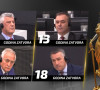
On September 16, the Specialist Chambers delivered first-instance judgments against four former senior officials of the so-called KLA—political leader Hashim Thaci, intelligence chief Kadri Veseli, General Staff member Rexhep Selimi and spokesman Jakup Krasniqi. Charged with war crimes and crimes against humanity committed during 1998 and 1999 in Kosovo and Metohija and northern Albania, Thaci and Krasniqi were each sentenced to 25 years in prison, Veseli to 18 years and Selimi to 13 years.
The judgment against Thaci was read out exactly 16 years after then-US Vice President and later President Joseph Biden, posing in front of a large portrait of George Washington, compared him to the first US President.
“This is Kosovo’s George Washington,” Biden said at the time.
To date, the European Union, under whose auspices the proceedings are being conducted, has invested enormous sums in the work of the Court—it is estimated that approximately EUR 500 million has been spent since the investigations began in 2008. Pristina’s institutions have officially spent between EUR 40 million and EUR 50 million on the defense of the former KLA leaders.
Appeals and initiatives: Can the Court be abolished?
All four convicted men have announced appeals before the Court of Appeals Panel. Its decision will determine whether the Defense teams subsequently seek recourse before the remaining instances—the Supreme Court and the Constitutional Court, whose chambers, composed exclusively of international judges, are also seated in The Hague.
Almost simultaneously, Kosovo Liberation Army veterans, who have been protesting for days over the judgments of the Specialist Chambers in The Hague, announced that they would launch a parliamentary initiative to dissolve the Chambers. Thaci’s Democratic Party of Kosovo has also announced its support.
Legal experts, however, consider such a development unlikely because abolishing the Court, which was established only after considerable difficulties, would require constitutional amendments supported by a two-thirds majority in parliament, including two thirds of the MPs representing non-majority communities.
As a precaution, Western diplomats reminded Kosovo Albanian leaders and KLA veterans of the message delivered by the ambassadors of the United States, Germany, Italy, France and the United Kingdom in early 2018, when the Kosovo parliament previously attempted to repeal the law establishing the Specialist Chambers.
“Anyone who supports [the suspension of the Specialist Chambers] is simultaneously rejecting Kosovo’s partnership with our countries... We call on Kosovo’s leaders and members of parliament to honestly inform the people of Kosovo about the severe negative consequences if they continue down this path,” the Quint ambassadors warned at the time.
One of the strongest warnings delivered to Kosovo Albanians since 1998, when US Ambassador Robert Gelbard described the KLA as a terrorist organization, came after 43 MPs launched an initiative on December 22, 2017, to repeal the law establishing the Specialist Chambers.
Immediately afterward, then-US Ambassador Greg Delawie entered the parliament in Pristina accompanied by the other Quint ambassadors and warned those behind the initiative that it was a “terrible idea” that would have “terrible consequences.”
The parliament in Pristina subsequently attempted twice to hold a session, but both attempts failed because MPs from the Democratic League of Kosovo, the Self-Determination Movement and the Serbian List boycotted the proceedings.
Former Constitutional Court President Enver Hasani subsequently explained to Kosovo politicians that the Specialist Chambers could not be abolished without amending the Constitution and that the legal route for abolishing them was the same as the one through which they had been established—securing a two-thirds majority, including the votes of two thirds of MPs representing non-majority communities.
“This is not a matter of amending a law, but of changing the constitutional foundation. Through the constitutional amendment, part of the judicial powers was transferred to the international community,” Hasani told BIRN. “Repealing the Law on the Specialist Chambers has no basis unless the constitutional amendments are also repealed... We cannot abolish Kosovo’s international obligations,” he said at the time.
Appeals before the courts in The Hague
Hashim Thaci and the three other former Kosovo Liberation Army leaders therefore cannot appeal to the regular Kosovo Constitutional Court but can, in theory, refer matters to the Specialist Chamber of the Constitutional Court in The Hague, composed of three judges of the Specialist Chambers.
Thaci has so far made four unsuccessful referrals to this body. He filed his first referral in November 2020, but it was rejected after the Specialist Chamber of the Constitutional Court found that accepting his arguments would undermine the legal foundations on which the Court was based. Four referrals by Pjeter Shala were likewise unsuccessful.
Appeals may be based on errors of law that could invalidate the judgment, errors of fact that resulted in a miscarriage of justice, or errors in sentencing.
Notices of appeal must be filed within 30 days of the delivery of the judgment.
The Presiding Judge of the three-member Court of Appeals Panel then designates a Pre-Appeal Judge responsible for the subsequent conduct of the proceedings, including issuing decisions, orders and directions.
Within 21 days, the Pre-Appeal Judge must convene a conference at which issues relating to the appeal are addressed. When filing an appeal, the Prosecution and the Defense must include in their submissions all arguments and legal authorities on which the appeal is based. The deadline for these submissions is 60 days, or 30 days if the appeal concerns only the sentence.
The subsequent course of the appeal proceedings includes a 30-day period for filing legal arguments, or 15 days where a submission concerns only the sentence. The Rules also provide for response briefs to be filed within periods ranging from 10 to 15 days. If necessary, the Court of Appeals Panel may schedule a hearing once these deadlines have expired.
After the parties have completed their written submissions, the Court of Appeals Panel considers the case and delivers its judgment on the basis of the appellate record and any additional evidence.
The Court of Appeals Panel may affirm, reverse or revise the judgment, or order a new trial. If an appeal is filed only on behalf of a convicted person, the Appeals Panel cannot impose a sentence more severe than that imposed at first instance.
In principle, the appeal judgment is delivered within 60 days of the filing of the final submission, although this period may be extended upon a reasoned justification.
The path to the Supreme Court
If the parties remain dissatisfied, the case may subsequently reach the Supreme Court and then the Specialist Chamber of the Constitutional Court, meaning that the proceedings could continue for years.
The Specialist Chamber of the Constitutional Court consists of three judges selected from the roster of judges of the Specialist Chambers. Its mandate is strictly limited to interpreting the Kosovo Constitution in relation to the jurisdiction and legal framework governing the proceedings of the Specialist Chambers and the Specialist Prosecutor’s Office.
Thaci has already made four unsuccessful referrals to this body.
His legal team’s referrals concerned the validity of the charges in proceedings registered under case number KSC-CC-2022-15; in 2024, he challenged the legality of special investigative measures in KSC-CC-2024-25. A year later, he filed a referral concerning the case in which he was being tried for alleged witness interference, which was also rejected.
He filed his first referral even before his formal arrest, challenging the Court’s mandate and invoking the subsequently unsuccessful constitutional initiative aimed at reviewing and potentially limiting the mandate of the Specialist Chambers. In November 2020, the Specialist Chamber of the Constitutional Court rejected Thaci’s challenge.
Pjeter Shala also made four unsuccessful referrals to the Specialist Chamber of the Constitutional Court. In July 2024, Shala was sentenced in The Hague to 18 years in prison for war crimes committed in Kukes, Albania, in 1999. The Court of Appeals later reduced his sentence to 13 years.
The first final judgment was delivered against Salih Mustafa, a former local KLA commander, who was sentenced to 22 years in prison for murder, arbitrary detention and torture at the Zllash detention compound.
As matters currently stand, the appeals proceedings involving the four former KLA leaders could continue for years.
Written for RTS by Rade Maroevic

0 comments