
IN MEMORIAM Henry Kissinger and Kosovo
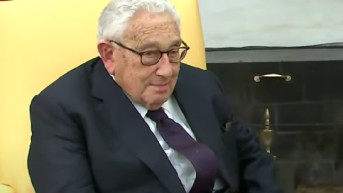
Former US Secretary of State Henry Kissinger passed away at the age of 100 in his home in Connecticut, and on this occasion, the Kosovo Online portal republishes the text from May 26, 2023, authored by journalist Dragan Bisenic.
Tomorrow, May 27, former US Secretary of State Henry Kissinger turns 100 years old. Despite his age, he is still intellectually very active, which makes him a curiosity not of these years, but of these centuries. Last year and this year, he dealt with the most topical issues of today's world - the conflict in Ukraine and artificial intelligence. As he is at the epicenter of events today, he was also 24 years ago, at the time of the bombing of Serbia in 1999 and the search for a solution to Kosovo. He was unique in that he publicly questioned the meaning and effects of the bombing on the relations between the Serbs and Albanians, stability in the Balkans, but also the creation of a precedent that would shake the relations of the great powers on the global level. When we look back, we see how right Kissinger was and that he already saw the limited value of the actions of the American administration at that time.
From the beginning, he questioned the so-called "American approach" to centuries-old problems. "It's a very American approach - take a Muslim ethnic group and a Serbian ethnic group and give them an 80-page document and say this is the final solution to 400 years of history; if you both sign it, the problem will disappear. Such an approach could only arise in America. You find a similar temptation in every phase of American foreign policy," Kissinger said.
The war in Kosovo is the product of a conflict that has lasted for centuries. It is happening on the dividing line between the Ottoman and Austrian empires, between Islam and Christianity, and between Serbian and Albanian nationalism. Ethnic groups lived together in peace only when that coexistence was imposed - like under foreign empires or Tito's dictatorship. President Clinton stated that, after a short period of NATO occupation, the ethnic groups would reconcile. There is no real basis for that assumption.
Kissinger contested the reasons for the bombing presented by US President Clinton in his speech on March 24, 1999, the most convincing of which is that the suffering in Kosovo is so offensive to American moral sensibilities that it is determined to use force to end it even without traditional national interest considerations. But since this leaves open the question of why we don't intervene in East Africa, Sri Lanka, Kurdistan, Kashmir, and Afghanistan -- to name just a few of the places where casualties are infinitely greater than in Kosovo -- the president's appeal to historical analogies or current threats that are extremely doubtful," Kissinger assessed.
Kissinger also criticized other points of Clinton's explanation for the NATO bombing of Serbia - Slobodan Milosevic is not Hitler but a Balkan bully, and the crisis in Kosovo has no analogy with the events that preceded the First World War. Neither Milosevic nor any other Balkan leader is in a position to threaten the global balance, as the president constantly claims. Milosevic bears a great deal of responsibility for the brutalities in Bosnia, but unlike Bosnia, Kosovo is a war for the territory that the Serbs consider nationally sacred. That is why there were few if any, signs of opposition to Milosevic's Kosovo policy in Belgrade.
In addition, the First World War began in the Balkans not as a result of ethnic conflicts, but for exactly the opposite reasons - because external powers intervened in a local conflict. The assassination of the heir to the throne of Austria by a Serbian nationalist led to a world war because Russia supported Serbia and France supported Russia, while Germany supported Austria.
Kissinger rejected the comparison to World War II, saying it had not started in the Balkans, much less had been the result of its ethnic conflicts.
"It is absurd to claim that the economic well-being of the European Union, with a GNP that exceeds America, depends on the outcome of ethnic relations in impoverished Kosovo. This is even more true for Atlantic prosperity," Kissinger emphasized.
In the text "When the ovations die down" that he published in the weekly "Newsweek" after the end of the bombing, on June 21, 1999, Kissinger analyzed the adopted documents in relation to which the bombing ended with the proposal from Rambouillet, which formally served as the reason for the bombing. He stated that the differences were significant. NATO forces entered Kosovo based on a UN mandate, not an agreement between Belgrade and the Atlantic Alliance. Kosovo was explicitly described as part of Yugoslavia, although autonomous (Article 5); the territorial integrity and sovereignty of Yugoslavia were confirmed (Article 8). The referendum provision was abandoned after three years, and the original insistence on full NATO control was somewhat diluted by a series of UN mandates and the presence of Russian forces. But even where the peace plan still parallels the Rambouillet accord, it threatens almost permanent US involvement in an endless series of predictable conflicts and possible guerrilla warfare. The sharp language of the agreement is designed to be firm, but so that each party can interpret the inevitable ambiguities as favorable to itself.
Kissinger predicted almost a quarter of a century ago that Kosovo would poison international relations, especially relations with Russia and China, but that it would cause an "uprising" of small states against the US. Pointing out the difference between Dayton and the UN resolution on Kosovo with Resolution 1244, Kissinger pointed out that most countries in the world supported or tolerated the Dayton Agreement. The Dayton Agreement was the result of negotiations by all three parties in which America appeared as a mediator. The situation in Kosovo was imposed by the US and NATO.
This is not the case in Kosovo. Russia may have thrown in the towel in an effort to significantly shape the immediate outcome. But he feels deeply humiliated; Kosovo has become a public symbol of Russia's loss of influence and public degradation by the West. Russia has no incentive to facilitate the arrangement once it is in place. Instead, Moscow is likely to look for opportunities to obstruct it or to counter elsewhere what it perceives as America's hegemonic tendencies. From the US point of view, the sooner the issue of Kosovo is removed from the Russian-American agenda, the better for our long-term relations. Countries concerned that they could be the target of unilateral NATO action may distance themselves from America after the dust settles. They may have an incentive to acquire weapons of mass destruction as the surest deterrent against America's conventional superiority. How ironically history repeats its patterns. During the Cold War, democracies relied on nuclear weapons to counterbalance perceived Soviet conventional superiority. In the post-Kosovo period, smaller countries may turn to weapons of mass destruction in response to America's overwhelming technological advantage in conventional weapons," Kissinger predicted.
Kissinger opposed any form of triumphalism over Kosovo and demanded that the Kosovo strategy be reconsidered before Kosovo is taken as a new model for humanitarian diplomacy. There are 22 million refugees and many conflicts in the world. To which of these can it be applied as a relevant mixture of force and diplomacy? Where else can we bomb for 10 weeks without casualties or setting a precedent for actions by other states?
In the article "Insulting History", published in "Newsweek", on April 5, 1999, Kissinger also posed the deeper dilemmas he faces as "someone who supported every military action of the Clinton administration -- or who criticized it for being too unconvincing." action, as in Iraq. He stated that "the war against Yugoslavia inspires deep ambivalence". He cited reasons that are almost in front of everyone in Serbia, but which have completely disappeared from the American view. "Serbia fought on our side in two world wars and opposed Stalin at the height of his power. We cannot ignore Milosevic's brutality, but the disappearance of Serbia from the Balkan balance may cause eruptions in other neighboring countries that have ethnic minorities. More importantly, the problem of Macedonia's integrity will be upon us, threatening a wider Balkan war. Let's hope that it will be approached with more foresight than in the current crisis," Kissinger pointed out.
At the end of the bombing, Kissinger insisted on the American obligation to protect the Serbian population from the Albanians, "When the smoke clears, ethnic cleansing of the Serbian population is a likely outcome if we do not remain in the role of permanent occupation."
Kissinger recalled the words of Clinton, who, in his speech to the Serbs, declared: "Allies in NATO support the Serbs to keep Kosovo as part of your country." He added that the agreement "will guarantee the rights of all people in Kosovo - both the Serbs and Albanians in Serbia." None of this can be achieved by agreement, but only by external imposition.
Kissinger points out that the West recognized Belgrade's sovereignty over Kosovo in order to prevent its emergence as an independent international entity, but warned that this plan might not work smoothly. "Russia and Yugoslavia will have every incentive to assert Yugoslav sovereignty, while America and NATO cannot endlessly stand in the way of Albanian self-determination," Kissinger observed.
Already then, he proposed to cut the Balkan "Gordian Knot".
"It would be far wiser to cut the Gordian knot and recognize Kosovo's independence as part of an overall Balkan solution—perhaps including self-determination for each of Bosnia's three ethnic groups," Kissinger suggested.

0 comments