
Modi, Putin and Xi at the same table: BRICS reshaping the architecture of the world
Written by: Zeljko Sajn, Kosovo Online special correspondent in New Delhi
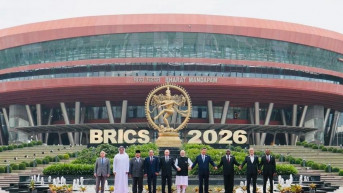
With the opening of the 18th BRICS Summit in New Delhi, India has become one of the world’s most important political centers. Narendra Modi, Vladimir Putin, Xi Jinping and Masoud Pezeshkian have gathered around the same table, alongside leaders and representatives of the expanded BRICS, while the presence of UN Secretary-General Antonio Guterres demonstrates that the discussions here concern not only the future of one organization, but also the future shape of the world order.
The very image of Modi, Putin and Xi together carries significance that goes far beyond protocol. Three major powers with different interests have come together at a time of wars, trade disputes, sanctions and profound changes in the global economy. In doing so, Modi is reaffirming India’s policy of strategic autonomy: India does not want to choose between the great powers, but rather to become one of the decision-making centers of an emerging multipolar world.
The meeting between Modi and Xi carried particular weight. Indian media have described it as one of the summit’s most important bilateral events. After years of tensions, the two leaders discussed stabilizing relations, trade and the economy. Xi said that China viewed its relations with India from a strategic and long-term perspective, while New Delhi insisted that peace and stability along the border were the foundation for further rapprochement.
The significance of the meeting extends beyond relations between Beijing and New Delhi. If China and India, despite their differences, can find room for cooperation, BRICS gains new political weight. Its strength does not lie in the absence of differences among its members, but in their ability to keep even their greatest differences under control. A multipolar world therefore does not mean a world without conflict, but a world in which conflict no longer necessarily results in an automatic division into blocs.
Putin’s talks with Modi reaffirm the importance of the Russia-India partnership in energy, defense, trade, technology and transport. Pezeshkian’s presence links BRICS to Middle Eastern security and energy.
Control over energy resources, maritime routes, critical minerals, food and technology is increasingly becoming part of the same strategic equation.
An even deeper transformation is taking place in finance. BRICS is not introducing a common currency, but it is developing mechanisms for greater use of national currencies, cross-border payment systems and new financial instruments. This is not about the immediate disappearance of the dollar, but about creating additional channels through which countries can trade and finance development. If the process continues, the global economy will become less dependent on a single financial center.
The New Delhi Declaration is therefore the summit’s key document. At its core are multilateralism, reform of global institutions, sovereignty, dialogue and diplomacy, but also energy, food, trade, technology and finance. Its call for maximum restraint in crises and for conflicts to be resolved through political means demonstrates that BRICS is seeking to transform its economic strength into a political voice for the Global South without becoming a formal military or ideological bloc.
Guterres’s presence carries particular symbolism. The UN and BRICS are coming together at a time when countries of the Global South are demanding greater representation in international decision-making. It is an encounter between the existing multilateral system and emerging centers of power. Guterres serves as a reminder that there can be no stable international order without reformed international institutions, while BRICS demonstrates that the existing architecture no longer fully reflects today’s distribution of economic and political power.
Ahead of a future meeting between Xi and Donald Trump, the message from New Delhi is particularly important. China can negotiate with Washington while simultaneously deepening its relations with India, Russia, Iran and the Global South. Xi will enter talks with Trump from the position of a country participating in the construction of new economic and political channels.
New Delhi is therefore becoming a center of the world not merely because powerful leaders have gathered here, but because it is here that the emerging redistribution of global power can be seen in action. The transformation is not happening overnight. It is being built through finance, energy, trade, technology and security. The world is shifting from a single dominant center toward multiple centers, and this September, New Delhi is the place where that transformation is most clearly visible.

comments