
New air base in Albania: From Stalin to NATO
Writing for Kosovo Online: Dragan Bisenic
The opening of the first NATO air base in the Western Balkans on Monday, March 3, brought a major shift in the military balance of power in the region. This is the Kucove Air Base in Albania. The construction of the base began way back in 1952 and was linked to the support of the USSR for the development of the Albanian People's Army as one of the pillars for pressuring the then-Yugoslav policy.
When this military base was built, the town was called "Stalin." Built a year after Stalin's death with the help of Soviet funds, it began its life as a part of the Warsaw Pact and is now a NATO base. The history of the base somewhat follows Albania's geostrategic journey, from a member of the Warsaw Pact to a NATO member and a part of the Western alliance in the region.
This military base significantly contributes to strengthening NATO in the Western Balkans and consolidating its military dominance in the region. Accordingly, it is emphasized that the first of the 31 Alliance member countries to benefit geopolitically is Albania itself, but far from being the only beneficiary of the significant enhancement of NATO's performance, others will also benefit, albeit not as much as those who are automatically assumed to do so. Surprisingly, such a role is intended for Kosovo in Albanian public opinion.
Albania is a country with an "outward-looking" geopolitical position in the Mediterranean region. This means it can be utilized for future NATO offensive actions. In the coming years, this will be the most important airbase for activities in the Balkans, for receiving and accommodating US troops and aircrews. During the large-scale NATO exercises held in 2021 and 2023, as well as at the beginning of this year, the mobility of US troops from the continental United States to the Mediterranean areas was tested, with particular importance given to Albania, as Americans disembarked at the port of Durres, then were involved in various preparations and military training activities at the Bize range.
The Kucove Base is intended to be utilized as necessary for hosting fighter jets from Italy and Greece, which are tasked with protecting Albanian airspace as a part of NATO's Integrated Air and Missile Defense System. Additionally, Italian and Greek aviation cover Montenegro and North Macedonia, and all three countries - Albania included - are obligated to have a base where allied fighters can land.
Albanian analysts do not overlook the precedent set within NATO by this military base, as it is the first not belonging to a member country but directly to the military alliance headquartered in Brussels. This is somewhat covered by the fact that this military base is financed by NATO funds. The project started in 2018 with 50 million euros from the Alliance's joint fund, with only 5 million euros from the Albanian side. Albania's funds were used for expropriations, construction of security perimeters and access roads, maintenance standards for hangars, fuel tanks, lighting, security cameras, and sensors for detection around the base.
The roles of this base encompass three dimensions. The first is the strengthening of Albania's role within the NATO alliance. The second is an undeniable focus against Russia in the war in Ukraine, which later may extend to strategic implications. Finally, it is promoted as the most crucial NATO resource in the Western Balkans. NATO officials state that the new base will serve as a modern hub for NATO activities in the Western Balkans and to support operations in the broader Eastern Mediterranean and Black Sea regions. From the Albanian perspective, the construction of this base and the "peace-time presence of NATO in Albanian territory" undoubtedly convey a "message of strength" to "Putin's Russia" and any other country "still being manipulated by the Kremlin." Albanian analysts rhetorically question, "Who dares to militarily attack not only the territorial integrity of the Republic of Albania but also the presence of NATO (such as the Kucove Air Base), will be confronted and appropriately punished by the unmatched air power of the NATO alliance, as confirmed in 1999 against Milosevic's criminal machinery, isn't that right?" Prime Minister Edi Rama articulated this differently at the opening of the air base:
"This is a base that will add another element of security to our Western Balkan region, which we all know is threatened by the challenges and neo-imperialistic ambitions of the Russian Federation," Rama said during the inauguration before two combat aircraft flew into Kucove from NATO's Aviano base in Italy to open the runway.
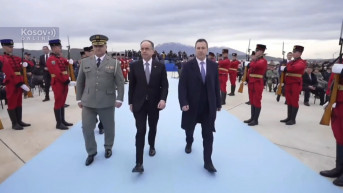
The inauguration ceremony itself was not as grandiose as one might expect; none of the highest-ranking officials from member states in the region were present, and as it seems, no representatives from Kosovo attended the opening ceremony. Understandably, the entire event contributed to a significant boost in confidence within political circles in Albania, particularly among those close to Prime Minister Edi Rama. His merits and superiority over rivals are described with certain tones of "triumphalism with style." This is directed towards both internal rivals in Albania and "populist politicians" in Kosovo, where it is quite clear to whom this message is directed. All of this sparks debate over why Rama is not criticized by anyone in the international community, unlike most other Western Balkan leaders. Not only is he not criticized, but he is also highlighted as a model politician according to Western standards.
Starting from the premise that the current era resembles the Cold War due to the significance and place that foreign policy holds in the modern world, where foreign policy takes precedence over domestic, and questions of internal democracy take a secondary place. The only significant criterion among allied states or countries with common interests is reliability, loyalty, and readiness for mutual sacrifice. In such circumstances, NATO and the US consider how reliable leaders are in allied states, friendly, and loyal countries.
"So, taking the case of Albania, allied countries will not be overly concerned whether Rama leads by democratic methods or not, but rather whether this is a reliable leader and willing to make common sacrifices among allies," Albanian commentators conclude.
They argue that the most important thing is to mitigate the risks faced by allied countries, and the hierarchy among allies is measured by the guarantees and loyal attitudes that are the main questions and criteria for determining whether to consider someone an ally or not, and the more real the risk to national security, the more the desire for an assessment of democratic rules in a country that is a part of the Alliance fades!
Rama is recognized for understanding "better than anyone else the reality we are going through and has already prioritized foreign policy, demonstrating maximum dedication and commitment to the US, NATO, and EU countries." Therefore, as long as Rama is considered loyal and willing to make any common sacrifice, do not expect the West or the US to confront him by criticizing him for not adhering to democratic rules!
The presence of NATO in Albania is primarily a political issue. For NATO to be a pro-Western country, it requires more than just a formal agreement on its presence; such matters do not concern it. What is important is that the country has a clear Western orientation and is an ally of the West, not just in words, but with a guaranteed system of Western values.
In this context, it is emphasized that the same applies to Kosovo's policy. However, Albanian media specifically highlights that "the NATO base in Kucove means greater security for Kosovo and is good news for the Albanian world, but NATO cannot protect Albania and Kosovo from anti-Western Albanians." Kosovo, with current Prime Minister Albin Kurti at the helm, is included among those who cannot be protected. "This is why sometimes people in Kosovo or supporters of populist leaders become uneasy because Albania opposes Kosovo, as it is on the side of the West. It opposes and will oppose every time a politician who opposes the West is found in Kosovo, as the West guarantees the national security of Albanians." This goes even further, calling for the "isolation" of anti-Western leaders in Kosovo.
Therefore, there is a demand for Albania to "protect itself from the dangers threatening the West in Albania, by isolating anti-Western leaders in Albania and Kosovo." If this does not happen, it is warned that the NATO base, which was solemnly opened in Kucove, will appear as if it was built back in the town formerly known as "Stalin," prominent newspaper analysts conclude.


0 comments