
Prapashtica: Actors have no national barriers
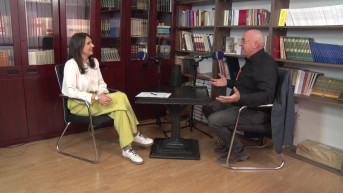
Art is the same everywhere. Whenever I meet an artist, an actor, we are one. When we sit, drink, sing, talk, it doesn’t matter who’s who. I always feel like I’m sitting with my own people. I remember back in 1996, when Dragan Nikolic and Milena Dravic came to the Dodona Theater in Pristina, founded by Enver Petrovci. They wanted to make a melodrama about Albanians and Serbs, but the situation at that time was catastrophic. As soon as politics got involved, the project was stopped, even though both Serbian and Albanian actors had agreed to take part. As an actor, I don’t have those barriers, and I guarantee that actors in Belgrade don’t either. I can imagine myself performing on stage at the Cultural Center in Gracanica, because art has no borders; it is one. When politics steps in, everything changes, Pristina actor Ilir Prapashtica said in the KOntext podcast.
Ilir Prapashtica is one of Kosovo’s most popular actors, a man who has gone from the theater stages of Pristina to international festivals. The film Hive, in which he starred, nearly became Kosovo’s first candidate for the Oscar for Best International Feature Film. After graduating in acting in Pristina in the class of Professor Enver Petrovci, he moved to England, and later returned to Kosovo in the early 2000s. That’s when he gained fame with his role as Longari in the series Modern Family.
“Modern Family was strange for Albanians all over the world because it was our first series, more popular even than Better Life (Bolji Zivot). It aired every Sunday at 8 p.m. and at that time, you could only hear the birds in Kosovo, everyone was glued to their TVs,” Prapashtica recalls, who, after returning from England, went to audition for one episode but, by coincidence, became one of the audience’s favorite characters.
“In England, I had seen real sitcoms, and I didn’t like this one at all. I refused to act when I saw the pilot episode. Director Fatos Berisha called me several times until I finally agreed,” Prapashtica said.
Thanks to the director’s persistence, Albanians around the world recognize him today. In Kosovo, Presevo, Bujanovac, Medvedja… even Albanian bakers in Belgrade and Novi Sad.
“Not to mention Switzerland, where the largest Albanian diaspora lives. And my character in the show was actually an Albanian from Switzerland who returns to Kosovo after the war,” the KOntext guest said.
He jokes that he has achieved global fame. He is currently acting in the series The Big House, playing a Serbian police officer who fled Kosovo after the war and then returned. He says he has no problem playing a Serb, his only problem is when he has to play a character he can’t identify with or emotionally enter into. Serbian audiences recognize him from a guest role in the TV series South Wind (Juzni vetar).
“I’m still in touch with Milos Avramovic. When he called me for the show, I already knew about the South Wind film. He told me there was a small role for me, as an Albanian who smuggles drugs by truck. We set the date, and I went to Belgrade,” Prapashtica said.
He believes there is work for actors across the Balkans, but the problem lies in a lack of initiative.
“There are a lot of productions and actors in Kosovo who expect money from the state, but nowhere in the world does the state give money to actors. The film and theater industry is private everywhere. When I work with Balkan actors on regional projects, Serbs, Albanians, Croats, Macedonians, they all say the same thing: that the state doesn’t give money. But if you have the money as a production, you don’t need anyone, not even the state. That is the mentality left over from the old country. I lived in England, you can’t go to a theater there and say, ‘I want a salary of two thousand pounds to act in plays.’ There, actors perform several times a day. I saw ‘Chicago’ in London, a three-hour musical performed four times a day,” the Pristina actor says.
As he recalls the great actors of Kosovo origin who built their careers in the former Yugoslavia, he notes that Kosovo today also has young acting talents appearing in films made primarily for the local audience.
He doesn’t follow politics, even though he’s the son-in-law of a well-known politician. The only sport he watches is boxing. He doesn’t like football but has a funny story about a Manchester United tracksuit that almost got him beaten up in England. He wore that same tracksuit proudly when he returned to Pristina for the first time after the war.
He visits Belgrade occasionally, hhe loves taverns and Skadarlija street, where he always requests the song “Ajde Jano.”
Why that song in particular? Find out in Ilir Prapashtica’s conversation with Dragana Biberovic in the video interview.


0 comments