
Religious minorities in Syria should be mindful of what happened to Serbian Orthodox Christians in Kosovo and Metohija
Written for Kosovo Online by Srdjan Garcevic, founder of The Nutshell Times
While the fall of Bashar al-Assad in Syria was widely celebrated as a victory for freedom and tolerance - with the Daily Telegraph describing the new government as "diversity-friendly jihadists” - anybody who saw such wildly optimistic reports before felt a familiar sense of dread, part of it was due to the fact that the same jubilant media proved to be a bit unreliable - the BBC correspondent forgot that there are almost no Jews in Syria to celebrate the change and the CNN correspondent bravely rescued a former torturer from prison - but the part of it was an unpleasant déjà-vu, for all those who remembered similar exuberance around the multiethnic and tolerant future in Kosovo and Metohija in 1999.
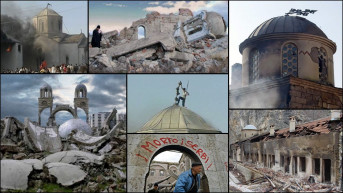
In June 1999, as the Kumanovo Agreement ended the bombing of Yugoslavia, despite the NATO guarantees to protect the Serbian population, Kosovo Albanian extremists launched a horrific reign of terror against Serbs and other minorities, often targeting their places of worship and clergy. While many churches were desecrated and burnt, an especially gruesome event happened in Prizren, when a monk, Hariton Lukić, was abducted and beheaded in a clearly religiously motivated attack. Extremists damaged many important Serbian monasteries, especially targeting Devič monastery, which the Kosvo Liberation Army vandalized and its icons destroyed.
For the past 25 years, many tried to maintain the illusion of religious and ethnic tolerance under Priština authorities - citing relative religious diversity among Albanians, the constant attacks against Serbian Orthodox Christians and their property, as well as the growing popularity of Islamism in Kosovo and Metohija proved them wrong.
In March 2004, a week after the Al Qaeda bombing in Madrid, during a particularly violent episode, Serbian churches and clergy were once again attacked by Albanian extremists. Once again, in Prizren, they besieged and burned the Serbian Orthodox seminary, where one person died, as well as all other Serbian religious sites in the city, including Our Lady of Ljeviš, a UNESCO-protected medieval church. The nuns of Devič had to be evacuated once again, and the Monastery was burned down in front of the peacekeeping forces.
In the past two decades, religious persecution of Serbs continued, as one can see by the barbed wires, guards, and even military checkpoints at the entrances to churches and monasteries. However, the case of UNESCO-protected Dečani Monastery, another frequent target of Albanian extremist attacks, illustrates that religious persecution extends beyond physical attacks.
While the physical attacks still occur - in 2016, an armed Albanian Islamist cell with arms was stopped before the attack - other methods are subtler but equally pernicious. One is lawfare - the Priština government refused to recognize the Monastery's ownership over a piece of land and only caved after intense diplomatic pressure - while the other is criminalization through baseless accusations that Serbian monasteries stock arms or have participated in attacks against the Albanians during the war. While the brotherhood of Dečani is forced to frequently deny such dangerous accusations, they are parroted not only by Priština officials but also by Priština-friendly foreign politicians, further endangering Serbian Orthodox Christians, whose graves, monuments, and churches are still routinely attacked. The attacks also come from regine officials: in 2023, two Serbian young men were shot and injured by a member of the Priština security forces, while carrying a Serbian Christmas tree.
While one can hope that the religious minorities in Syria will indeed have a better future than the Orthodox Serbs in Kosovo and Metohija, it is also not heartening to know that a lot of those attacking Christians in Kosovo and Metohija have gone to Syria in the past to join ISIS.
However, this holiday season, one should be hopeful for the minorities in Syria for two reasons. Firstly, while the media have ignored the plight of Serbian Orthodox Christians, now there are outlets such - as the Free Press, the Wall Street Journal, and others - who are more open to reporting on what is really going on rather than presenting a naively cheery picture.
Secondly, and more importantly, the incoming US Administration seems more attuned to the problems of Christians - even more so than the administration of famously pro-Judeo-Christian George W. Bush, during whose term the March 2004 pogrom in Kosovo and Metohija occurred.
Ahead of the November election, Donald Trump post on Truth social accused the US Democrats of not caring about the fate of Christians around the world, highlighting the expulsion of Armenian Christians from Artsakh in 2023. The US vice-president-elect JD Vance was even more worried about the position of Christians, stating in a tweet that "all over the world, Christians are the most persecuted religious group." One can only hope that they remember the Serbian Orthodox after January 21 and learn from what happened to them.


0 comments