
From Tesla Square to the United Nations – Serbian suffering through shifting world orders
Written exclusively for Kosovo Online from New York by Zeljko Sajn
Few cities in the world bring the past and the future together as directly as Manhattan. The scent of hot asphalt, the murmur of the East River, the sound of sirens, and the endless stream of people from every continent create the impression that history is being written here every single day.
Nearly every language in the world can be heard on the streets of New York, while just a few blocks away, representatives of the 193 United Nations member states meet daily at the UN Headquarters, with their permanent missions located throughout Manhattan. From here, messages of peace, cooperation, human rights, and respect for international law are sent to the world.
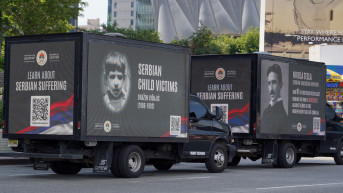
It is through this very setting that the Republic of Srpska Memorial Center's traveling multimedia exhibition, "Discover Serbian Suffering," has been making its way in recent days, bringing documented testimony of the suffering endured by the Serbian people before the international public.
Digital screens displaying archival photographs, historical documents, and eyewitness accounts move through the streets of Manhattan, drawing the attention of passersby who, by scanning a QR code, gain access to the Republic of Srpska Memorial Center's digital archive.
The exhibition takes on particular symbolism as it passes Nikola Tesla Square. At a place named after the man whose inventions transformed the course of modern civilization, images recalling human suffering appear on the screens. It is as though two stories of the same nation converge at a single point—the story of creativity that illuminated the world and the story of victims who refuse to be forgotten.
New York remembers its great Serbs. It was here that Nikola Tesla achieved his most significant scientific breakthroughs.
Mihajlo Pupin was not only an outstanding scientist but also a humanitarian, philanthropist, and one of the most influential advocates of Serbia and the Slavic peoples in the United States during the First World War. As a proud son of the Serbian nation, he used his scientific prestige to assist Serbia, raise humanitarian aid, and influence American public opinion and political circles in support of the rights of small nations. Milutin Milankovic permanently transformed the scientific understanding of Earth's climatic history through his groundbreaking work, while Mileva Maric remains an integral part of the history of modern physics.
The world knows Tesla, Pupin, Milankovic, Novak Djokovic, and Nikola Jokic. It is precisely from that premise that this international campaign asks whether the world is equally familiar with the history of the suffering endured by the people from whom these distinguished figures emerged.
The history of the Serbian people can also be viewed through the prism of major transformations of the international order. From the collapse of the great empires after the First World War, through the tragedy of the Second World War, the establishment of the United Nations and the Cold War division of the world, to the dissolution of the bipolar system and today's transformation of international relations, Serbs have often found themselves either direct participants in or victims of profound geopolitical change.
While scientists such as Tesla, Pupin, and Milankovic changed the world through their achievements, the history of the Serbian people has been marked by wars, devastation, persecution, and immense human suffering.
At a time when many analysts speak of the revolution, evolution, and transformation of the international order, the organizers believe there is an opportunity to present the Serbian people's historical experience to the international community.
That is why choosing New York as the starting point of this campaign carries particular symbolism. In a city where diplomacy, politics, and the global public intersect every day, the story of Serbian suffering has the opportunity to become part of a broader conversation about the culture of remembrance, human rights, and the dignity of every innocent victim.
The Director of the Republic of Srpska Memorial Center, Denis Bojic, said that the campaign's objective is not to create new divisions but to give the international public an opportunity to become acquainted with historical facts and testimonies that have remained largely unknown outside the region.
"The world knows the great names of the Serbian people and their contributions to science, culture, and sport. Our goal is to present to the international community that part of our history which remains insufficiently known—the suffering of the Serbian people," Bojic said.
That message lies at the heart of the entire campaign. The Republic of Srpska Memorial Center believes that the culture of remembrance should not remain confined within national borders but should become part of an international dialogue on civilian victims, human rights, and the preservation of historical memory.
The digital displays feature documents and archival material relating to the suffering of Serbs during the Second World War, including crimes committed in the Independent State of Croatia, as well as materials concerning the wars of the 1990s, the suffering of Serbs in Bosnia and Herzegovina, the expulsion of Serbs from Croatia, events in Kosovo and Metohija, and the 1999 NATO bombing of the Federal Republic of Yugoslavia. A special section of the exhibition is dedicated to Serbian children who fell victim to war, with the aim of presenting the human dimension of wartime tragedies through their personal stories.
It is no coincidence that the campaign was launched in New York. A city that has long symbolized international diplomacy offers an opportunity for the message to reach representatives of virtually the entire world. Just a few hundred meters from the route taken by the mobile exhibition stands the headquarters of the United Nations—an organization established after the Second World War with the aim of sparing future generations the scourge of war.
History, however, demonstrates that international relations have not always adhered to the ideals enshrined in the Charter of the United Nations. NATO's military intervention against the Federal Republic of Yugoslavia in 1999 was carried out without authorization from the United Nations Security Council, a fact that remains the subject of international legal and political debate to this day. For that reason, presenting this campaign in New York carries additional symbolism—a place from which messages of peace are sent to the world every day also becomes a venue for presenting the culture of remembrance.
As the convoy carrying the exhibition passes the flags of the United Nations member states, it is difficult not to notice the symbolism of the scene. Only a few New York avenues separate Tesla Square from the UN Headquarters, yet symbolically that short distance bridges science and diplomacy, creativity and remembrance, the past and the future.
Perhaps that is the exhibition's deepest message. Nations are remembered not only for what they have contributed to humanity but also for the way they preserve the memory of their victims. If New York is the city where messages to the world are shaped each day, then presenting the culture of remembrance on its streets is an invitation to view the history of all peoples in all its complexity, with respect for the dignity of every innocent victim and the conviction that lasting peace can be built only on truth, dialogue, and mutual understanding.
0 comments