
Three centuries of supernaturally evil Serbs
Written for Kosovo Online by Srdjan Garcevic, founder of The Nutshell Times
This year marks many significant anniversaries for Serbia, including 80 years since the victory in WWII, 30 years since the Dayton Agreement, as well as the ethnic cleansing of Serbs from Croatia during Operation Storm. One anniversary that will probably go unremarked is that it is 300 years since Serbia first made a significant appearance in the global press, thanks to Petar Blagojević.
A native of Kisiljevo, a village between the scenic Ram and Golubac fortresses on the Danube, Blagojević died unexpectedly in 1725, a bit less than a decade since the Habsburgs took control of Serbia. He was not a particularly notable man during his lifetime, but became very famous in his (un)death.
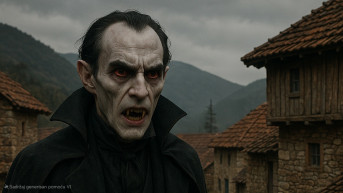
The local Habsburg forces reported that he was responsible for the death of several other villagers, who he came to haunt from beyond the grave. He was the first Serbian vampire, and this curious case shocked the European press during the peak of the Age of Enlightenment and popularized the word "vampire" (the only Serbian one to enter the global lexicon). Blagojević was not alone: a few months later, there was Arnold Paole (Arnaut Pavle, or Pavel the Albanian) who drained the life from villagers close to Trstenik. Around the same time as Blagojević, another vampire appeared close to Kragujevac, but for some reason, his case was only discussed several decades later. The growth of printed media in late 17th and throughout the 18th century, such as Wiennerischers Diarium (present- day Wiener Zeitung) which first spread these exciting stories from these exotic lands, causing a vampire panic across Europe. The discourse around vampires involved many great minds of the era, including Voltaire, but was put to rest when Empress Maria Theresa sent her physician Gerard van Swieten to asses the vases. In 1897, Bram Stoker revived interest in vampires with his Gothic novel "Dracula." However, he relocated them across the Danube to the more evocative "Transylvania," thereby alleviating Serbia of its macabre reputation, as well as tourism potential which vampires now bring.
This, however, was far from the last of the darkly fantastical stories told about Serbia and Serbs.
Indeed, the recent interview with an OSCE-employed Italian general Gianni Fantini for the Italian Krisis portal, correcting the official narrative of what happened in Račak in 1999 was a proof that many still hold, despite ample evidence to the contrary. Fantini, like many before him, claims that the alleged Račak massacre, during which Serbian forces were allegedly killing unarmed Kosovo Albanian civilians, was actually a battle between the terrorist Kosovo Liberation Army and Serbian forces (who even took the pain to remove civilians from the area to avoid harm). While every war is full of such events, Račak was notable for setting off the NATO bombing of Serbia and “selling” the war to the global audience and once again showed that many of macabre stories about Serbia and Serbs are fabrications.
Unlike the stories about vampire attacks in the 18th century, here, the fabrications had a clear purpose: wartime propaganda. The examples are too numerous to mention: a whole cottage industry of films and books, as well as news stories and "academic" studies, that prove unique Serbian villainy throughout history. However, thankfully, there have been those who have tried to correct the record and provide nuanced, factual accounts, without exaggerations, which even now plague the media and regional relations.
As soon as the war ended, overviews of the media tactics employed against Serbia during the wars of Yugoslav succession began to appear. British journalist and professor at London South Bank University, Philip Hammond wrote extensively about this phenomenon and, along with Edward S. Herman (of "Manufacturing consent" fame), edited a tome about the use of propaganda in the war across the world, with contributions from veteran journalist John Pilger as well as, the great British playwright, Harold Pinter. Similar works discussing non-humanitarian motivations behind the wars as well as media complicity in stoking them appeared in France (by the journalist and editor Serge Halimi), as well as in Germany (by Matthias Küntzel as well as Heinz Loquai), whose Defence Ministry fabricated "Operation Potkova" (horseshoe in Bulgarian), which was used in April 1999 as proof that the Serbian intent to cleanse Kosovo and Metohija ethnically. In 2008, the documentary "It Began with a Lie" by Jo Angerer and Mathias Werth reexamined the debunked story about the massacres of Kosovo Albanian men at a stadium in Priština, which was another potent story made up to stoke up the war.
In the US, the political scientist and cultural critic Michael Parenti was the most vocal critic of the jingoistic narratives against Serbia. At the same time, David N. Gibbs, a historian from the University of Arizona, gave a more circumspect view of the 1999 NATO "humanitarian intervention" in his 2009 work "First Do No Harm: Humanitarian Intervention and Destruction of Yugoslavia." The most interesting discussion of wartime propaganda, however, is the 2001 NHK documentary "Ethnic Cleansing: The Media and World Opinion," which featured executives from the PR firm Ruder Finn openly explaining how they "sold" the version of the war promoted by the Bosniak leaders.
Despite their importance in debunking myths, many of these tomes are rarely cited in the mainstream, almost unknown to researchers of the wars abroad and even in Serbia. Some of them have never been translated into Serbian, and those that have been so only relatively recently. This is unsurprising as any attempts at critiquing the narratives that led to wars were met with what we will call "cancellations" some twenty years later. Most famously, the Austrian playwright Peter Handke was hounded even in 2019, the year he won the Nobel Prize for Literature, for refusing to accept the Manichean narrative of the Yugoslav wars.
Nevertheless, due to the growing interest in official narratives across the West - now even from official positions - there is increasing interest in the truth about what was happening in the Balkans in the 1990s. As Gibbs noted in a recent interview, the wars against Serbia were the first wars after WWII, which provoked almost religious fervor across the political spectrum in the West, thanks to the media.
Whether it is Mike Benz's research into the involvement of various think tanks and development agencies in the politics of Yugoslavia or the statements of Jeffrey Sachs on Tucker Carlson's podcast about how Yugoslavia was dismembered for geopolitical rather than humanitarian reasons, we may hope that at least the future generations of journalists and historians will not have to deal with the caricatures of bloodthirsty Serbs, but rather learn from these tragic wars, about the Balkans and also about their states.

0 comments