
Why luxury developments beat luxury beliefs in making the world better and safer
Written for Kosovo Online by Srdjan Garcevic, founder of The Nutshell Times
In 2009, Barack Obama’s speech to the students of the University of Cairo was seen as a reset in the way the US and, more broadly, the West engaged with the Middle East (and arguably the rest of the World) after the failed wars in Iraq and Afghanistan. While most focused on what Obama said the West won’t do (invade), the Arab Spring, which started just a few months later, brought into focus Obama’s commitment that for all the respect for cultural diversity, the Middle East is still expected to adhere to accept the ever-changing, harsh rules of global liberalism — its “luxury beliefs” - both in its internal and especially foreign politics. What Obama meant is that the aims of the muscular global liberalism of the 1990s and early 2000s will continue, only without the cost of American military lives, but that instead, it will be the local activists, militia, and, of course, civilians who will have to lay their lives for achieving the global liberal aims, while the West will provide support - and ample financing - through “capacity building” networks, various “nation building” efforts, and other such activities.
Sixteen years later, Trump’s speech in Saudi Arabia signaled that we are entering a new, more realistic era, where countries are encouraged to pursue development on their terms, provided they contribute to global stability. The past few days, during the Iran-Israel clash, tested this idea, and, for now, it seems that Trump is a true believer in this approach.
Trump’s Riyadh moment reminded me of my visit to the region in 2013, when I realized how much of an achievement it was to create countries like the UAE, where people from all around the World want to live despite the cultural differences and harsh climate.
Before that, I was indoctrinated into the same worldview, which would instinctively dismiss the attractions of the Emirates (and even Singapore) as “consumerist” and “materialist," and highlight the supposed “unsustainability" (environmental, economic, social) of their model. Most of the intellectual and cultural tastemakers more than a decade ago were sneering at Dubai, extolling the (even then moribund) European approach to developing cities by effectively preserving them in ember for tourist and local underemployed elites, while making them as complex and pricey to live in for anybody working for a median salary.
However, one flight between Riyadh and Dubai made me appreciate how difficult and bold - even with ample resources - it is to build a place from scratch, which works not only for most of the people who live there but also attracts talent from more developed and established countries. Indeed, as I began my professional career in London, it was understood that since the Great Financial Crisis, those seeking better pay, comfort, and even career prospects should look towards the Gulf and East Asia, unless they were among the few who managed to establish themselves in Europe. Now, Dubai is one of the primary destinations for ambitious young people from Western Europe seeking to launch their careers.
The move towards a more pragmatic approach to development is good news for the Balkans, although perhaps not for all of its elites.
For most of the past thirty years, the West offered the Western Balkans a conditional level of development support, with the majority of beneficiaries being governmental and non-governmental bureaucratic elites.
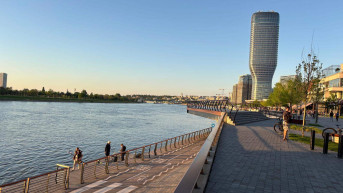
On the other hand, Serbia’s decision to adopt the Emirati playbook and attract investment from around the World for its own development was a risky move. It paid off not only in terms of better infrastructure and economy but also in attracting talent from abroad, most notably tens of thousands of young creatives and professionals, which has transformed the country, especially Belgrade and Novi Sad, following the outbreak of the 2022 war in Ukraine.
Despite many internal and external obstacles, as well as constant criticism, the country undertook steps to modernize, industrialize, and build places where people from all over the World want to live, rather than pander to the established elites and accept declinism which seems to be in vogue in the rest of the continent. The choice was an existential one: Serbia did not and does not have the luxury of most European countries to have centuries of accumulated wealth and industry, especially as much of the economy was decimated during the 1990s and 2000s. Thankfully, this trajectory and approach to development is set to continue. The currently much-advertised Expo 2027 is as much a way to launch another investment cycle as it is to attract even more business and cultural interest.
Serbia is, thankfully, not alone. Albanian government decided to attract starchitects to Tirana to give it a new sheen and also to develop its coast to suit the needs of contemporary high-end tourists. In the Baltics, Riga decided to take a leaf out of Belgrade’s book and develop its own waterfront with the same real estate development company.
Contrast that with the countries that chose the ultimately unsustainable dependency on the West, which failed to produce either better economies or societies.
A few years ago, I attended a workshop for “young leaders” in Sarajevo on sustainable projects; most attendees, half-jokingly, suggested that sustainability means the US will pay for whatever they are doing. Sadly, this joke is mirrored by the sadly low rates of industrial development in Bosnia and Herzegovina, as well as the reliance of its political elites on reproducing the instabilities from the past. Indeed, one attendee told me about her colleague from another ethnic group who staged an argument with her in front of foreign donors so that they could claim more funds.
Equally destructive for development are petty politics and ethnonationalism veiled as modish concern for “communities, “natural protection," and “equity."
The recent attempts by Emirati investors to help Ulcinj become an attractive regional hub have been met with staunch opposition, not only from activists and the media associated with the ousted Milo Đukanović, despite Đukanović’s pragmatic and admittedly successful approach to development, but also from parts of the Albanian minority in Montenegro. This included the Albanian mayor of Ulcinj, who openly stated that he viewed the project as a risk to the country's and the region's ethnic makeup.
This particular squabble reminded me of the “Three Arched Bridge” by Ismail Kadare. In the novel, the locals decided to fight tooth and nail against development, symbolized by the bridge, to preserve their old privileges and social order. In the book, they ultimately fell prey to an external force due to their internal squabbles.
While they may be supporting squabbles in the Balkans over development, even the erstwhile critics of the Emirati development model now use Dubai as a gold standard for developing regional hubs, often doing so from Dubai-like luxury condos, such as the developments around the Battersea Power Plant in central London. It seems that, in the end, luxury developments, rather than luxury beliefs, are on the “right side of history”.
0 comments