
Trump’s path to the Baku–Yerevan Agreement (3)
Written by Habib al Hadi for Kosovo Online
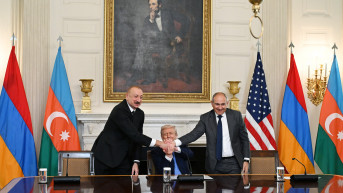
The peace agreement between Armenia and Azerbaijan is a geopolitical jackpot for Turkey and Azerbaijan, and a strategic victory for the United States. However, Trump’s corridor could be a threat leading to a new war between Iran and Israel, and potentially to a broader conflict that could arise from the resumption of the recently ended war between Tel Aviv and Tehran.
The Baku–Yerevan agreement is, in essence, a victory for Ankara. It fulfills decades-long Turkish plans to bypass Iran’s chokepoints in communications and transport, minimize Russia’s influence, and strengthen Washington’s position in the South Caucasus as never before. The power and potential of Turkey, which had been suppressed in the last century, have finally been realized. Turkey and its Turkic states and communities now stretch from the Balkans and the Caucasus to China. In its long history of confrontation with Turkey, Armenia appears to have concluded that it has ultimately made the right choice by opting for peace and developing cooperation with the Turks.
For Turkey, this is the geopolitical equivalent of the Baku–Tbilisi–Ceyhan pipeline moment in 2005 – only bigger.
Erdogan is now securing a direct land bridge to the Turkic world without Iranian mediation, enabling Ankara to project economic, cultural, and potentially military influence deep into Central Asia.
This corridor also fits perfectly with Ankara’s ambitions within NATO. By controlling a key Eurasian land route, Turkey gains an advantage over Europe’s energy diversification and over the transit patterns of the Belt and Road Initiative, making itself indispensable to both Brussels and Beijing.
For Aliyev, this is the vindication of his post-2020 war strategy: use military pressure and then secure gains through diplomacy backed by great-power mediation.
The corridor cements Baku’s victory in Nagorno-Karabakh, further integrates its economy with Turkey’s, and increases its geopolitical value to Washington as a counterweight to Iran and Russia.
The fact that the route will be “protected” by American contractors is the icing on the cake – meaning Armenian jurisdiction will be nominal, and any incident could be presented as an attack on U.S. interests, prompting direct Western intervention.
From Washington’s perspective, this is a masterstroke in the slow encirclement of Iran and the undermining of Russia’s southern flank. The corridor creates a NATO-friendly artery through the South Caucasus, undercuts the North–South International Transport Corridor championed by Moscow and Tehran, and plants the U.S. flag right on Iran’s doorstep.
It also places the United States in a position to monitor – and, if necessary, restrict – Chinese shipments within the Belt and Road framework that might otherwise transit through this route. In effect, the Zangezur Corridor becomes a geopolitical switch that Washington can flip depending on who it wants to target.
The existence of the corridor would undermine the customs integrity of the Eurasian Economic Union and call into question Russia’s control over South Caucasus transit. It is not hard to imagine that this “peace” agreement could be revisited under more turbulent circumstances.
Tehran has every reason to be alarmed. This agreement bypasses Iranian territory for trade between the Caspian region and Central Asia, reduces its already minimal share in South Caucasus trade, and brings U.S. security infrastructure within a few kilometers of its border.
Yet, as some Iranian analysts have admitted, this crisis is the product of two decades of strategic negligence: appeasing Baku, underestimating Turkey’s ambitions, and failing to secure long-term influence in the Caucasus. The result is a U.S.–Turkey–Azerbaijan corridor that could one day host not only trucks and trains but also surveillance systems and rapid-deployment forces.
Iranian President Masoud Pezeshkian, however, warned in a phone call with Armenian Prime Minister Nikol Pashinyan that “U.S. economic projects in the South Caucasus may aim to strengthen and expand influence in the region.” Therefore, it is “necessary to monitor future steps by the American side with special caution, as it may use investments and peaceful statements to conceal attempts to establish its hegemony in the South Caucasus.” Pezeshkian is convinced that Armenia “must not allow the participation of third-country armed forces” in the implementation of the transport corridor project linking Azerbaijan’s mainland with Nakhchivan.
In turn, Iran’s Ministry of Foreign Affairs commented on the agreements between Aliyev and Pashinyan on the “Trump corridor,” noting that “we are talking about a transit route to be created by Armenia and which will be under its jurisdiction and on its territory.” According to Iran’s Foreign Minister Abbas Araghchi, “Tehran’s positions on this matter have been taken into account, but we will continue to monitor the situation due to the fact that an American company wishes to join the project.” Earlier, during talks between Pashinyan and Aliyev in Washington, it was stated that a U.S. company would manage the Zangezur Corridor.
But regardless of what anyone says, American presence on Iran’s northern borders is becoming a reality, and the expansion of U.S. influence in this region could, under certain circumstances, strengthen NATO’s position across the South Caucasus – a point recently made by Ali Akbar Velayati, adviser to Iran’s Supreme Leader.
He warned that this is only the first step and that more active measures could follow. In his words, Armenia “should not allow the participation of third-country armed forces” under the pretext of setting up a transport route.
The problem is that the history of the “Zangezur Corridor” dates back to 1918, when the British–Turkish “Great Game” project to access Western Turkestan took real shape in the context of the collapse of the Russian Empire after the First World War and revolutionary upheavals.
Thus, in 1918–1920, Transcaucasia became the political battlefield for yet another experiment in forming national entities with arbitrary borders. It was Zangezur, together with Karabakh, that offered the Turks the shortest path to spatial access to the “Turkic world,” against the interests of Russia, Persia, and China. Incidentally, Turkish General Vehib Pasha warned Armenian delegation head Alexander Khatisian of this at the Batumi Conference.
However, after two interventions in Transcaucasia (1918 and 1920), the Turks failed to establish control over Zangezur, encountering fierce resistance – not without Persia’s support. Tehran was a staunch opponent of the British–Turkish “Turan” project, which would have posed a strategic threat to the territorial integrity and security of the Persian state.
Nevertheless, Zangezur returned to high politics after the collapse of the USSR and the re-emergence of the Armenian–Azerbaijani conflict over Nagorno-Karabakh’s status. The idea of the “Zangezur Corridor” was formally represented in the trilateral online statement of 9 November 2020 and in subsequent declarations by the leaders of Azerbaijan, Armenia, and Russia.
Although these texts do not explicitly mention the “Zangezur Corridor,” they do contain a provision on “unblocking all transport communications in the region.” It should also be noted that the interpretation of the “Zangezur Corridor” was first advanced by Azerbaijani President Ilham Aliyev, motivated by the need for unhindered communication between Azerbaijan’s mainland and the Nakhchivan enclave.
Baku and Ankara make no secret of the fact that the geopolitical and geo-economic significance of the “Zangezur Corridor” for them goes far beyond transport links, with their eyes set on China’s Belt and Road Initiative, enabling Turkey to move from West to East as far as the Uyghur city of Ürümqi.
Iran sees the implementation of the “Zangezur Corridor” as not only a pan-Turkic threat – one that will strengthen NATO member Turkey economically – but also as a future threat to Iran’s territorial integrity through the use of ethnic separatism. This is Iran’s main concern, given its 15–20 million ethnic Azeris.
Therefore, Iran has been, and continues to be, a categorical opponent of this project because of the growing Turkish factor on its northern borders and for economic reasons. However, with the reformist Pezeshkian coming to power, it is expected that Tehran may soften its stance toward the West in order to export its own gas to Europe. This is a significant nuance and the intrigue of the situation.
Moscow’s muted reaction is noteworthy. Distracted by Ukraine and perhaps unwilling to alienate Ankara while it still needs Turkish mediation with the West, the Kremlin has so far avoided a confrontation over the agreement. Russia has let this slide because it is not in a position to do anything, caught as it is in its Ukrainian trap. Trump is moving very quickly here, and it is a major victory for him – achieved before tomorrow’s meeting with Putin in Alaska. For Russia, it is imperative to end the war in Ukraine with a clear victory if it wants to project serious influence in this region. Thus, the Baku–Yerevan agreement is the antechamber to a Moscow–Kyiv deal. As it stands, Moscow will yield to Trump’s demands, as its strategic interest in preserving Trump’s credibility outweighs any desire to torpedo him – something that, in this situation, would otherwise be easy for Moscow to do.
For now, for Turkey and Azerbaijan, the Zangezur Corridor is the fulfillment of a long-awaited strategic vision. For Washington, it is a pressure valve on Iran and a lever over Russia and China. The United States may present this as the end of a conflict, but geopolitical logic suggests it is more of a “ticking time bomb” likely to produce more conflict than reconciliation.
(End)



0 comments