
Who is bothered by the graves of the Serbs in Kosovo?
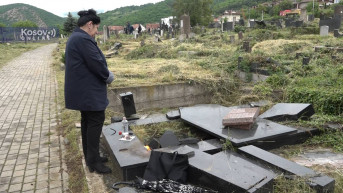
"Old Greeks had a custom worthy of respect. To those who perished in flames, swallowed by volcanic craters, torn apart by wild beasts, or devoured by sharks, to those whose bodies were scattered by vultures in the desert, they erected what they called cenotaphs - empty tombs in their homeland. Because the body is fire, water, or earth, while the soul is the alpha and omega, for it, we should build a shrine." This is how Danilo Kiš wrote in "A Tomb for Boris Davidovich", on behalf of all those whose graves are unknown for any unfortunate reason. In Kosovo, however, for years, Serb graves have been destroyed and desecrated, it's hard to understand, but it has become a common occurrence.
Written by: Milos Garic
From 1999 to the present day, at least 10,000 Serb tombstones have been destroyed in Kosovo, as reported by "Politika" a few days ago. The most recent case at the end of October, when Serbian Orthodox cemeteries in North Mitrovica, including graves dating back to the medieval period, were dug up using heavy machinery, once again highlighted the established practice of vandalism by extremist Albanians, which has no reasonable explanation from a civilizational standpoint.
Intact Serbian cemeteries can only be found in three municipalities in the north of Kosovo - Zvecan, Zubin Potok, and Leposavic. Extremists have not stopped even 24 years after the end of the war, all in front of the eyes of the international community. At the same time, all Albanian cemeteries in predominantly Serbian areas are untouched, and this is a fact that should not even be up for discussion.
According to the data from the Mitrovica Eparchy of the Serbian Orthodox Church, a special vandalism has been recorded at the Serbian cemetery in South Mitrovica, where more than 700 tombstones were destroyed. Similar damage has been done to the cemetery in Pristina, and in Gnjilane, Djakovica, and Urosevac, 80 percent of the graves have been turned into ruins.
Witnesses claim that stolen marble is used for paving sidewalks in front of Albanian houses and for other purposes.
The story of vandalism, incomprehensible to civilized people, is brought to the forefront at every memorial service when the Serbs traditionally visit the graves of their ancestors. This was the case last Saturday.
"Extremists want to erase every Serbian trace, every Serbian presence in this area, so even graves bother them because they preserve the memory and bear witness to the presence of the Serbs in Kosovo from ancient times", those who, two days ago, throughout Kosovo and Metohija, lit candles on destroyed graves for their buried relatives and friends unanimously agree.
Indeed, Albin Kurti and a significant number of Albanians consider Kosovo an exclusively Albanian space where the Serbs are unwelcome "foreigners". It's hard to say on what grounds this stance has been established, but this could be one of the main reasons for the intolerance towards Serb graves in Kosovo.
Kurti, as a representative of the authorities and the undisputed leader of today's majority population in Kosovo, has never mentioned the suffering of the Serbs, not even on the dates of some of the most monstrous crimes. Hatred is reflected in the highest levels and the most influential circles of the social elite. It's not surprising, therefore, that the Serbs are seen as enemies who should be attacked anywhere, in Prizren or Zubin Potok. The targets are equally young and old, men and women, and especially children, churches, and cemeteries. Extremists know that this will hurt the most and sow discord among their "enemies".
Unfortunately, young generations in Kosovo are growing up with stereotypes that fundamentally hinder the long-term normalization of relations between the two peoples. Until this kind of culture and upbringing changes, it's hard to expect progress on any level between the Serbs and the Albanians.
The fact that the whole issue is dangerous and long-lasting is indicated by a case from about ten years ago when, after a series of vandalism attacks on Serbian cemeteries, Ajshe Azemi, a former member of the Kosovo Police who worked at the security of the Saint Nicholas Church in Pristina, accused the priests of this church of "breaking the crosses at the old Pristina cemetery" themselves. The police administration later distanced itself from this scandalous statement, but nothing has changed to this day. So, should we then question why the police and the courts have never investigated and sanctioned any of the cases of ethnic incidents against the Serbs?
In a time when viewers around the world watch thousands of innocent people disappear under powerful grenades every day in live broadcasts, and the power of a few multinational corporations becomes so immense that it is measured by the GDP of entire continents, who still has the time to care about some destroyed graves? Even if they are in the heart of Europe.
A dramatic political, intellectual, social, economic, and above all moral crisis is underway at all levels. Especially in the part of the world that has dominated and imposed its interests and orders over the past five centuries.
Modern global "democracy" today promotes many anti-human values, erases memory, tradition, and history, and completely removes the idea of the importance of truth and justice from people's memories. What a person may no longer know in some future moment will then mean nothing to them and will not be necessary.
Therefore, this is probably the last moment to stop the destruction of graves and start building cenotaphs for all known and unknown victims of the general global suffering.


0 comments