
Who’s Who – Bedri Hamza: Tough on Kurti, critical of the Dialogue and Resolution 1244
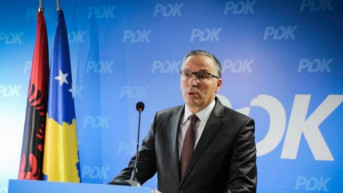
Bedri Hamza, a long-time economist, former Governor of the Central Bank of Kosovo and former Minister of Finance, was today elected President of the Democratic Party of Kosovo (DPK) at the party’s electoral convention, becoming its highest political representative at a moment when talk of early elections in Kosovo is growing louder. Hamza has positioned himself as the main challenger to Albin Kurti and has sharply criticized the government’s approach to the dialogue with Belgrade, assessing that it has been degraded and demanding the removal of Resolution 1244 from the agreements.
From Accountant to Governor
Hamza graduated from the Faculty of Economics at the University of Pristina, completed a master’s degree in economics, and earned a PhD at the University of Tirana.
He began working as Head of Accounting and Finance at Lead Metallurgy within “Trepca” in 1987, after which he continued his career in private companies. He then served twice as Minister of Finance, was elected to the Assembly of Kosovo for three terms, and was Governor of the Central Bank of Kosovo from 2013 to 2017.
He assumed the post of Mayor of South Mitrovica on 26 November 2021, defeating the incumbent mayor Agim Bahtiri of the Self-Determination Movement.
He will be succeeded in that position by Faton Peci of Self-Determination, who defeated Hamza’s party colleague Arian Tahiri in the second round of the local elections.
Candidate for Prime Minister
Bedri Hamza also served as the DPK’s candidate for Prime Minister in the parliamentary elections, in which he managed to win nearly 200,000 votes — a result many considered a success.
After being nominated as candidate for Prime Minister, he wasted no time and immediately began campaigning. The public noted that within just one month he met with as many as eight ambassadors of European countries accredited in Kosovo, as well as the Head of the EU Office in Kosovo. He stated that he presented to all of them his plans for the new government he intends to lead after the next elections.
Following his election today as President of the DPK, he is expected to again be the party’s candidate for Prime Minister in elections that, it seems, will become inevitable toward the end of the year.
Hamza vs. Kurti
In statements to the media, he said that he is better than the current caretaker Prime Minister Albin Kurti and that he has achieved better results in every position he has held.
He also criticized the President of Kosovo, Vjosa Osmani, stressing that she has in some cases failed to play her “unifying role” and has for years been a “blank-check supporter of the Kurti government’s policies.”
He criticized Kurti over the emigration of citizens from Kosovo, the stifling of the media and freedom of expression, and called the Law on the Independent Media Commission absurd.
On a Coalition with Self-Determination
Hamza confirmed that he is holding discussions with all opposition parties, including the Democratic League of Kosovo (DSK/LDK), but not with Self-Determination.
“I am speaking with LDK and all other political parties, except with Self-Determination,” he said.
Asked whether joint arrangements with Albin Kurti’s party are possible, he replied:
“There have never been red lines for coalitions, but it is more acceptable to form a coalition with opposition parties.”
Demanding Removal of Resolution 1244
Hamza stated that in recent years there has been regression in the dialogue between Belgrade and Pristina, considering that Kosovo accepted the Brussels Agreement and the Ohrid Annex, which do not entail mutual recognition.
Commenting on the agreed Brussels deal and the Ohrid Annex, Hamza emphasized that these documents pose a problem for Kosovo’s future.
On another occasion he said that some parts of the agreement need to be reconsidered and amended, such as Resolution 1244, which should not be part of it.
“Resolution 1244 should not be part of this document, and the arbitration issue undermines the credibility of Kosovo’s judicial institutions,” he said.
On Northern Kosovo
Hamza clashed with Kurti over the Central Bank’s decision to ban the use of the Serbian dinar. He said the decision itself is legitimate, but that the problem lies in the Kosovo government surprising international partners by taking such a sudden step.
“We should not surprise our partners or take actions without a clear plan — I must find the right moment for decisions to be made,” Hamza said.
He also called for coordination with the international community regarding the opening of the Ibar Bridge, and described Kurti’s actions in the north as “a premeditated propaganda farce.”
He added that the current government’s attempts to open the bridge are “destroying all other bridges.”
He also opposed the newly built bridge over the Ibar River, arguing that it could cause future flooding, and noting what he described as a ten-fold higher price compared to similar projects.
He added that as Mayor of South Mitrovica, he was pleased to have quietly but meaningfully completed projects on both sides of the city.
“One of them is the riverside promenade along the Ibar — both in the northern and southern parts — and of course I am always ready to cooperate with colleagues from North Mitrovica and the municipalities in northern Kosovo, which share a common interest in that area,” Hamza said.
Cooperation with the U.S. as Priority
Throughout his career, Hamza has always emphasized that maintaining good relations with the United States is a priority. In March this year he stated that if his party wins the elections, it will repair relations with the United States.
“We must develop good relations with the U.S. and always be grateful to them. Let them be our first address. Therefore, we will closely cooperate with President Trump’s administration. Unfortunately, in recent years we have not been sufficiently present in Washington and other decision-making centers around the world,” Hamza said.
Controversies
Many describe him as a prominent intellectual and one of the best economists Kosovo has ever had. Although generally seen as a man without blemish in his career, media outlets close to Albin Kurti have reminded the public of several controversies associated with him.
He was questioned as a witness last year in the trial known as the “53-million-euro case,” in which former Minister of Infrastructure Pal Lekaj and his associates are accused of procurement-related abuses.
Hamza, who was then Minister of Finance, told the court that he had authorized his deputy Fatmir Gashi to approve the payments and procedures amounting to 53 million euros, and that he himself was not involved in any phase of the process.
The media also recalled his statement that Kosovo was working toward having its own currency. After being ridiculed publicly, he never mentioned it again.
He was also accused of making false promises to increase salaries as Minister of Finance — promises that were never fulfilled — and that after becoming a minister he continued, contrary to the law, to receive 24,255 euros annually from the Central Bank of Kosovo for three years.
To the Anti-Corruption Agency, Hamza declared that he owns two apartments, a house, three garages, land worth around 50,000 euros, and a car worth 25,000 euros.
He also reported having more than seven thousand euros in bank accounts, as well as a loan he took out to renovate his house.
Biography
Hamza was born on 8 November 1963 in Gornja Klina. In addition to a political career, he works as a professor at the University of Pristina, where he teaches Macroeconomics II and Banking Management.
He speaks English and Serbo-Croatian, he is married, and has three children.

comments