
Who’s Who – Fatmir Limaj: Once a critic of Kurti, then offered him support, now at risk of falling below the threshold
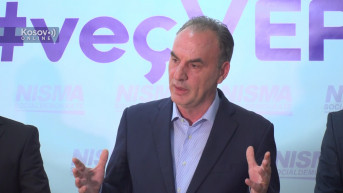
Unlike the 9 February elections, when it ran in a coalition with Ramush Haradinaj’s Alliance for the Future of Kosovo (AAK), Fatmir Limaj’s Social Democratic Initiative (Nisma) will go to the polls alone on 28 December. Negotiations with larger parties on forming a coalition did not bear fruit, and the former Deputy Prime Minister, Minister of Transport and Telecommunications, and one of the former KLA commanders known by the nickname “Çelik” (“Steel”), now risks again, as in 2021, failing to enter parliament, analysts say.
After the February elections, Limaj’s party obtained three seats, which could have served as a lifeline for Albin Kurti over the past months—had Kurti secured clear support from non-Serb minority MPs to form his third government.
At the end of October, Limaj stated that Nisma did not wish to go to new elections and that he had offered the caretaker Prime Minister Albin Kurti the support of Nisma’s three MPs for a “Kurti 3” government, without participation in the cabinet. However, Kurti reportedly wanted a partnership and for Limaj to be part of the government.
When Kurti’s bid for prime minister failed in parliament, and Self-Determination nominated Glauk Konjufca as the new candidate for prime minister, Limaj said the proposal was the result of “electoral calculations” and that he would not vote for partisan or election-driven agendas.
Following the announcement of new elections for 28 December, Nisma—according to Limaj—was in contact with the Democratic League of Kosovo (LDK) in an attempt to reach an electoral agreement. There were also media reports that he was negotiating with the Democratic Party of Kosovo (PDK), but Limaj denied that any deal had been reached.
In the end, Nisma will face voters independently.
Limaj began his political career as one of the founders of the Democratic Party of Kosovo (PDK), which he joined after the end of the conflict in Kosovo. He co-founded the Social Democratic Initiative in 2014 together with Jakup Krasniqi, also a former PDK member, who is currently on trial before the Specialist Chambers in The Hague for war crimes and crimes against humanity.
Limaj himself was indicted for war crimes before the International Criminal Tribunal for the former Yugoslavia (ICTY) in 2003, accused of participating in crimes committed in the Lapusnik area and in the Lapusnik prison camp in 1998. He was arrested on 18 February 2003, and acquitted by the Trial Chamber on 30 November 2005. He was also acquitted by the Appeals Chamber on 27 September 2007.
He was tried multiple times in Kosovo as well.
He was charged with organized crime and abuse of office during his term as Minister of Transport and Telecommunications between 2008 and 2010. After a seven-year process, he was acquitted in 2017.
In 2017, he was tried again, this time for an alleged war crime against the civilian population—accused of failing to take reasonable and necessary measures to prevent the killing of two Kosovo Albanian civilians while he was a KLA commander in October 1998. In 2018, the Court of Appeals upheld a verdict acquitting Limaj of all charges.
Opponent of the CSM
Two years ago, Limaj stated that he and his party were categorically opposed to establishing the Community of Serb-Majority Municipalities (CSM), while he argued that the Franco-German plan offered nothing to Kosovo and merely postponed the crisis for another 10–20 years.
“Such a draft statute of the CSM will never have my approval. It does not normalize relations; it opens new conflicts. It is an open and lasting conflict between two peoples,” Limaj said in February 2024 in response to the proposed European draft statute for the CSM.
For him, the 2023 Agreement on the Path to Normalization reached in the dialogue represented a step backwards for Kosovo, because it focused on the CSM rather than on mutual recognition. After the Ohrid Annex was agreed, he called for Kurti’s resignation.
Sharp Criticism of Kurti
Ahead of the February 2025 elections, Limaj was a sharp critic of Albin Kurti, saying that Kurti and his government were deceiving the international community and that Kosovo would face the consequences of his poor governance “for the next 100 years.”
“I believe the biggest failure of this government is its conduct in the north, and the greatest damage done to Kosovo is precisely the way it approached the north,” Limaj said last autumn, accusing the government of provoking EU sanctions due to the situation in the north and reducing Kosovo’s standing on the international stage to “zero.”
He also claimed that the government was ruling through trauma, social polarization, and fear, and that Kosovo had become the “black sheep” of the region because those in power refuse to take responsibility.
During Ramush Haradinaj’s government, in which he served as Deputy Prime Minister, Limaj was nominated in 2018 to join the government’s negotiating team for dialogue with Belgrade, even though at the time the dialogue was conducted at the presidential level between Hashim Thaçi and Aleksandar Vucic. In Kosovo’s public discourse, the formation of a government negotiating team was viewed as part of a rivalry between Thaçi and Haradinaj. Ultimately, the Constitutional Court annulled the “Dialogue Law,” which transferred negotiations from the president to the government team, thereby limiting Thaçi’s authority.
A Lawyer from Suva Reka
Limaj was born on 4 February 1971 in the village of Banja, municipality of Suva Reka. He graduated from the Faculty of Law in Pristina.
He served as Minister of Transport, Postal Services, and Telecommunications from 2007 to 2010. In Ramush Haradinaj’s government beginning in 2017, he served as Deputy Prime Minister. In the 2021 elections, his party Nisma failed to enter parliament.
He ran for mayor of Pristina in 2007 as a PDK candidate, losing to Isa Mustafa from LDK.
He is the father of four children.

0 comments