
Who’s Who – Lumir Abdixhiku: He survived an electoral debacle, but can he revive the LDK?
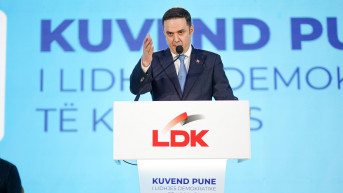
Neither the unexpectedly poor election result of the Democratic League of Kosovo (LDK) in the 28 December elections nor criticism from party colleagues has shaken LDK leader Lumir Abdixhiku in his position. He offered his resignation, but survived the verdict of the party assembly and will continue to lead the LDK—an outcome that observers say offers little hope for the party’s future unless internal changes take place.
As the first preliminary results were being tallied on 28 December, it became clear that the LDK had performed worse than it had ten months earlier. That night, Abdixhiku told journalists that the election result was not what he had expected, but that it had to be respected; that he had failed to take the party to where he believed it should be; and that this was a “moment for reflection.”
In the elections, the Democratic League of Kosovo won 13.24 percent of the vote, securing 15 parliamentary seats—fewer than after the elections of 9 February last year.
After reflecting, Abdixhiku convened a meeting of the party Presidency and announced that he would offer his resignation to the party Assembly, which was held a few days ago.
Despite criticism from some party colleagues calling for his resignation—perhaps most vocally from Vice President Hikmete Bajrami—and the announcement by Avdullah Hoti that he would run for party leader, Abdixhiku “survived.” A majority of delegates rejected his offered resignation, and he remained at the head of the party.
In a statement following the conclusion of the party Assembly, Abdixhiku said the focus would now be on recovery and uniting the membership.
“The path forward for the LDK has a name—recovery,” he said two days ago.
Whether he will succeed remains an open question. Some analysts believe the party’s future under his leadership is “uncertain.” Although Abdixhiku took over the party in difficult circumstances and managed to increase support by around 60,000 votes, that support has since declined. Without deep structural reforms and a new political approach, they warn, the LDK risks being left out of serious political competition.
Cooperation with Self-Determination?
Following the elections held on 9 February last year, Abdixhiku repeatedly stated that there would be no cooperation with Self-Determination.
A month after those elections, he said:
“We have not held meetings with any political party in Kosovo, especially not with the ruling party. We do not want cooperation, we have no cooperation, and we are not working on cooperation with Self-Determination,” Abdixhiku stated clearly at the time at a press conference.
The LDK remained consistent in this stance, refusing to support either the proposal to form a government by Albin Kurti or, two weeks later, the proposal by Glauk Konjufca. Support was also withheld from proposed laws, primarily the budget, which still awaits the new MPs to be voted through—leaving Kosovo without EU funds. Perhaps that very defiance contributed to the decline in support for the LDK, and to a lesser extent for other parties as well, except Self-Determination.
Whatever the reason, even before the elections signals were coming from the LDK that there would be no cooperation with Self-Determination. However, on 13 January, Pristina Mayor and close associate of Lumir Abdixhiku, Përparim Rama, stated that he would “support any coalition that is in the interest of citizens, including one with Self-Determination,” despite having had bad experiences with them.
Whether this signals a change in the stance of the LDK and its leader remains to be seen. In any case, the fact is that Self-Determination no longer needs them to form a government.
Mutual Recognition
When it comes to relations with Serbia, Lumir Abdixhiku’s position does not differ from that of other Albanian leaders: the Kosovo–Serbia dialogue process must end with a final agreement whose essence is mutual recognition.
Even when he supports the dialogue, he does not deviate from this position.
“The LDK supports the implementation of all agreements reached in this process. Kosovo needs an agreement focused on mutual recognition, because no other agreement guarantees normalization of relations between Kosovo and Serbia,” Abdixhiku has said.
He is also an advocate of Kosovo’s membership in the EU and NATO.
He supported Kosovo’s participation in the Peace Committee as well, stating that it is “proof of Kosovo’s success and responsibility, and that every joint step with the United States strengthens its security and deepens strategic alliances.”
Economist, British-Educated, Great Admirer of Ibrahim Rugova
Lumir Abdixhiku was born on 22 April 1983 in Pristina, where he completed primary and secondary school and undergraduate studies at the University of Pristina. He earned a master’s degree in fiscal policy in 2006 from Staffordshire University in the United Kingdom.
He obtained his PhD in economics in England in 2013, following four years of research into corporate tax evasion in transition economies.
He has been a member of the LDK since 2017 and has been elected several times as a member of the Kosovo Assembly. He served as chair of the parliamentary Committee on Budget and Finance.
He was elected president of the LDK in 2021, becoming its youngest leader at just 38 years of age. At the Electoral Assembly, he received the support of 191 party delegates, while deputy leader Lutfi Haziri earned the confidence of 116 delegates, and Besian Mustafa just 16 votes.
He is the fourth president of the Democratic League of Kosovo, following founder Ibrahim Rugova, Fatmir Sejdiu, and Isa Mustafa.
He does not hide that he is a great admirer of Ibrahim Rugova, of whom he said at a recent commemoration marking the 20th anniversary of Rugova’s death that he “remains the greatest Albanian of all time” and “a man who not only fulfilled the historic dream of the people of Kosovo for freedom, independence, and democracy, but also created a great project—the greatest among Kosovo Albanians.”
comments