
Who’s Who – Paul Williams: Thaçi’s witness advised the entire Balkans, decorated by Osmani
American professor of international law, legal adviser to the Kosovo delegation in Rambouillet, and a long-standing advocate of Kosovo’s independence – Paul Williams has been engaged in international peace processes for three decades, and today testifies before the Specialist Chambers in The Hague in defense of former KLA leaders.
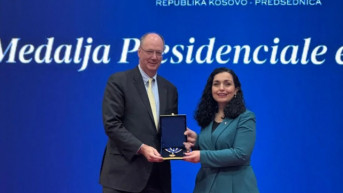
He has advised in negotiations ranging from Rambouillet to The Hague, as well as in Bosnia and Herzegovina, Montenegro, and North Macedonia, and for his contributions to Kosovo he was awarded the Presidential Medal of Merit.
Paul Williams is a professor of international law at American University in Washington, D.C., and co-founder of the “Public International Law & Policy Group” (PILPG), through which he has provided free legal advice in more than 20 peace processes worldwide – from Bosnia and Herzegovina and Libya, to South Sudan and Armenia.
Williams is regarded as one of the leading experts in the fields of self-determination of peoples, recognition of states, peace negotiations, and transitional justice.
Role in Rambouillet
During the Rambouillet negotiations in 1999, Williams was part of the Kosovo delegation at the invitation of then Prime Minister in exile Bujar Bukoshi, on behalf of President Ibrahim Rugova.
He supported the idea that the Rambouillet Agreement represented a transitional solution and a step toward Kosovo’s final independence.
According to his testimony today in The Hague, the Kosovo delegation tasked him with drafting formulations that would allow the International Criminal Tribunal for the former Yugoslavia (ICTY) to carry out its mandate without restriction on the territory of Kosovo.
Views on Kosovo’s Independence
Williams has for decades been a consistent advocate of Kosovo’s independence. He argued that Kosovo had the legal right to self-determination, including independence, due to specific circumstances on the ground.
“More than 100 countries have recognized Kosovo as independent, making its sovereignty, territorial integrity, and political independence indisputable,” Williams stated in an interview with Voice of America in 2024, adding that “Serbia is interested in undermining Kosovo’s independence.”
As early as 2009, just a year after the declaration of independence, he told Voice of America that although Kosovo was not a UN member state, “it is a state and enjoys all the rights and obligations of an independent country.”
In a 2003 interview with the Washington Post, he emphasized: “The aspiration for Kosovo’s independence from Serbia represents the only perspective for long-term stability in the Balkans and should not be delayed.”
Decoration and Dua Lipa
In 2024, Kosovo President Vjosa Osmani awarded him the Presidential Medal of Merit.
“Professor Paul R. Williams has been awarded the Presidential Medal of Merit for his contribution as Kosovo’s legal adviser during the Rambouillet peace negotiations,” the Presidency announced at the time.
He shared the award on LinkedIn as a “fun fact,” humorously comparing himself with singer Dua Lipa:
“What do Dua Lipa and I have in common? We are both recipients of Kosovo’s Presidential Medal of Merit,” he wrote.
Testimony in The Hague
Williams is testifying today before the Specialist Chambers for Kosovo in The Hague in the trial against former President Hashim Thaçi and other former KLA leaders.
At the start of his testimony, as the second defense witness in this case, he reminded the panel that he had been invited by the Kosovo delegation to serve as their legal adviser during the Rambouillet negotiations on behalf of Ibrahim Rugova.
He said that one of the goals of the Kosovo delegation in Rambouillet was to ensure the jurisdiction of the ICTY, noting that the context of those talks was the Racak massacre.
He claimed that Thaçi was “controlled” by external actors and that Thaçi was aware that the investigations would also cover the KLA.
Missions in the Region
In addition to being part of the Kosovo delegation in Rambouillet, Williams also served as adviser to the Bosnian, Macedonian, and Montenegrin delegations in various negotiations.
He was a legal adviser to the Bosnian government during the Dayton Peace Agreement negotiations and advised on the Brčko arbitration.
He served as legal adviser to the Macedonian-Albanian delegation during the peace talks in Skopje and Ohrid, and also advised the Macedonian president on options at the UN to overcome the dispute with Greece over the use of the name “Republic of Macedonia.”
He was also a legal adviser to the Montenegrin government during negotiations on the State Union treaty with Serbia. In addition, he assisted the Montenegrin government in preparations for the 2006 independence referendum and in drafting the new constitution.
As a legal adviser at the U.S. State Department, Williams provided advice on issues related to the dissolution of Yugoslavia, prepared UN Security Council resolutions, and co-advised the sanctions working group against Serbia.
He also provided legal assistance to the Office of the Prosecutor of the ICTY in The Hague, working as part of a team with research assistants.
Writings on Yugoslavia and Milosevic
Williams graduated in 1987 from the University of California, Davis, earned his law degree in 1990 from Stanford, and obtained his PhD at the University of Cambridge, where he was also a Fulbright Scholar.
In 2010, he received the “Teacher/Scholar of the Year” award at American University, the highest honor the institution bestows upon its faculty.
Williams is the author of numerous works in the field of international law and accountability for war crimes, focusing on the wars in the former Yugoslavia and the indictment against Slobodan Milosevic.

0 comments