
What Slovakia and Serbia taught Europe in Moscow
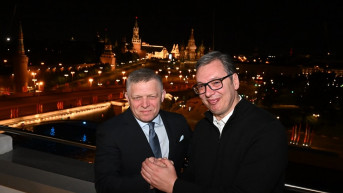
Written for Kosovo Online by Srdjan Garcevic, founder of The Nutshell Times
The decision of the presidents of Serbia and Slovakia, Aleksandar Vučić and Robert Fico, to attend the celebration of the 80th anniversary of the victory in WWII in Moscow predictably drew attention from around the world, and especially Europe.
Their path to Moscow was not only politically but also physically daunting. Ever since they announced their intention to travel to Russia, both leaders faced opprobrium both inside their countries and from their European colleagues, including the Latvian and Lithuanian leadership, who barred them from passing through their airspace. This meant that both Vučić and Fico had to make a marathon voyage across the Black and Caspian seas and over the unsafe skies of southern Russia to join other leaders, including Xi Jinping, Lula de Silva, and their host, Vladimir Putin. Unsurprisingly, the EU's chief diplomat, Kaja Kallas, said that Fico was on the "wrong side of history".
However, both leaders should be appreciated, if not praised, for teaching valuable lessons to their continent.
The first one is the importance of remembering history and the lessons of WWII. While the post-war order has already been abandoned, the lessons of what an actual continental conflagration means should be remembered, especially as new generations in Europe, outside the Balkans, have not had the experience of what sabre rattling can lead to, and that the position on "the right side of history" is not something a bureaucrat can measure, but is fought for with blood.
Equally importantly, they showed the true meaning of fighting for national interest and sovereignty. One of the leading thinkers about international relations in the world after "the end of the end of history", Philip Cunliffe, stresses the need to rediscover national interest after the failure of global liberalism.
Most the attacks on Vučić and Fico sounded less like objective political criticism, and more like quasi-religious anathemas. This is especially true regarding the invocation of the "right side of history".
Despite its prior roots in Whiggish and Hegelian understanding of the world, this concept was most recently popularized by the hierophant of global liberalism, Barack Obama. However, one needs to understand that the apotheosis of global liberalism, its full elevation into a secular religion and severing ties from practicality, happened just as it proved it was unable to deliver on its (worldly) promises. During Obama's reign, and despite the promises of the reigning ideology, societies did not become more equal or just, and neither did globalist liberalism help its followers outcompete not only China and Russia. With the failures of the Arab Spring and uprisings in Venezuela, Hong Kong, and Georgia, it seems that the attraction of global liberalism as an export significantly diminished since the 1990s and 2000s.
In the situation when Europe risks being isolated, left without energy and allies, in the throes of a dying globalist liberal quasireligion, Fico and Vučič have shown that there can be a path forward. It is the one where countries of Europe serve the continent and the EU by serving their citizens. It is the one where European countries build their relationships not only with the US, Russia, and China, but also around the world, understanding how we can work together and develop together. With the past twenty years of mutual accusations of free-riding within the EU, would the taxpayers prefer that they pay more for Slovakia and, eventually, Serbia to develop, or would they prefer that we take care of our own economies?
As the Serbian-American economist, Branko Milanović, recently posted on X, the time of Europe offering "gratuitous lessons to the world", and especially to the countries that have managed quite a bit better than Europe, is over. The fact that it is time to learn from each other and work together is evident as many of the largest European companies, as well as countries, despite the rhetoric, hope for cooperation with China (despite heated rhetoric about it), still rely on Russian gas, and covet the access to the US market.
Finally, Vučić and Fico have shown that leadership still means putting yourself on the line for what your country voted for. In the coming trying times, we must relearn courage, including the courage to accept that the old principles have failed, and move on.
0 comments