
Return of Balkan tensions
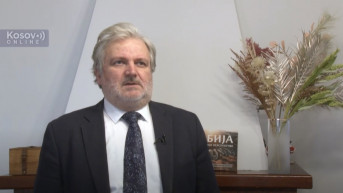
Dragan Bisenic, a journalist, writes for Kosovo Online
Two recent events from the south of Europe show how sensitive and unstable this region is and how any progress in improving the atmosphere and strengthening cooperation can be deceptive and short-lived.
Both are connected with gatherings and political activities of neighbors in areas with a stronger presence of national minority communities.
The first such case is the visit of Pristina Prime Minister Albin Kurti to North Macedonia; the second is almost simultaneous protests related to the issue of the Greek national minority in Albania.
Kurti's visit to the opposition Albanian parties in North Macedonia provoked strong reactions from the Macedonian authorities, primarily because of the flag of the secessionist project "Greater Albania" and the proclamation of Kurti as the "Prime Minister of all Albanians".
The reason for the Kosovo Prime Minister's trip to North Macedonia last Friday was the opening of a street in the Skopje municipality of Chair, which until then had the name "Second Macedonian Brigade". On that day, it was solemnly renamed "Adem Demaci Street".
After that, Kurti went to Tetovo, where a meeting was organized during which there was a disputed iconography and a disputed narrative. On that occasion, he said that Skopje should move closer to Kosovo, Albania, and Bulgaria, and further away from Serbia.
"North Macedonia should be as close as possible to Kosovo, Albania, and Bulgaria, and further away from Serbia, which does not distance itself from (Slobodan) Milosevic or (Vladimir) Putin. In this way, North Macedonia will be as close as possible to joining the EU, and the region in the Balkans will be safer. That's why we should help it and we will support North Macedonia," Kurti said.
Kurti has to seek and create his base in the Albanian population in the region since he has publicly declared ambitions of regional unification of all Albanians, and at the same time worsened relations with the Prime Minister of Albania, Edi Rama.
It was in Tetovo that Kurti said that he and Rama had "good and correct relations, but also disagreements".
"We have good relations. It is about the institutional obligations that we have, but also political and national ones, but that does not mean that we are not criticized or that we never have disagreements about anything. I believe that criticism is a part of democracy and should be constructive," Kurti said during his visit to Tetovo.
Regardless, Kurti bothered both North Macedonia and Albania.
Just two days later, the President of North Macedonia, Stevo Pendarovski, requested the punishment of the leaders of Chair and Tetovo municipalities for, as he said, "nationalist provocations that suggest chauvinistic ideas of large states" during the visit of the Prime Minister of Kosovo to Tetovo and the suburbs of Skopje.
"Establishing provocative nationalist iconography, which promotes chauvinistic ideas of large states, represents the incitement of hatred and ethnic intolerance, which undoubtedly attack the basic principles and values of the Framework Agreement, as well as the concept of Macedonia as a multi-ethnic state," the President of North Macedonia stated in his reaction.
He demands that the organizers of the gatherings be sanctioned "for violating the legal provisions on the use of the state flag and anthem and the flags and symbols of communities, while completely ignoring the symbols of the state."
The Macedonian President also raised doubts about the violation of the procedure for naming a street in Chair after Adem Demaci, doubting that the principle of "double majority" was respected, which included the votes of communities that were not the majority in that municipality.
Because of this, the prosecutor has already initiated proceedings, and an initiative has been launched to return the street's former name.
The President of Kosovo, Vjosa Osmani, tried to calm the atmosphere, judging that the criticism of the officials of North Macedonia, who assessed Kurti's performances during his visit to that country as nationalist, was the result of a "misunderstanding".
Criticism has come from Tirana that Kurti is operating in North Macedonia as he did in 2021 in Tirana, with a comparison with Sali Berisha who is cited as Kurti's main ally.
Albanian media indicate that Kurti wants to tell the international factors that imposed sanctions on him, "that he is capable of setting the region on fire" and "opening up inter-ethnic tensions in North Macedonia".
"If Sali Berisha tried it 30 years ago and failed, can Kurti succeed with this try of destabilization? Of course not", answer the Albanian commentators.
Prime Minister Edi Rama responded with a lengthy public letter a day after a protest was held in Himare, demanding the release of a Greek, the elected mayor of Himare, Freddie Belleri.
Belleri received only 20 more votes than his opponent, and the main cause of the misunderstanding seems to be that opposition politicians, Sali Berisha and Ilir Meta, were behind his victory.
Among the protesters were the mayors of Athens and Thessaloniki, for whom Rama had a message asking them to respect the law and that they could not oppose the decisions of the courts of a democratic state.
A few weeks ago, Margaritis Schinas, Vice President of the European Commission, published a letter addressed to the Commissioner for Enlargement, Oliver Varhelyi.
She asked her colleague to intervene with the Albanian authorities because otherwise, she saw "an immediate risk that this issue will negatively affect relations between Albania's progress until 2023 and its commitment to promoting the legal order".
Margaritis Schinas goes further, and in her letter, she opens the issue of the position of the Greek national minority in Albania.
In these terms and with the same conviction as in the previously mentioned letter, also about "the connection of this issue with the general respect for fundamental rights or the unresolved issue of the property of the Greek minority in the territory of the municipality in question, as well as with the accusations of violation of their borders by the state," as writes in her letter.
Rama spares no words of praise for the Greek Prime Minister Mitsotakis and points out his satisfaction "due to the extraordinary progress that we have made together with the Greek Prime Minister in recent years, to unite the Balkans in a European spirit, which has been real in Albanian-Greek relations for years, looking each other in the eye and addressing old deadlocks with an open mind and goodwill".
At the same time, he indicates that he is "seriously concerned" by the way in which this issue is escalating - "a protest of this nature, unprecedented in the history of Europe - at least as far as I know", which can lead "to regressive consequences of re-igniting the flag of nationalism and mutual negative feelings what this flag causes in misinformed layers and certain groups of extremists, who look forward to them. In these cases, I have a bucket of gasoline in my hand, which I do not doubt for a second that not only I and the Albanian Government but also the Prime Minister and the Greek Government don't want at all".
Rama indicates that he does not know of a case where elected officials of one state organized protests on the territory of another state.
In contrast to the suddenly deteriorating atmosphere in political circles, the public mood is, one would say, completely different.
Just a few weeks ago, a public opinion survey on the perception of Serbia and the Serbs in Albania, conducted by the Albanian Institute for International Studies, was presented in Belgrade.
This survey shows that 44 percent of Albanian citizens assess that the two countries have normal relations, 20 percent that these relations are good, and 18 percent that they are bad. Also, 71 citizens positively evaluated the increased influx of tourists from Serbia.
Twelve hundred respondents participated in the research organized as a part of the project of the Joint Center for Albanian-Serbian Relations, which has been implemented since 2015 in cooperation with the European Movement in Serbia and the Albanian Institute for International Studies.
At its presentation, the President of the European Movement of Serbia, Jelica Minic, said that "there is no general problem between the Serbs and the Albanians. The problems are caused by political ambitions, not by the relations between Serbia and Albania. This shows that the relations, between the two peoples, in the region where we will live together for a long time, can be good provided that a constructive policy is pursued."
On behalf of the Albanian institute, Ledion Krisafi stated that "in the last 10 years, good things have been done in Serbian and Albanian studies", which had contributed to the improvement of relations between Serbia and Albania.
Relations with Serbia are important for 40 percent of respondents, very important for 10 percent, and "not so important" for 27 percent.
In assessing how the relations between the two countries will be in the future, 42 percent believe that they will be better, and 37 percent that there will be no changes.
Here is how Albanians perceive threats to their country.
Russia is considered the greatest threat by 38 percent of respondents, followed by Iran with 20 percent of respondents, and Serbia is in third place, considered the greatest threat by 18 percent of respondents.
Right behind Serbia is Greece, which is considered such by 16 percent of respondents.
The dominant issue that complicates relations between the two countries, according to 53 percent of respondents, is the legacy of historical enmity, and in second place is the issue of Kosovo with 45 percent of respondents, while behind them is the lack of communication between the citizens of the two countries and insufficient economic cooperation.
Almost 60 percent of those surveyed believe that the "Open Balkan" initiative improves Albania's relations with the countries of the region, while 40 percent of them believe that this initiative is positive for the entire region.
Tourist perception is mutually positive. Serbia's discovery of Albania began at the time of the corona when Albania did not ask for PCR tests, and the borders were open thanks to the "Mini Schengen" initiative at the time, which later turned into "Open Balkan".
It is clear that there is a potential for cooperation in the region, but that means and instruments are necessary for its improvement.
We do not have to say that the incidents in North Macedonia and Albanian-Greek relations occurred immediately after the announcement of the end of the "Open Balkan" initiative, nor that these processes are directly interconnected, but there is a well-founded assumption that by removing the space for constructive relations and joint action, opens up space for misunderstandings and confrontations.
That is why it is wrong to demolish the old before something new is built.
comments