
Bisenic: The end of the "Brussels" and the beginning of the "Palestinian" process in Kosovo
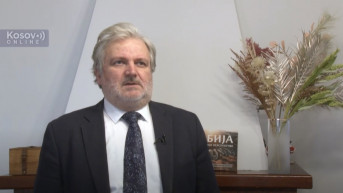
After the decision of the US to cancel Kosovo's participation in the joint military exercise, and the statement of the American ambassador in Pristina, Jeffrey Hovenier, who had two demands for Pristina, journalist Dragan Bisenic says that there is no doubt that the center of American dissatisfaction at the moment is Kosovo Prime Minister Albin Kurti and adds that Hovenier certainly did not find the examples of Palestine or Cyprus at the time of making the statement, but they were considered as options in the event of a worsening situation.
In an author's text for Tanjug, Bisenic states that the Brussels process has been brought to the brink, which is why it does not make much sense to insist on it, but to listen to the recommendations of the US Secretary of State, who requests that Kurti and his government ensure that mayors perform their transitional duties from alternative locations and withdraw police forces, while Serbia lowers the highest level of combat readiness of the Serbian Army and appeals to the Serbs not to clash with KFOR.
Stating that the attempt by the Albanian police forces on May 26 to enter the Municipal Assembly buildings in the north, where the Serb population is in the undisputed majority, led to serious clashes that eventually led to a significant number of injured Serb demonstrators and KFOR members, Bisenic notes that American reactions to it have three forms so far.
One, he says, is a condemnation of unilateral actions, the second is a call for an end to escalation, and the third is an announcement of sanctions that will be taken against the Kosovo authorities.
"The first in a harsh form followed immediately after the police actions and was intended for the Kosovo government and its president Albin Kurti, the second followed a day later, when the situation had calmed down to a certain extent, and was addressed to the Serbian and Albanian sides. The third one is intended, for now, only for the Albanian side. In the first two cases, the bearer was the State Secretary Antony Blinken himself, who first "strongly condemned" the unilateral moves of the Kosovo government. Blinken announced that 'the actions of the Kosovo authorities would have consequences in the relations between Washington and Pristina,'" Bisenic explains.
He also notes that the American administration has made several concrete moves in a short time and has announced even more.
"That duty, it seems with conviction, is carried out by the American ambassador in Pristina, Jeffrey Hovenier. Kosovo's participation in NATO's Defender exercise was immediately canceled while Hovenier said that 'the US no longer has the enthusiasm to convince European countries that have not recognized Kosovo to do so'. It can be expected that publicly or in internal discussions, he will go a step further that he will hint at the denial of American support for admission to the Council of Europe", Bisenic said.
That is why there is no doubt for him that the center of American discontent at this moment is Kosovo's Prime Minister Albin Kurti.
"The idea of approving and holding fake elections in the north of Kosovo where mayors could be elected with only a few tenths of votes, as opposed to tens of thousands of Serbian votes that do not appear in the elections, and then to accept those elections as legal, was not at all wise from the beginning. It was known that it leads to mini-apartheid for the Serbian community in Kosovo. This provided a formal basis for Kurti's actions, although he was certainly aware of where the intervention of special police units in the appointment of authorized municipal presidents was leading," Bisenic adds.
He states that, although the US tried to find a conciliatory solution so that the presidents of the municipalities and their offices would perform only technical work, in other buildings, and not in the Municipal Assemblies, Kurti disputed Blinken's statement that the decision to use force to enter municipal buildings in the north was adopted "against the advice" of the US and European partners and that "tensions escalated unnecessarily".
"Not only did he dispute the statement, but Kurti seems to have gone even further and questioned the US Secretary of State's ability to deal with the Kosovo issue.”I think it's not only unfair, wrong, and harmful, but at the same time, it's very naive. Maybe Secretary Blinken will explain this further one day, but it definitely wasn't helpful,' Kurti said. Maybe Kurti sees a danger to himself that is slowly taking shape in Washington," Bisenic assesses.
He also points out that the appearance of Hashim Thaci in Kosovo, even if he is temporarily free, looks like a very clear American threat to the temporary institutions that this administration will do what the Trump administration has already done - simply remove Kurti from power and replace him, this time, with more effort to install Hashim Thaci.
He also notes that Richard Grenell, who at that time was assigned the "executive role", is currently in the Balkans and is "suggesting" just such a solution, publicly asking Thaci to take Kurti's place.
Bisenic recalls that Grenell himself said that Kurti had never accepted the ideas of the Americans when he stated:
"The problem is that I know Albin Kurti. Look at his politics and I invite you to find one American idea that he agrees with. He rejected every idea, from Obama, Clinton, and George W. Bush, he was always against it."
In addition, Bisenic also stated that Grenell had stated again that the indictment against Thaci had been brought only to prevent him from meeting with former US President Donald Trump at the White House to sign the "final agreement with Serbia".
"Probably because of this, Kurti also caused a small personal insult to the American ambassador in Pristina when he did not allow two mayors from his list to go to a meeting with Hovenier, while Thaci's mayors were at that meeting," Bisenic believes.
He also states that all of this has an additional dimension that Hovenier explained when he said that we were moving towards a complete foreign protectorate in the north of Kosovo.
"When you say 'foreign', then it can be read as an American protectorate. The first step in that direction is to increase the number and composition of NATO troops. The first contingent of 700 soldiers is already arriving, and the second one will probably follow, in order to clearly signal the American mood in which patience is coming to an end," Bisenic pointed out.
Hovenier, he adds, mentioned two models according to which the situation in Kosovo could develop - Palestine and Cyprus when he said that "more NATO troops in Kosovo means more foreign troops, and that means less power and authority for Kosovo." More foreign presence in Kosovo means fewer opportunities for the local population and Albanians to decide for themselves".
Given that Hovenier warned that there was a very serious risk that foreigners would establish a "de facto" and perhaps a "de jure" protectorate over the north of Kosovo, he emphasized that "short-sighted politics in the worst case creates Palestine, and in the best case Cyprus,” it is certain that the American ambassador did not find these examples at the time when he made the statement, but that they were considered as options in the event of a worsening of the situation in Kosovo, Bisenic explains.
He also notes that the scenes seen in the north are reminiscent of the scenes seen on the news from the Palestinian West Bank.
He also recalls that the Oslo II Agreement of 1995 established the administrative division of the Palestinian West Bank into areas A, B, and C as a transitional arrangement, until an agreement on final status is reached, and that the divisions still exist, with Area A being administered by the Palestinian Authority, Area C by Israel, and Area B under joint control.
"Let's assume that the American ambassador essentially meant an analogy with the last area C, which is mixed and the most disputed in terms of security and where conflicts and riots break out most often. Area C, administered by Israel, covers over 60 percent of the West Bank. An estimated 300,000 Palestinians live in 532 residential settlements located partially or entirely in Area C, along with approximately 400,000 Israeli settlers living in approximately 230 settlements. This zone has numerous problems and solving its status is the most complex part of the peace process in the Middle East. Comparing at this time, when the European paper on the normalization of relations between Pristina and Belgrade, when some principles were accepted in Brussels on February 27 and Ohrid on March 18, opens the question of the future of this process," Bisenic noted.
Therefore, he states that the sustainability of the process has been brought to the brink.
"It seems that it is clear to everyone that in these conditions there is not much sense in insisting on it until such an atmosphere is established in which agreements and their respect will be possible. To begin with, it seems appropriate to heed the recommendations of the US Secretary of State, who requests that Kurti and his government ensure that mayors perform their interim duties from alternative locations and withdraw police forces, and that Serbia reduces the highest level of combat readiness of the Serbian Armed Forces and that appeal to Kosovo Serbs not to clash with KFOR. Especially since the Serbian Army has exemplary cooperation with KFOR, and the continuation of that cooperation is in everyone's interest," Bisenic concluded.
0 comments