
Botsan-Kharchenko: The Kosovo issue won't be resolved tomorrow, but in new geopolitical conditions
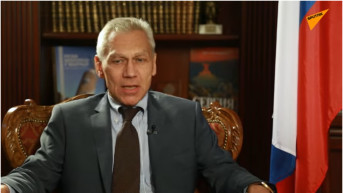
The Kosovo issue can be resolved, and it will happen, not tomorrow, but in some time, primarily by returning the matter to the framework of UN Resolution 1244 and taking Belgrade's interests into account, the Russian Ambassador to Serbia, Alexander Botsan-Kharchenko, said, as reported by Politika.
Botsan-Kharchenko said for Sputnik that it would occur under new geopolitical conditions.
He stated that the West needed a "pretend solution" for Kosovo and argued that nothing new was being proposed, nor could it be proposed.
"Because, regardless of what is being said, one goal that has existed since the late '90s is either explicitly named or implied: Kosovo's independence and Belgrade's recognition of that independence. This is what the West considers its interest, and they always act in their own interest. They have never given up on that, regardless of the wording they choose within the framework of status negotiations," the Russian Ambassador explained.
He believes that "it was immediately clear that these were status negotiations," and that even though statuses can vary, there can only be one - independence.
"Through negotiations or not," Botsan-Kharchenko emphasized.
He thinks that all further efforts for what he calls "normalization" on the Western side are seen and treated as a way to "force Belgrade to accept Kosovo's independence."
"They use all methods, from certain negotiating traps, and in this case, I find it hard to imagine that President Vucic could fall into such a trap. He is a very experienced politician with vast experience in negotiations and in life in general," Botsan-Kharchenko pointed out.
He said that Vucic managed to resist those temptations and provocations on a political and negotiating level.
"Another method, not new but one we've returned to, which was used before, is applying pressure on Belgrade by creating unbearable, impossible conditions for Serbs in Kosovo, assuming that this could compel Belgrade to take steps toward recognition," Botsan-Kharchenko explained.
He added that "since nothing can be done in that situation, Pristina and Kurti are encouraged."
"It's not about Kurti; he's probably more radical, but anyone in his position before or after would do the same. He directly and unambiguously says he wants control over Serbian municipalities and that he doesn't want Serbs in Kosovo. He's doing everything to prevent not only normalization of relations with Belgrade but any kind of connection between Kosovo or Serbian-populated municipalities and Belgrade," Botsan-Kharchenko stated.
He believes that, regardless of all agreements, Kurti will not accept any decisions regarding the formation of the Community of Serb Municipalities, even though it's part of the Brussels Agreement.
"All of this has existed for a long time but has not been resolved yet. It all keeps repeating, like a broken record," the ambassador noted.
He emphasized that, in the process of ultimately resolving the Kosovo issue, the UN Security Council could not be bypassed.
As Botsan-Kharchenko said, without Russia's and China's positions in the UN Security Council, the West would have attempted to resolve the issue through a vote based on the Ahtisaari Plan back in 2006 or 2007.
He also pointed out that keeping the Kosovo issue on the UN Security Council's agenda provided an opportunity for constant discussion, raising awareness of existing problems.
"I cannot say that this can change the situation fundamentally, but the process is lengthy, and I am convinced it cannot be resolved. The West very much wants to resolve it; they want to create the impression of intensive efforts, that's clear," Botsan-Kharchenko said.
He added that some kind of "solution to the problem" would benefit the West, especially in the context of Ukraine, and they would demonstrate that, regarding Kosovo, it was their success and that the problem was solved.
"In this case, there can be no comparison; everything they did, the NATO aggression, all of that has been crossed out, so to speak. The victor is not judged. In this case, there is a consensus and an agreement reached between Belgrade and Pristina, and Belgrade agrees with everything. Without realizing that it won't happen and can't happen. It won't and can't happen," Botsan-Kharchenko emphasized.

0 comments