
Brnabic in Zagreb: On open questions in the most rational way possible
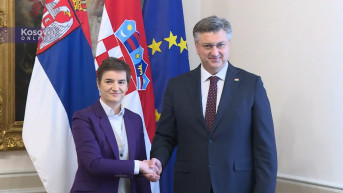
The Prime Minister of Serbia, Ana Brnabic, said today in Zagreb that she wanted the visits of the officials of the two countries to be more frequent and not to be a symbol, especially not a negative and hostile one, but a normal working day that would be used to discuss all open issues in the most rational way possible, and about topics important for the future of citizens and the economy, RTV reported.
"I am glad that, it seems, at least for now, because you never know that in our country, we managed to make a good and high-quality step forward in 2023, first of all, thanks to Milorad Pupovac and Minister Tomislav Zigmanov, and I thank them because of that," Brnabic said at the assembly of the Serbian National Council in Zagreb.
The Prime Minister welcomed the signed Declaration on the Cooperation of the Serbs from Croatia and Croats from Serbia, which had been signed by representatives of minority political parties in Serbia and Croatia in January of this year.
"I sincerely hope that in this way a new dimension of cooperation has been opened that will give concrete results very soon and perhaps my visit today and my stay in Zagreb is a concrete result of this," Brnabic said.
She also reminded that in January, Minister Ivica Dacic, together with Ministers Tanja Miscevic and Tomislav Zigmanov, had attended the Serb National Council's Christmas reception in Zagreb, then President Aleksandar Vucic had met with Croatian Prime Minister Andrej Plenkovic on the sidelines of the forum in Davos, and new meetings of the officials had followed.
"We expect political consultations of the ministries of foreign affairs of our two countries to take place this year, and we will work on that," Brnabic said.
She said that today she had had good and concrete discussions with Prime Minister Andrej Plenkovic regarding projects, such as the re-establishment of railway traffic between Belgrade and Zagreb and Ljubljana, and also, she said, they had mentioned all open issues, however difficult and emotional they might be.
"We talked about how to start solving these issues," the Prime Minister of Serbia underlined.
When it came to the Serbian community in Croatia, the Government of Serbia and President Vucic were deeply committed and cared that they could feel that they have all the help and support at all times, Brnabic said.
She stated that since 2016, more and more financial investments had been made in the projects of the Serbian community in Croatia, stating that more than six million euros had been invested so far.
In addition, she says, assistance in the amount of 2.5 million euros was sent to Croatia for the rehabilitation of the consequences of the earthquake, and additional assistance was sent to the Serbian Orthodox Church in Croatia.
The Prime Minister said that the doors of all institutions in Serbia, including the president, were open for dialogue with representatives of the Serbs in Croatia, as well as the Croats in Serbia.
"Our nations are directed towards each other and are and must be one of the most necessary guarantors of peace, stability, and prosperity in this part of Europe," Brnabic said.
She congratulated Croatia on joining the Eurozone and the Schengen area, as well as on the double taxation agreement with the US.
"In a region like ours, every success means greater stability and better potential for all of us," Brnabic pointed out.
The issue of missing persons places the greatest burden on the relations between Serbia and Croatia
The issue of the missing person placed the greatest strain on the relations between Serbia and Croatia, Prime Minister, Ana Brnabic, told the Croatian media in Zagreb today, after the assembly of the Serbian National Council (SNV).
"I am glad that in 2023 we had some progress on these issues. We also had a commission of the competent bodies of the two countries that met and discussed in January of this year and certain specific activities in March of this year. That is something that burdens us too," Brnabic said.
She stated that in Croatia, in morgues in Zagreb, Rijeka, and Osjek, there were remains of 878 unidentified persons.
"Serbia is really completely open to solving and closing everything we have in this sense, as open issues," the Prime Minister said.
She states that this issue is not easy to solve for politicians from both sides.
"It's not easy for politicians, it won't bring any political points, but it's our responsibility that we have to fulfill," Brnabic said.
The Prime Minister also referred to her earlier statement when she had said that Croatia was an enemy country because of the ban on the import of Russian oil to Serbia.
"I stand behind that statement. I think the blocking of oil imports was extremely incorrect. I think it's a moment when energy is used for political purposes; I think it's not good and appropriate, especially for two neighboring countries. We, whenever we have countless open and difficult issues, whenever we have any political misunderstanding, we return to those difficult and unresolved issues," Brnabic concluded.
Plenkovic: We should make decisions that will improve the position of the Serbs in Croatia
We needed to make decisions that would improve the position of the Serbs and other national minorities in Croatia, Croatian Prime Minister, Andrej Plenkovic, said today at the Grand Assembly of the Serb National Council (SNV) in Zagreb.
"As the Prime Minister, who for the seventh year maintains a strong partnership with all representatives of national minorities in the Parliament, but also with everyone in Croatia, nurturing an open and tolerant society in which Croatia in 2023 represents a country that has solved all its key national issues. Croatia has gained an international position in which we have practically achieved all state and political goals in the last 30 years," Plenkovic said.
As he explained, they did so with confidence and the desire that everyone living in Croatia, whether Croats or members of national minorities, enjoyed all their rights, felt good, and contributed to the Croatian state.
He said that he was saying this because Prime Minister Brnabic herself had said that relations between Serbia and Croatia were burdened by numerous legacies "in the last hundred years".
Those problems lived on and affected the mood, said Plenkovic, and stated that they represented obstacles in the improvement of relations between Croatia and Serbia.
Pupovac: Relations between the Serbs and the Croats should once again become the axis of our part of Europe
The presence of the Prime Ministers of Serbia and Croatia, Ana Brnabic and Andrej Plenkovic at the Assembly of SNV was a great encouragement for those gathered, who would convey important messages from the meeting to their communities, SNV President Milorad Pupovac said today.
"Thank you for coming to support and encourage us who have gathered here, especially Brnabic and Plenkovic, because your arrival is an extremely important encouragement for those who have gathered here and who will convey messages from here to their communities and share them with people they live with," Pupovac said.
Pupovac stressed that the Serbs belonged to the European people and lived with the European people.
"We have done a lot for the country of Croatia to become a full member of the EU, we know that the relations between the Serbs and the Croats, Serbia, and Croatia, were and should be again the axis of Europe in this part of it. Together with our friends and partners, the Croats from Serbia, we are doing everything and we will do to put the wheels of the European partnership on that axle," Pupovac said.
He reminded that SNV inherited a long parliamentary tradition.
"That tradition and our joint actions are based on the ideas of common freedom and living together on responsibility for oneself and responsibility for the state in which we acted, may it be so in the future as well," Pupovac said.
He also stated that the heritage of the SNV included the suffering of the Serbs and the traumas that had arisen from it, but also the suffering of the Croats and others – Roma people, Jewish, and Bosniak.
These, as he emphasized, were the traumas that were still alive as well as the obligations towards them, especially towards those whose feelings were still hurt and rights unfulfilled, whether it was about unpunished crimes, unexplained fates of the disappeared or the uprooting of centuries-old homelands.
According to his words, it is everyone's duty to always remember all that, to be dedicated to those rights and feelings, and to never inherit hatred, but to oppose it always and everywhere.
Pupovac said that the meaning of SNV's actions was to spread the feeling of freedom for every citizen, every Serb in Croatia, by inheriting those two heritages, so that everyone was free to be who they were and that no one had a problem accepting that as a rule of a libertarian society.
He emphasized that it was important that no child grew up with greetings that were a form of glorified crime.
"Our task is that everyone has the prerequisites to live in areas that have electricity and water, in which the roads have been renovated, there is public transport, in which there are community centers, health centers, and pharmacies that the difference between Korenica and Lapac, Gospic and Gracac, was decreasing. Our permanent obligation is the development of the areas where the Serbs live, especially the strengthening of financial development capacities and the development of the underdeveloped municipalities of Dvor, Drevnik..." Pupovac said.
Their goal, he says, is additional development and additional strengthening of the areas where the Serbs live, through the provision of additional services, tourism, energy production, and wood processing...
He stated that it was important that every larger community got the opportunity to have at least one cultural, educational, or sports program in every season.
He also emphasized that education in the Serbian language required much greater commitment, especially according to model C, which covered most of Croatia.
"The low number of students and teachers involved in that program is worrying. That's why it's important that together with the school authorities, we develop programs that will go towards the children, so that they can learn Italian, and Spanish along with learning Cyrillic..." Pupovac said.
He emphasized that he would foster cooperation with his compatriots from Kosovo and Metohija.
Cooperation with them would continue to have an important place in our activities, regardless of whether it was Croats in Serbia or our compatriots in Kosovo and Metohija, said Pupovac at the meeting attended by ministers Tomislav Zigmanov, Gordan Grlic Radman, Serbian ambassador Jelena Milic, envoy of the President of the Parliament, Deputy Prime Minister of the Croatian Government, MPs, and representatives of the Serbian Orthodox Church...
At the end of the assembly, the Declaration on the Position and Rights of the Serbs in Croatia was adopted.
Zigmanov: Plenkovic is coming to Serbia in the second half of June
Croatian Prime Minister, Andrej Plenkovic, would visit Serbia in the second half of June, the Minister for Human and Minority Rights, Tomislav Zigmanov, announced.
He stated that this had been agreed upon at a meeting between Plenkovic and Serbian Prime Minister, Ana Brnabic, in Zagreb.
"It will be in the second half of June, when, apart from the Croatian National Council as the umbrella institution of the Croats in Serbia, one of the hosts will be the Prime <inister," Zigmanov announced.
He pointed out that the representatives of the Croatian national minority in Serbia were encouraged after today's meeting between the prime ministers of Croatia and Serbia, where open questions had been approached responsibly, but also with an unequivocal message that Croatia would support Serbia's European path.
"Awareness of sensitivity and the need to resolve it positively has opened, it seems to me, new hope when it comes to the perspective of Croatian-Serbian relations," Zigmanov said.
Through institutional communication, solving those sensitive issues like those that had disappeared during the war in the 1990s would ultimately lead to a positive outcome, Zigmanov said after the SNV assembly.
The upward trend of communication and cooperation between the two countries will result in a positive resolution of all open issues, the creation of stable relations between the two countries, and then also the two nations," Zigmanov believes.
The Minister also referred to the decline in the number of Croats in Serbia, saying that part of the problem related to the fact that the Croats in Serbia were older than average.
"The average Croat is almost 10 years older than the average citizen of the Republic of Serbia. The economic situation is uncertain, especially in areas where Croats live. They are excluded from the decision-making process and influencing decisions, especially in local communities when it comes to policies and measures that concern the development of the areas where Croats live," Zigmanov said.
0 comments