
Celic: Hague judgment brought no justice for anyone

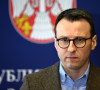
Assistant Professor at the Faculty of Law of the University of Pristina, temporarily seated in Kosovska Mitrovica, Dusko Celic said, commenting on the judgment against the former KLA leaders in The Hague, that the impressions were mixed, although the Hague judgment had, for the first time, cast a different light on the events in Kosovo.
Celic, who is also President of the Management Board of the Coordination of Serbian Associations of Families of Missing and Murdered Persons, stressed that he himself came from a family of victims from Kosovo.
His older brother, he said, was abducted in Pristina on June 14, and it was only three years later that the family learned of his tragic fate. Asked whether he had expected this outcome of the trial, Celic said that his expectations had not been high.
“How many Ivans, Milans, Zorans, Dragans, hundreds of others and their families received justice from yesterday’s court decision? I would say—not one,” Celic said, adding that the indictment had not encompassed the majority of crimes committed against Serbs.
He recalled that from 1998 until the end of 1999, more than one thousand Serbs were killed and more than nine hundred abducted, with the largest number of crimes committed after June 10, 1999. That period, he explained, was not covered by the indictment because prosecutors and judges considered that, following the establishment of peace in Kosovo, the acts committed could no longer be classified as war crimes.
He also recalled the findings of the United Nations Human Rights Advisory Panel (UNMIK), which, he said, had established the responsibility of UNMIK and KFOR in relation to numerous abductions and disappearances of Serbs after June 10, 1999.
Celic sees precisely this as one of the reasons for the reaction of Albanian public opinion—for the first time, he said, there was discussion of organized and systematic criminal acts committed by individuals at the very top of the KLA hierarchy, thereby challenging the claim that the KLA had merely been a guerrilla organization. He also recalled the Limaj and Haradinaj cases, in which, he said, witnesses had mysteriously disappeared, assessing that the obstruction of justice itself indicated that “something was not right.”
Double standards in The Hague and Pristina
Commenting on the sentences imposed—which were a combined 100 years shorter than the maximum sentences sought for all four defendants—Celic drew a parallel with trials in Pristina, including the “Banjska” case, in which two life sentences and one 30-year prison sentence were imposed.
“Here, as far as we know, we have around 300 victims, more than 96 killings, yet we have sentences of 25 years and less, which indicates, to put it mildly, a double standard when it comes to adjudication,” Celic said.
He assessed that inconsistent standards were being applied both in The Hague and Pristina—“when Serbs are defendants, one standard applies; when Albanians are defendants, another applies, regardless of the gravity of the criminal offense.”
He said the reactions to the judgment did not surprise him, given that, in his view, a public policy had been developed in Pristina since 2008 under which the KLA was “untouchable.” He cited the example of a former mayor of Zvecan who, he said, had been prosecuted for critically commenting on the events in Racak.
Celic also addressed the attacks on the EULEX building, explaining that EULEX was the only international mission with an executive mandate in criminal matters and had provided logistical support to the Specialist Chambers in the questioning of witnesses.
“Without EULEX, there probably would not even have been yesterday’s first-instance judgment,” Celic stressed.
Asked what final outcome he expected, given that both sides had the right to appeal, Celic recalled what he described as the negative experience of the International Criminal Tribunal for the former Yugoslavia in the “Operation Storm” case, in which Ante Gotovina was sentenced to 20 years’ imprisonment at first instance before all the defendants were acquitted on appeal.
“I fear that yesterday’s demonstrations, both in The Hague and in Pristina, are already intended to exert pressure on the Appeals Panel, the second-instance chamber,” Celic warned.
No crimes against humanity
Celic particularly emphasized that the judgment covered war crimes but not crimes against humanity, which he regarded as a key problem. He explained that, without the latter legal classification, criminal acts committed after June 10, 1999, such as the abduction of his brother, effectively amounted to “ordinary murders” and “ordinary abductions.”
“That means that prosecution for those criminal offenses becomes time-barred and that earthly justice for those crimes will never be attainable. Had they fallen within the category of war crimes, they would not have been subject to a statute of limitations,” Celic said.
He also recalled the findings of Clint Williamson, head of the Special Investigative Task Force established in 2011 following the Council of Europe resolution based on Dick Marty’s report. Celic said that Williamson had concluded in 2014 that the KLA had deliberately ethnically cleansed entire areas of Kosovo of Serbs and other non-Albanian communities. Those findings, however, had no procedural legal effect at the time, while the six counts of the indictment concerning crimes against humanity were ultimately not sustained in the judgment.
“Those of us who lived through everything that happened in 1998 and 1999 know that Serbs suffered, unfortunately, simply because they were Serbs,” Celic concluded.
Expects further pressure on Serbs
Asked whether he expected new proceedings to be opened, given that the judgment mentioned another six or seven individuals involved in the “joint criminal enterprise” who had not been indicted, Celic said this could not be ruled out, although he did not expect a broader expansion of criminal responsibility, precisely because of what he described as the experience of double standards.
Asked whether he expected further unrest, Celic assessed that the judgment would not lead Albanian society to confront its past.
“Albanian society will perhaps adhere even more firmly to the position that the past of the so-called Kosovo Liberation Army is beyond question—that is the foundation on which the new identity of so-called Kosovo is being built. I do not expect mass unrest, but I do expect, and fear, even more intense and systematic pressure on Serbs and their remaining institutions in Kosovo and Metohija,” Dusko Celic concluded.
Hashim Thaci and three other former KLA leaders were sentenced in The Hague yesterday to a combined total of 81 years in prison. The judgment was followed by unrest both in The Hague and in Pristina. In The Hague, demonstrators clashed with police, who responded with tear gas and water cannons. In Pristina, KLA supporters threw objects at the premises of EULEX and the Kosovo Government.
0 comments