
Conference on Serbia-US cooperation; Djuric: There is no major issue for the Serbian people in which relations with America are not crucial
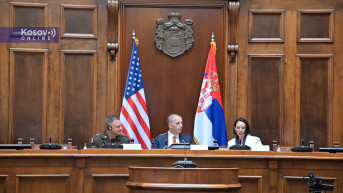
There is no major state or national issue for the Serbian people in which relations with the United States are not of crucial importance, Serbian Foreign Minister Marko Djuric said today at the conference “Belgrade Dialogue: Political Pillars and Economic Bridges between the US and Serbia – From the Military and State Partnership with Ohio to Economic Synergy.”
The conference, held at the National Assembly of Serbia, was organized by the Congress of Serbian-American Friendship and opened with ceremonial performances of the Serbian and US national anthems.
President of the Congress of Serbian-American Friendship Vladimir Marinkovic said that the conference, being held for the fifth time, also marked the 250th anniversary of American independence and the 20th anniversary of the signing of the partnership agreement between the US state of Ohio and Serbia.
Serbian-US relations have made significant progress in recent years, Foreign Minister Marko Djuric said, adding that the launch of the Strategic Dialogue had opened a new chapter in bilateral cooperation.
“I am convinced that the best period of cooperation and relations between Serbia and America lies ahead of us,” the Serbian Foreign Minister said.
Djuric stressed the importance of contacts with US representatives within KFOR, as well as the role of US diplomatic missions in Belgrade and Pristina in promoting and protecting the position and rights not only of the Serbian people but of all non-majority communities in Kosovo.
He expressed hope that 2027 would see a record level of cooperation between the two countries in the economy, as well as in education and military cooperation.
“There is no doubt that Serbia jealously safeguards its independence, autonomy and sovereignty, and in order to achieve that objective, we need energy security. Energy security means reliable supplies of liquefied petroleum gas and oil, but it also means using resources such as the Danube to increase electricity generation and employing new technologies for electricity production. I believe that, in partnership with the United States, we have a reliable partner for achieving these goals,” he said.
Last year, he added, extraordinary results were achieved in cooperation with the US administration regarding the situation in the region, in Bosnia and Herzegovina and specifically in Republika Srpska.
“If we look at where Republika Srpska is today compared with where it was a year ago, I can say that the stability we have today would not have been possible without a strong partnership with the United States,” Djuric said.
Speaking about Serbia’s partnership with the US state of Ohio, he said it had completely transformed perceptions of Serbian soldiers in America, as well as perceptions of American soldiers in Serbia.
The armed forces of the two countries, he said, had succeeded through their joint efforts in building trust, partnership and personal friendships among officers and soldiers.
“We have succeeded in contributing to the interoperability of our armed forces, meaning a greater ability to respond jointly to challenges, participate in international missions and take part in exercises such as those held in Serbia this year, as well as training conducted in the United States for members of our armed forces in cooperation with the Ohio National Guard,” Djuric said.
Ohio, he added, has a population of slightly more than ten million and an annual gross domestic product exceeding USD 650 billion—a GDP larger than that of several major European countries combined.
“The fact that Ohio is committed to developing a strategic partnership with Serbia, in both its military and civilian dimensions, represents an exceptional opportunity for us,” he said.
Djuric noted that Ohio had believed in partnership with Serbia at a time when few others did, when Serbia was still burdened by the very difficult reputation it had acquired during the 1990s and when investing politically in relations with Serbia was considered risky.
“Today, we have reached the point where that partnership has not only grown but, I would say, has begun to blossom and bear positive fruit for both sides,” he said.
At a time that he described as complicated, difficult and highly polarized, Djuric said he was particularly pleased that Serbia-US cooperation enjoyed bipartisan support in the United States, as well as broad support in Serbia.
“But I must also underline the fact that, of all European countries, President Trump is most popular in Serbia. We would like to see and welcome the US President, the Secretary of State and other senior officials in Belgrade. It will be our honor to host American representatives at Expo,” the Serbian Foreign Minister said.
National Assembly Speaker Ana Brnabic told the conference that the United States had been a crucial partner for Serbia in preserving peace and stability in this part of Europe.
“Particularly during President Trump’s first term, when he appointed his envoy for the dialogue between Belgrade and Pristina. That demonstrated pragmatism—the idea that when tensions have accumulated, as they have between Belgrade and Pristina, you try to open economic channels and strengthen economic ties, allowing the economy to lead the way and politics to follow. That pragmatism is desperately needed. We have had enough talk; we need results that will open the way for political dialogue, which has not produced satisfactory results and has not brought us closer to reconciliation,” Brnabic said.
The launch of the Strategic Dialogue between the two countries, she said, was important as a signal, but it was underpinned by years of work, effort and results.
“Information and communications technology is the fastest-growing sector of our economy. In 2025, our exports in this sector alone exceeded EUR 4.5 billion, and we believe that figure will be surpassed in 2026,” she said, adding that the United States was by far Serbia’s largest partner in this field.
US Embassy in Belgrade Chargé d’Affaires Alexander Titolo said that the launch of the Strategic Dialogue between the two countries marked the beginning of discussions, commitments and initiatives that would bring Serbia and the United States closer to achieving their shared objectives.
“It is not an end result in itself. It signifies our mutual commitment to implementing joint projects and addressing challenges in order to create a safer future and greater prosperity for our citizens. Together with our Serbian partners, we look forward to seizing these opportunities and working toward a safer and more prosperous future,” Titolo said.
Major General and Adjutant General of the Ohio National Guard Matthew Woodruff said that, returning to Serbia each year, he could see the relationship maturing and mutual trust deepening.
“We have conducted many military exercises together and enhanced our capabilities in areas such as cybersecurity and space. The State Partnership Program, which began with military cooperation, has expanded into other areas. We will explore how we can develop cooperation in healthcare, the private sector and other fields. I truly believe our future is bright, and I look forward to what awaits us in the years ahead,” Woodruff said.
He stressed that the process worked both ways, as the Ohio National Guard also learned from the Serbian Armed Forces and the two sides exchanged experience.
“I think the next five years will be excellent and that we will strengthen our partnerships. We will continue conducting joint military exercises and training. Each year, we will build on what we have previously learned and shared so that we can address the challenges ahead in the most effective way possible,” he said.
Vice President of the Serbian Chamber of Commerce Ivan Bosnjak assessed that the new political framework created by the launch of the Serbia-US Strategic Dialogue was already acquiring an economic dimension.
“Serbia and America have launched a Strategic Dialogue, which provides an institutional framework for cooperation between the two countries in areas of major importance to the economy, from energy and investment to trade, new technologies, science and education. For me, as a businessman and Vice President of the Serbian Chamber of Commerce, it is particularly important that this new political framework is already acquiring an economic dimension. The best relations between countries are those that create opportunities for people and companies—for new contacts, investment, exchanges of knowledge, technology and experience, and joint projects,” Bosnjak said.
He added that Serbia and the United States already had a strong economic foundation for such cooperation.
“American companies are present in Serbia across various sectors, while Serbian companies are increasingly turning toward the US market, particularly in services and information technology. The Serbian Chamber of Commerce will, as always, remain open to connecting companies, institutions and businesspeople and helping to build new bridges,” Bosnjak said.
Congressman Robert Aderholt addressed the conference in a video message, saying that he had always valued efforts to build strong and lasting relations between Serbia and the United States.
“I am committed to continuing cooperation between our two countries and advancing stability and prosperity,” Aderholt said.
Pastor Mark Burns, a spiritual adviser to President Donald Trump, also addressed the conference by video message.

0 comments