
War crimes convictions, but no convictions for crimes against humanity—what does the judgment against former KLA leaders mean?
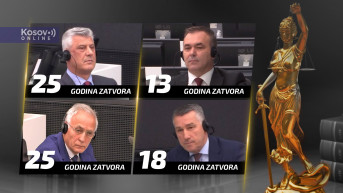
Neither Pristina nor Belgrade is satisfied with the first-instance judgment delivered by the Kosovo Specialist Chambers in The Hague in the case against the former KLA leaders. After Hashim Thaci was sentenced to 25 years in prison, his supporters pelted the EULEX headquarters in Pristina with stones and bottles, windows were also broken at the Kosovo Government building, and clashes broke out with Dutch police. Belgrade, meanwhile, argues that by acquitting Thaci, Veseli, Krasniqi and Selimi of crimes against humanity, the judgment effectively absolves them of crimes committed against Serbs.
Written by: Veljko Nestorovic
Hashim Thaci, Kadri Veseli, Jakup Krasniqi and Rexhep Selimi were found guilty and sentenced to a combined total of 81 years in prison.
Brussels and Washington called for respect for the judgments delivered in The Hague, while embassies in Pristina reiterated their support for the Specialist Chambers. In Kosovo, meanwhile, representatives of the PDK and other Albanian parties raised the issue of abolishing the Court.
Attorneys for the former KLA leaders have already announced appeals, while the Prosecution could challenge their acquittals on the crimes against humanity charges. The appeal proceedings are estimated to potentially last up to a year, after which a referral to the Constitutional Court could follow.
The summary of the judgment states that the Trial Panel found all four defendants—Thaci, Veseli, Krasniqi and Selimi—criminally responsible for the war crimes of arbitrary arrest and detention involving 385 persons, cruel treatment involving 49 persons, torture involving 303 persons and murder involving 96 persons.
The Trial Panel acquitted the accused of crimes against humanity, finding that the Specialist Prosecutor had failed to establish beyond reasonable doubt the existence of a widespread or systematic attack directed against a civilian population. The accused were also acquitted in relation to a number of alleged war-crime incidents.
Director of the Office for Kosovo and Metohija Petar Petkovic said that six of the ten counts in the indictment had failed—those relating to crimes against humanity.
“The Court dismissed six counts relating to crimes against humanity. By rejecting the crimes against humanity charges, they are effectively absolving them of the crimes they committed against Serbs. The entire judgment concerns around 400 people who were detained, mistreated and subjected to cruel treatment, with 96 of them murdered. Among those people were women, children, professors and farmers—people who had absolutely nothing to do with the hostilities,” Petkovic said.
Former US Assistant Secretary of State for European and Eurasian Affairs Philip Reeker told Kosovo Online that he was surprised by the severity of the sentences imposed on the former KLA leaders, adding that the appeal process would now follow and that its outcome remained to be seen.
Reeker said it was not for him to determine whether the judgment itself was fair.
“A judgment is a judgment. This is a process being conducted before an institution established precisely for that purpose. I know that in the region, and among many people, there is a sense of injustice. We can see that sense of injustice being expressed now. But, as I said, I think we should look at the process that lies ahead, which includes the appeal proceedings, and see where that process ultimately takes us. What is important, in my view, is to think about the future of the region, the future of Kosovo, the future of Serbia, the future of the entire Balkans and Europe. I have long hoped that we would see genuine progress in that direction. Unfortunately, that progress has been very slow. I am not sure that this judgment or this process helps us move in that direction,” Reeker said.
Commenting on the reaction in Pristina following the announcement of the judgment, Reeker said that many people felt that an injustice had been done.
“It is important to bear in mind that this is part of a process. There is an opportunity to appeal. I am sure that process is already underway. This is about individual responsibility, as determined by the Court. This is not about collective responsibility,” he said.
Reeker added that people in the region should think about their broader future and how they could work together.
“You are not going to change history. You are not going to change geography or the reality of the region. The better solution is to find a way forward so that everyone in the region can live in safer and more prosperous conditions and work toward their own future, as well as that of their children and grandchildren,” he explained.
Political analyst Lulzim Farizi told Kosovo Online that, regardless of where people lived in the former Yugoslavia, societies in the region seemed unable to come to terms with judgments handed down by the Hague Tribunal and the Kosovo Specialist Chambers.
Farizi also said that politics should “stay away” from court judgments and that they should not be subjected to political commentary.
“The judgments were delivered on the basis of evidence presented before the Court in The Hague. I therefore believe politics should stay away from judgments and that court judgments should not be commented on politically. They have the right to appeal—that is, those convicted have the right to appeal until the judgment becomes final—but I think politics should no longer be conducted around people who have been convicted before those courts, or before this particular court in The Hague. Somehow, in the Balkans, we are still unable to close this chapter or heal the wounds that have troubled us for so many years—25 or 26 years, let us say. But this is an indication, a message, that everyone who violates the law or international law and commits criminal offenses should be convicted,” Farizi said.
He added that this chapter should finally be brought to an end, as, in his words, the chapter concerning “almost all the states, or the wars that took place in the Balkans,” was already drawing to a close.
Silvana Marinkovic of the Association of Families of Kidnapped and Missing Serbs said after the judgment was delivered that justice had been partially served, but that the sentences were too lenient for the crimes committed.
Marinkovic told Kosovo Online that the indictment against the former KLA leaders had encompassed only a small number of Serbian victims and that she feared the judgment could be overturned on appeal.
“I can say that justice has been served to some extent. However, they were not convicted for the kidnappings, and unfortunately, the indictment does not encompass the crimes against Serbs. It does include some, but only a very small number, perhaps around five percent. We are afraid that they could be acquitted on appeal. In any event, these sentences are very lenient when we recall the crimes that were committed, not only against the Serbian population but also against the Albanian and other populations in Kosovo and Metohija. The crimes were grave, but the sentences imposed are very, very lenient in relation to the crimes committed,” she stressed.
Journalist and analyst Dritan Llaci told Kosovo Online that he had expected the four former KLA leaders to be found guilty, but that, having reviewed the judgment and the reasoning accompanying it, he believed it contained numerous shortcomings and amounted to a form of collective punishment.
Llaci said he had also expected sentences considerably more lenient than the 45 years sought by the Prosecution.
“Although it was stated from the outset that this was not a judgment against the KLA, nor against the KLA’s war, which I regard as a war for freedom, but rather an individual judgment concerning crimes committed by people who held leadership responsibilities during that war, when we speak about individual responsibility, we are speaking about people who fought for their people in Kosovo and helped Kosovo achieve independence. They were therefore prepared to sacrifice their lives. In that sense, it is understandable that it is difficult to separate their responsibility from that of the KLA. I see this as a decision that essentially appears indirectly intended to tarnish the KLA’s liberation war, although the judges did not say so. It would have been logical not to frame it in this way,” Llaci said.
Attorney Dragan Pasic said that legal experts had not expected the former KLA leaders to be acquitted on the counts charging them with crimes against humanity, adding that appeal proceedings would follow and, in his assessment, would last approximately one year.
Pasic told Kosovo Online that the Court had found that those convicted had acted with the common purpose of establishing full control over Kosovo through intimidation, mistreatment and the elimination of those they regarded as opponents.
“By that I mean Serbs, Roma and political opponents among the Albanians,” Pasic said.
He stressed that the KLA leaders had been acquitted of crimes against humanity because the Court found that there had not been a widespread or systematic attack directed against the civilian population as a whole, which, he explained, was a legal requirement for conduct to qualify as a crime against humanity.
Historian from Gracanica Aleksandar Gudzic said that the judgment against Hashim Thaci, Kadri Veseli, Rexhep Selimi and Jakup Krasniqi in The Hague had cast a shadow over the nature of the KLA’s struggle, given that the prevailing view in Kosovo had been that “the war was just.”
“Justice has been partially served. The judgment and the entire proceedings excluded the period of late 1999 and early 2000, when more than 250,000 Serbs were expelled and Operation ‘Broom’ was carried out. The judgment against Hashim Thaci itself concerns murder, cruel treatment, unlawful detention and other war crimes. The judgment will have an impact on Kosovo itself,” Gudzic told Kosovo Online.




0 comments