
Commander of KFOR: Kurti was wrong, enough with unilateral actions
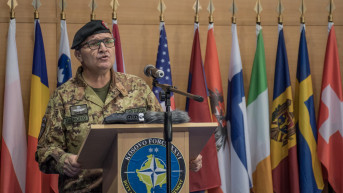
KFOR commander Angelo Michele Ristuccia criticized, in an interview with the Italian daily Corriere della Sera, Kosovo Prime Minister Albin Kurti, pointing out that he had been wrong to appoint mayors of Albanian nationality in the north of Kosovo who were not recognized by the Serbian majority.
"The NATO mission cannot and must not be considered an umbrella under which it can take refuge after unilateral actions that disrupt very precarious balances," Ristuccia said.
General Ristuccia pointed out that the bloodshed could have happened without the intervention of KFOR and blamed the unilateral actions of Kurti.
"First of all, the decision of Kosovo Prime Minister Albin Kurti to appoint mayors of Albanian nationality that the Serbian majority does not recognize, without taking into account the contrary advice of the entire international community. The second unilateral action of the Pristina government was the use of force without consulting us, which made our intervention necessary to avoide tragedy," he explained.
When asked if that had not been a legitimate choice of the government acting on its own territory, Ristuccia replied that one should not pretend that it was a normal situation.
"Please, let's not pretend that this is a normal situation. These are decisions made without prior coordination with us and with the parties involved. This is not the first time this has happened. This is an approach that certainly does not encourage mutual trust. The adverse consequences should always be assessed, which this kind of action has. When he talked to me, Prime Minister Kurti always agreed with this approach," he added.
When further asked why he hadn’t acted like that this time, he said they should ask Kurti.
Regarding Corriere della Sera's statement that Kurti said that Kosovo was a sovereign state and that it could not give in to the blackmail of thugs, Ristuccia pointed out that members of KFOR, as soldiers, were concerned about the safety, stability, and freedom of movement of the two ethnic groups.
"I do not judge political decisions, but I have a duty to take care of their consequences, which in such a delicate context can easily lead to escalation, as we have just seen," he underlined.
Asked what would happen in the north of Kosovo without the NATO mission, the Italian general said "Another hotbed of war".
"The situation we are facing is the result of a series of crises that have accumulated over time. Let's call it controlled instability, which, however, is becoming increasingly unstable on the ground, due to the fragility of the relationship between the two ethnic groups and the one who represents them. Every balance achieved with great effort, crisis after crisis, is becoming more and more insecure," he added.
He said that the responsibilities were not only on one side.
"Both sides are not able to capitalize on the goals achieved over the years, with the great efforts of international diplomacy. The moment there is an agreement, it must be implemented. But without any dialogue, it remains a dead letter. At the base of everything is just mutual mistrust. Pacta sunt servanda. This would be enough. But they can't do it," Ristuccia said.
He pointed out that the environment he was in was saturated with absolutely unproductive and dangerous rhetoric, completely dysfunctional for the peace goals that the international community wanted to achieve in Kosovo.
Asked if this meant that there was a lack of political will, Ristuccia replied that important results had been achieved in the last twenty years.
"Even in terms of peaceful coexistence. But starting in 2021, we are moving backward, like shrimp. Due to the extreme polarization of some facts, which were exploited by all parties involved in the name of extremist politics, which undermined the stability between the two ethnic groups," he explained.
Ristuccia said that KFOR's intervention had only created a short-term effect.
"With diplomatic action, Serbia and Kosovo are starting to talk to each other again. We hope that this time frame will be used to start real negotiations. As has not been done so far," he concluded.
0 comments