
Dacic: We welcome the fact that "Friends of the Western Balkans" think of the region; there should be no insistence on status issues
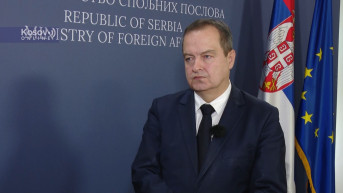
The group "Friends of the Western Balkans" recently addressed the EU member states with a non-paper expressing support for the region on the path to EU integration. Speaking about the work and goals of this group, Serbian Foreign Minister Ivica Dacic says for Kosovo Online that, in principle, Serbia welcomes any effort that aims to open the EU's doors to Western Balkan countries' membership, however, he emphasizes that there should be no insistence on status issues, considering that Serbia does not recognize Kosovo as a state.
"If someone wants this to work normally, there should be no insistence on status issues. Instead, let's talk specifically about the need for the Western Balkans to integrate into the European Union. We do not consider Kosovo a state, and in this regard, our views differ from the opinions of some members of that group. So, in one part, we agree with them, and in another, when it comes to status issues, we cannot agree," Dacic stated.
The group was launched this summer by Austrian Foreign Minister Alexander Schallenberg, and besides Austria, it includes Italy, Croatia, the Czech Republic, Greece, Slovakia, and Slovenia; that is, there are only two EU members that do not recognize Kosovo – Greece and Slovakia.
"Italy was, in fact, the leader of that group, and this is in line with their desire to position themselves within the EU. We welcome someone thinking about the Western Balkans, but we call for attention to what is acceptable for Serbia and what is not concerning status issues related to Kosovo and Metohija," Dacic emphasized.
In the non-paper delivered to the EU member states last week, the group stated that the "Friends of the Western Balkans" share a special responsibility for keeping this region high on the EU's political agenda, especially regarding support for these countries on their European path.
"As the region faces destabilizing factors such as malicious influences of third parties, hybrid threats, disinformation, and illegal migrations, this agenda should also provide a new impetus for deepening cooperation in the field of common foreign and security policy, as well as more regular and structured exchanges with our partners following established EU procedures and policies," the non-paper stated, among other things.

0 comments