
Djukic: Belgrade is an important factor for Kyiv; we are far from Ukrainian recognition of Kosovo
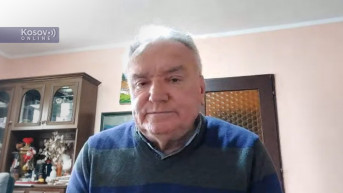
Srecko Djukic, former diplomat and member of the Forum for International Relations of the European Movement in Serbia, assesses that, regardless of the recent announcement, the issue of recognizing Kosovo will not be on Ukraine's agenda for a long time.
"Such a thing is not a question of Ukraine's current or short-term policy. This issue will wait for matters to be resolved between Belgrade and Pristina or for matters to be resolved within Ukraine itself," Djukic emphasizes to Kosovo Online.
He stresses that it is important for both Ukraine and Serbia to follow a policy of respecting territorial integrity.
"It is important for us, but it is also important for Ukraine to maintain the current status because it is a principled stance of supporting a country whose territorial integrity is threatened, that is, non-recognition of Kosovo. Serbia has, after all, supported the territorial integrity of Ukraine in all resolutions adopted by the UN, and I think there are six or seven of them," Djukic emphasizes.
He explains that it is very important for Serbia that Ukraine does not change its stance because it could trigger a chain reaction in former Soviet countries.
"An important moment for understanding the overall situation in Serbian-Ukrainian relations and why it is important for Ukraine not to recognize Pristina is also the fact that it would be the first country from the post-Soviet space, excluding the three Baltic states, to recognize Kosovo as an independent state," Djukic says.
Djukic interprets Ambassador of Ukraine to Tirana Volodymyr Shkurov's announcement that this country could change its stance and that "recognizing Kosovo is only a matter of time" as "a quite free and broad interpretation of possible Ukrainian policy towards Serbia."
"That topic is open in Ukrainian public discourse. There have been discussions not only in the media but also in the Supreme Rada and with some personalities. This is something that, in the end, must be brought up. However, objectively speaking, it is not a current topic, nor is it a topic that will be soon considered in the sense that Ukraine could recognize Kosovo as an independent state. For several reasons. Firstly, it is a principled, fundamental stance. Both countries are fighting for their territorial integrity, and certainly Ukraine, regardless of how many powerful allies it has who objectively are not allies to Serbia, would not deviate from that framework," Djukic is convinced.
He notes that Serbia is an important factor for Ukraine, as confirmed by the Declaration adopted at the Ukraine-Balkans Summit in Tirana as well as in the discussions held there between the two presidents, Aleksandar Vucic and Volodymyr Zelenskyy.
Asked how much Serbia's neutral stance on the war in Ukraine complicates matters, Djukic responds that Serbia's position is too complicated, and it depends on how one interprets that neutrality.
"It depends on who and how they observe it. I think that Serbian policy needs to be active on all fronts and domains, including the Ukrainian-Russian war. It's hard to say that Serbia has a neutral status there. I would say that Serbian policy is more tied to Russian policy and the belief that through this strong connection with Moscow, the status of Kosovo and Metohija is preserved, and in that sense, the issue of Serbian-Ukrainian relations is pushed into the background, or that our policy towards Ukraine is insufficiently active," Djukic says.
Asked whether the statement by the Ukrainian ambassador should be interpreted as a possible announcement of the opening of this country's diplomatic mission in Pristina, Djukic says that it is possible and that it would be "nothing unusual."
"But Ukraine would not gain anything special by doing so. It might mean something for Pristina, considering that it fully supports Ukraine," Djukic says, reminding that many other states that have not recognized Kosovo's independence have similar missions, below the level of embassies, in Pristina.
"Ukraine can do that any day; it wouldn't be anything unusual and wouldn't set a precedent because a significant number of states have their embassy offices in Pristina accredited from Belgrade. Starting from Russia, China, Greece, and many other countries. They have accredited their offices and diplomats from Belgrade to Pristina through our Ministry of Foreign Affairs and, of course, through the Pristina Ministry of Foreign Affairs. Russia has maintained its strong diplomatic mission since 2000. Greece raised the level of its diplomatic representation to the level of a trade representation a few years ago," Djukic reminds.


0 comments