
Djuric to Der Spiegel: EU is Serbia’s strategic goal; we consistently support Ukraine’s territorial integrity
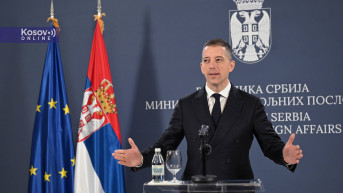
Serbian Foreign Minister Marko Djuric said in an interview with Der Spiegel that membership in the European Union is not merely a symbolic acknowledgment for Serbia, but a strategic goal, also stressing that the priority is for citizens to be satisfied and that the country pursues an open foreign policy. He also emphasized that Serbia’s position on sanctions against Russia is complex, because both Russia and Ukraine support Serbia’s territorial integrity regarding Kosovo, while reminding that Serbia has consistently voted in favor of Ukraine’s territorial integrity and sovereignty in votes at the United Nations General Assembly.
Asked how serious the Serbian government is about EU membership, given that in its latest report the Union assessed Serbia “more critically than rarely before”, among other things due to shortcomings in the rule of law, Djuric stressed that for Serbia, EU membership is not merely symbolic recognition, but a strategic goal, noting that two thirds of Serbia’s foreign trade is conducted precisely with the Union.
“In recent years we have implemented reforms such as a new law on voter registers and reform of the Regulatory Authority for Electronic Media. These reforms were also positively assessed by the opposition. Much more still needs to be done on our side, but I hope Europe will not view Serbia as a problematic case,” the head of Serbian diplomacy said.
Responding to the observation that in foreign policy Serbia maintains close relations with very different partners – with the EU, as well as with China, Russia and the United States – Djuric pointed out that the priority is for the people of Serbia to be satisfied.
“Yes, we pursue an open foreign policy. Serbia is uniquely positioned; we have free trade agreements with the EU as well as with China, Russia, Turkey and the Emirates. This is part of a long tradition dating back to the Middle Ages – Serbia as ‘the West in the East and the East in the West’. Politically, we want to become an EU member, and our foreign policy largely aligns with that of Brussels. At the same time, we maintain old friendships, for example with African countries that, like Yugoslavia, were once part of the Non-Aligned Movement,” Djuric said.
Asked why Serbia does not take part in sanctions against Russia, he replied that the country’s position is complex and that both Russia and Ukraine support Serbia’s territorial integrity regarding Kosovo.
“At the same time, we have provided humanitarian assistance to Ukraine and received more than 300,000 people from Ukraine and Russia. In general, we do not attach much importance to sanctions because they usually hit the population more than political elites. I remember the 1990s under Milosevic; sanctions hit the wrong people,” the minister noted.
When asked whether he would describe Russia’s invasion of Ukraine as a violation of international law, he responded by recalling that Serbia has consistently voted for Ukraine’s territorial integrity and sovereignty in votes at the United Nations General Assembly.
“Our stance in international organizations always takes into account the impact on our core interests, especially regarding the issue of Kosovo and Metohija. At the same time, we participate in initiatives such as the Crimean Platform, send humanitarian aid and support Ukrainian children through public and private projects. Our voting behavior often reflects a balance between principles and real political constraints,” Djuric explained.
Regarding the fact that the balance between blocs is currently reaching its limits, for example in energy policy, and that the oil refinery near Belgrade had to halt production due to US sanctions against Russia, Djuric pointed out that the key word is diversification.
“We are building new gas pipelines that bring us closer to Europe. We are investing in solar and hydropower. Moreover, last year I signed an energy partnership agreement with the United States. The Russian share in our national oil company is currently being reassessed,” he said.
Commenting on the observation that inflation in Serbia is high while social tensions are rising, he noted that the standard of living in Serbia has increased significantly over the past ten years.
“We created 600,000 new jobs, and incomes and pensions have doubled. Of course, we also feel the effects of global price increases. But compared with Bosnia and Herzegovina, our purchasing power is now higher by 20 to 30 percent. In foreign policy, however, we must do more to cooperate even more closely with our neighbors – economically, in transport and politically. That will be the focus of my work in 2026,” Minister Djuric said.
Asked how he explains the “contradiction” that the Serbian government “on the one hand preaches the territorial integrity of Bosnia and Herzegovina, and on the other maintains close ties with Milorad Dodik, who wants to secede the Republic of Srpska”, Djuric responded that the Dayton Agreement explicitly provides for Serbia and the Republic of Srpska to maintain special relations, that this is neither illegal nor unlawful, and that at the same time Belgrade has never undermined the territorial integrity of Bosnia and Herzegovina over the past three decades.
“Otherwise, Bosnia would look very different today. On the contrary, we have worked on de-escalating the situation. We reject any separatist rhetoric, but we also oppose tendencies in Sarajevo to marginalize the constitutional rights of Serbs and Croats. Our goal is cooperation, better transport routes, more trade, more exchange,” Djuric said.
Speaking about how realistic a swift resolution to the war in Ukraine is, given that he has spoken with both Western leaders and representatives of Russia, the head of Serbian diplomacy stressed that peace in Ukraine is an urgent issue for Europe and reiterated that Serbia strongly supports the peace efforts of US President Donald Trump in that direction.
“Europe is under pressure to rediscover its own strength. We strongly support the plan of US President Donald Trump and all other initiatives that can lead to an end to the fighting. Belgrade is offering itself as a platform for talks; we are one of the few capitals from which it is possible to fly directly to the United States, Europe, Russia, China or the Middle East. Moreover, we have a reputation as good and discreet hosts,” Djuric said.
0 comments