
Djuric: The EU gains a lot from Serbia's membership, the enlargement process needs to be accelerated
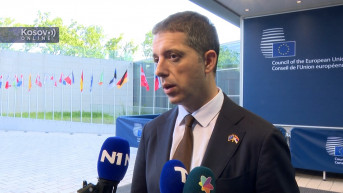
Serbian Foreign Minister Marko Djuric stated today in Luxembourg that implementing the reform agenda by 2027 is one of the state's priorities on the path to the EU. He emphasized that the Union stands to gain significantly from Serbia's membership and that of the entire region, with the message that Serbia does not want to be a "secondary market" but a full-fledged EU member.
"Today was an important day for Serbia's European integration; we discussed how to accelerate and give new impetus to Serbia's European integration," Djuric told reporters.
He conveyed to his interlocutors that for the Serbian government, implementing the reform agenda by 2027 is an absolute priority because the goal is for the country to be fully prepared for full membership by then, in terms of the economy, rule of law, democracy, and other aspects.
At the same time, he added that he emphasized that the EU can gain significantly from the membership of Serbia and other Western Balkan countries in terms of human capital, tradition, culture, knowledge, security, and energy security.
"I conveyed the message that, until then, the citizens of Serbia have the right and should gain access to EU funds because scientists, students, and farmers in Serbia should not have a second-class status compared to those in any other country. We are not interested in being a secondary market or something similar; we want a full-fledged seat and an equal place at the table," said Djuric.
With all due respect to the status of Puerto Rico within the USA, which has achieved phenomenal results compared to other Caribbean territories, Djuric pointed out that Serbia does not want to be the "Puerto Rico of the European Union" but an equal part of the European family.
Responding to questions, he said that discussions also covered alignment with European foreign and security policies. He noted that Serbia would surely have a common foreign and security policy with the EU upon joining, but then it would also be able to influence it.
"Until then, we want to raise the level of alignment with the common foreign and security policy, but we also seek help to resolve issues from the past for which the current generations are not responsible, and which cannot be resolved fairly without the full engagement of the international community," the Serbian Foreign Minister pointed out.
In this context, he once again highlighted to EU representatives the violations of the collective rights of Serbs in Kosovo and the need for a stricter, more aggressive implementation of the Brussels Agreement, signed ten years ago.
"I told them - let's help each other, meet halfway, and speed up the EU enlargement process," the minister added.
He noted that Serbia already significantly contributes to the common foreign and security policy by participating in EU peacekeeping missions. Regarding the conflict in Ukraine specifically, he recalled that Serbia has supported UN resolutions upholding Ukraine's territorial integrity from the beginning.
"We have specific reasons why our foreign policy on this issue differs from other member countries, but we expect the EU to help normalize relations in the region sufficiently and improve the security and geopolitical situation to enable greater alignment in the future. Serbia will seek ways to protect national interests while aligning as closely as possible with the EU," Djuric said.
He conveyed that he also met with his Polish counterpart, Radosław Sikorski, and the Foreign Minister of Benin, a friendly country since the Non-Aligned Movement.
Serbia will, he reiterated, continue to seek new friends worldwide while not losing old ones.
"No matter how difficult this policy is, we will fight to explain it, to create conditions for faster EU membership while preserving state and national interests," emphasized the Serbian Foreign Minister.
Asked what he expects from Hungary's presidency of the EU Council, he replied that Serbia is very excited about it, as it can provide an additional impetus to the European integration of the entire region.
"We have great confidence in Péter Szijjártó and Viktor Orbán, in their sincere desire for the EU to expand to our region. We will continue to highlight our good relations with Hungary as an example of how relations that were once complex can be transformed within a few years. Serbia and Hungary are a European example of cooperation. Therefore, we have positive expectations," Djuric said, adding that others also believe Hungary's EU Council presidency will bring the necessary tone of reconciliation, cooperation, and focus on the Union's enlargement.


0 comments