
Djuric: Ghana strongly supports Serbia, African partnerships key to preserving Kosovo and Metohija
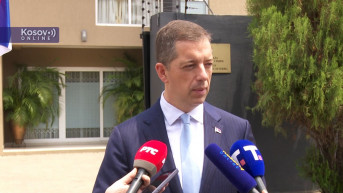
Minister of Foreign Affairs Marko Djuric stated today that Ghana, where he is currently on an official visit, is one of the most important African countries that consistently supports the territorial integrity of Serbia, including its stance on Kosovo and Metohija. He emphasized his belief that Africa is the continent of the future, highlighting that partnerships with African countries represent a significant development opportunity for Serbia and an additional source of support in the fight to preserve Kosovo and Metohija within the United Nations General Assembly.
“We are beginning an official visit to the Republic of Ghana, our decades-long, traditional and loyal friend in this part of the world—a country that was among the first to raise the banner of the anti-colonial struggle, beginning its path to independence in 1957 and achieving it in 1960, led by then-President Nkrumah, a great friend of our country and President Tito. It is through this very path—of non-alignment—that we continue to walk today, building friendships with the peoples of Africa,” said Djuric.
He added that he held excellent discussions today with Ghana’s Minister of Foreign Affairs and Minister of Agriculture, and that meetings with the Ministers of Culture, Sports, and Defense are also planned.
“It is very important for us to align economically as well. This is one of the most promising markets in the world, with an average population age of 20 and an annual economic growth rate between 4% and 5%, even in weaker years. This presents a phenomenal export market for our companies. Later today, we will visit the congress center being built by Energoprojekt, but that is just a drop in the ocean of opportunities that exist here for our economy,” he said.
Djuric noted that Serbia has around 50 Ghanaian students studying at Serbian universities and that today the Ghanaian foreign minister offered scholarships for Serbian students to come to Ghana and study African history, culture, arts, and sciences at the University of Ghana, one of the most prestigious institutions in this part of Africa.
“Our visit will also include discussions in the field of defense, which may result in new business for our defense industry. Our talks in agriculture have already led to agreements that will create opportunities for our institutes, agricultural institutions, and producers of agricultural machinery,” Djuric said.
He stressed that the way the Serbian delegation has been received is something he wishes to share with the Serbian public.
“Truly, the treatment and respect the Serbian delegation has received here are unprecedented. I was told that all Nordic foreign ministers were recently here together and had fewer meetings than we’ve had in just these three and a half days,” he said.
Djuric is also expected to meet with the President of Ghana, with Kosovo and Metohija being one of the topics.
“I will be meeting with the President of the Republic of Ghana, Mr. Mahama, who recently assumed office, elected by the majority will of Ghana’s citizens. It is extremely important for us that Ghana respects and upholds the sovereignty and territorial integrity of Serbia. Naturally, we discussed Kosovo and Metohija, as well as other regional issues, and we are deeply grateful to Ghana for its support,” he stated.
He noted that other topics were also discussed.
“I would say that in this year, marking 80 years since the founding of the United Nations, we find in Ghana a strong advocate for the principles of the UN Charter and international law—something vital for countries like ours. Ghana is an important country, with a population exceeding 30 million, and is undoubtedly a key player in this part of Africa. Our strengthened position here, achieved through this visit, opens doors and ensures that we can reap tangible political and economic benefits from this cooperation,” said the minister.
He remarked that hearing about President Mahama’s vision for economic transformation in Ghana and the region gave him the impression of listening to a story about Serbia 10–12 years ago.
“A country that faced bankruptcy and hardship, but began turning things around through fiscal consolidation, austerity, and responsible public finance management, all while committing to hard work. The 24-hour economy promoted by President Mahama means not only 24/7 public services but also efforts to increase factory productivity—crucial given Ghana’s young average age of around 20, and the need to employ a highly educated youth due to its developed education system,” he said.
Djuric reiterated his belief that Africa is the continent of the future—not only because of its young population, but also because of its ambition and desire to build a better future.
“For Serbia, a country that is also ambitious and doesn’t look narrowly just to its neighborhood or backyard, this represents a major development opportunity. In these countries where wealth is being built and accumulated through work, we can align ourselves. That is our comparative advantage on the European path, and it is why we can guarantee continued support for Serbia in the UN General Assembly regarding Kosovo and Metohija through such visits,” the minister concluded.
He emphasized the importance of the Serbian government's decision—one he contributed to—to declare September 1st as the Day of the Non-Aligned Movement in the Republic of Serbia.
“This is a special expression of our respect for those peoples who once suffered under colonial rule—sometimes for centuries—but who are now rising and will become, even in our time, economic and global leaders. I believe in Africa’s potential and in the benefits Serbia can gain by being a key entry point for economic, political, and other types of cooperation between Africa and Europe,” he said.
Defense cooperation, according to Djuric, is something Serbia should certainly keep in mind.
“African countries—especially those like Ghana, which play a crucial role in regional stability—avoid being drawn into power struggles among major world powers. When procuring arms from great powers, it often comes at a cost. But when you build your arsenal through partnerships with equal and friendly nations like Serbia, it allows you to maintain an independent and sovereign foreign policy. There is a high level of mutual trust and understanding here, because we seek the same things: respect for international law, sovereign equality among states. This presents an opportunity for our defense industry to export its products to countries like Ghana that stand firmly against terrorism, extremism, and radical religious ideologies—and that are among the most stable nations on the continent,” Djuric concluded.


0 comments