
Djuric: Kosovo and Metohija are an integral part of Serbia; I would like Trump to visit Belgrade
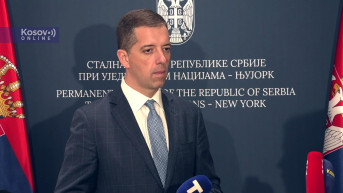
"Kosovo and Metohija are an integral part of our country. According to the Constitution of Serbia, it has never received any validation, after its illegal independence in 2008, in the United Nations or any other relevant forum," said the Serbian Foreign Minister Marko Djuric in an interview with Euronews.
Djuric highlighted that Serbian foreign policy is a complex dance performed in the interest of the current and future generations of our citizens.
"This is a balanced policy that extends a hand of cooperation to countries with different ideological and political profiles," said Djuric, adding that "on the issue of our territorial integrity, we will not compromise. The number of countries that have recognized Kosovo's independence, thanks to activities inspired by President Aleksandar Vucic, has dropped from 116 or 117 at one point to 81 or 82 countries. Thus, 27 countries have withdrawn recognition, and five or six have frozen recognition. There are slight differences in these statistics, but at one point, it was determined during the dialogue process that Pristina would no longer lobby for new recognitions of independence and new memberships in international organizations, Serbia has achieved significant results in winning over the international community to our position," Djuric stated.
The Serbian Foreign Minister emphasized that Belgrade "continues to work hard on winning over even those countries that have recognized and even were founders and establishers of the idea of an independent so-called Kosovo, to recognize that Serbia must have far more rights in Kosovo and Metohija, that the Community of Serb Municipalities must be formed, and that the basic human rights of our people must be respected."
"And this is an ongoing struggle, daily informing about the problems our people face is a task for each of our diplomatic-consular missions," said Djuric.
About Trump's visit to Belgrade
"We would like to see Donald Trump in Serbia. He would undoubtedly be welcomed as a friend in a manner unprecedented for a European country," says Djuric.
He noted that he would like Trump to be the second U.S. president to visit Serbia (Jimmy Carter visited Belgrade in 1980).
"I recently, while in Washington, visited the National Portrait Gallery, where photographs of all the presidents of the United States from its founding to the present are exhibited, saw a photograph of President Carter that I believe was taken during his visit to Belgrade in October 1980. The fact that this visit was so long ago always serves as an argument that a new top-level visit should happen sooner rather than later," Djuric remarked.
He mentioned a detail from September 2020, when he and President Aleksandar Vucic spoke with Trump in the Oval Office.
"He then noted that he respects the Serbian people very much and had a very serious conversation with the president, saying that after winning the elections, he intends to visit Serbia. We will strive to remind the people in the administration of the promise that was given then. And we would certainly like to see Donald Trump in Serbia. He would undoubtedly be welcomed as a friend in a manner unprecedented for a European country," said the Foreign Minister.
Djuric also commented on the change in the American administration. Asked whether Serbs' expectations that America would now fully be on our side were too high, Djuric said that in Serbia, there is a great appetite for a new, different, much closer type of relationship between Serbia and America.
"There is a huge appetite to put aside differences from the past, in order to create a friendship in the interest of the present and future generations in Serbia, as well as the stability of the region, similar to the one that has existed for most of the 143 years of U.S.-Serbian relations. So we at the Ministry of Foreign Affairs will diligently work on that with the new American administration, where indeed I know a number of people personally, with whom both President Vucic and other ministers, Minister Mali and others, have excellent cooperation, to create a new type of relationship," Djuric explained.
He also reminded that Prime Minister Milos Vucevic recently spoke with Trump in Paris during the opening of Notre Dame Cathedral, for whose restoration Serbia has contributed a significant amount of money as a gesture of solidarity with our friendly nation of France.
"Right in that church, our prime minister had the opportunity to have a brief conversation with the elected president of the United States, and I think that, given the fact that President Vucic was among the first ten world leaders to have a telephone conversation with Donald Trump, this leaves us room to believe that we will, if nothing else, have at least a more direct and immediate access to the American administration. Whether this will change the administration's stance on, for example, the issue of Kosovo and Metohija, namely their recognition of the independence of Kosovo and Metohija? No, it will not. I should remind that during the Republican President Bush's term, Kosovo declared independence. Yes, there was bombing and aggression during Clinton's time, but during Bush's term, at the end of his mandate, independence was declared. So, what we can hope for is a constructive approach, a sincere desire to establish friendly relations with Serbia in political, economic, and every other aspect, and then we will negotiate a bit to see who is willing to give what, who is willing to receive in return, I am convinced that we can successfully resolve even the toughest issues with our American partners in the future."
Serbia conducts its own, independent foreign policy
Discussing the daily struggle and whether there is any respite for Serbian diplomacy, Djuric said that Serbia is a phenomenal country that deserves to have a much better image in the international community than it currently does.
"We must be motivated to work daily on improving that image. Because we really have a phenomenal story to tell about a country that, in just over a decade, has reversed a number of negative trends, has gotten its economy back on its feet, and has started to modernize its infrastructure, making great strides forward," Djuric stated.
At the same time, we are a country that is uniquely positioned, not just geographically, but also geopolitically, Djuric added.
"We are a country that conducts its own, independent foreign policy with a strong ambition to become a member of the European Union as soon as possible, to take its rightful place in the family of European nations, where decisions about our fate are anyway made. But at the same time, we have this incredible advantage of having a fantastic network of friendships inherited from the times of the former Yugoslavia with countries in Africa, Asia, and Latin America. And then this imposes an obligation to be so active. A Serbian diplomat must be robustly healthy, highly motivated, and I think we have quite a few such people in our team."
When asked how difficult it is to follow the policy of Aleksandar Vucic, Serbia's cooperation with the East and West, Djuric said.
"This is a policy supported by the overwhelming majority of the citizens of Serbia. I think we have a very sincere dialogue with countries of different ideological and political profiles. I am proud of the fact that during my tenure in the United States, significant progress has been made in bilateral cooperation with a country that is key in the Western civilization to which we geographically, politically, and security-wise belong. However, we have not neglected our relations with other partners. Today, Serbia also profiles itself as a meeting place. Some of the conflicting actors in the international community, although they will not say it publicly, privately talk about seeing Serbia as part of the solution, potentially in some small, maybe technical or logistical role. But definitely as part of the solution, not part of the problem. This was tough to endure, but I must say that the vision Serbia set in February 2022, in the conclusions of the National Security Council, when the invasion of Russian forces in Ukraine led to global geopolitical turbulence, our position has stood the test of time, it is principled, based on the UN Charter, and best reflects our interests."
0 comments