
Djuric: Kurti’s regime’s policy toward Serbs driven by hatred
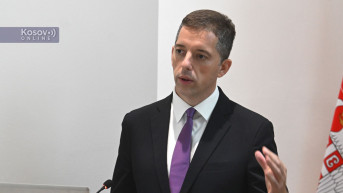
What is happening in Kosovo is horrific and inhumane, and the closure of social welfare centers and the Social and Pension Insurance Fund shows that the policy of Kurti’s regime is driven by hatred toward Serbs, Serbian Foreign Minister Marko Djuric stated.
Speaking to RTV, Djuric stressed that Kurti’s actions go beyond all bounds.
“When you target social welfare centers and the Social and Pension Insurance Fund, you demonstrate that this is not ordinary hostility, but a policy driven by hatred toward Serbs,” he emphasized.
Asked what Serbia is doing, Djuric said that preparations have been underway for years to change the international community’s stance on this issue.
He explained that through daily talks and reporting from Serbia’s perspective on every incident, the situation has reached a point where some countries that once strongly supported Kosovo’s independence are now clearly speaking out against what is happening.
He noted that this shift is visible not only in social media statements.
“The U.S. decision to suspend all strategic dialogue with Kosovo until further notice is a significant step with implications for Kosovo’s political scene. It sends a message to everyone in Kosovo and Metohija that the policy of erasing the Serbian presence, of obstructing normalization, and of unilateral moves and escalation has no support in the international community,” he said.
Djuric added that this should serve as a wake-up call for Albanians, who will withdraw their support from Kurti’s regime.
“As Minister, my job is to secure diplomatic support. But there are other forms of support through different parts of our system. Material assistance to Serbs in Kosovo and Metohija has not only continued under these difficult circumstances but has also increased. And I don’t mean individual stipends; the state has hired additional staff, introduced different support programs, and ensured that what Kurti wants — to cut off Serbs’ lifelines — does not happen,” he stressed.
According to him, Serbian institutions are being forced out on the ground, but they continue to function nonetheless.
Responding to remarks that pensions are being paid in Raska, Djuric said that choosing to continue payments there rather than suspending them entirely is a matter of survival for Serbs.
He recalled that during the current government, 28 countries have withdrawn their recognition of Kosovo, though three unfortunately recognized it.
“We still have some surprises up our sleeve. We have not neglected the issue of international recognition,” Djuric stated.
He underlined that even under the greatest pressure, President Aleksandar Vucic and the Government of Serbia have never accepted and never will accept Kosovo’s independence.
“We will never accept it, not only because it is our formal legal obligation, but because we believe what happened in 2008 was political crime and injustice. The illegally declared independence of Kosovo and Metohija — contrary to international law, Serbia’s Constitution, and without any referendum either in Serbia or even in Kosovo itself — was an insult to the majority of our citizens. It is not just about 13 percent of our territory, but about the very cradle of our identity,” the minister said.
On claims that Serbia, under the SNS government, has given up nearly all authority in Kosovo without gaining the Community of Serb-majority Municipalities, Djuric disagreed. He argued that Serbia did not relinquish authority, but rather that Kurti’s regime forcefully seized it — including offices where such competencies were exercised.
He recalled that in 2011, long before the SNS came to power, the then-government had reached agreements on customs stamps and cadastre issues.
“Those are facts, and we cannot claim they have anything to do with the current government. The Democratic Party at the time created legal frameworks that Pristina used to physically seize some competences. We opposed this,” Djuric explained.
He added that although the Association of Serb-majority Municipalities still does not exist, support for Serbs in Kosovo has not ceased, and peace has been preserved.
“No one could have imagined that partners who once supported Kosovo’s independence would now be closer to Serbia’s positions. That is no coincidence, but the result of serious work,” he stressed.
Asked how this helps Serbs being evicted from their apartments, Djuric said that as someone who led the Office for Kosovo and Metohija for eight and a half years, he feels deeply frustrated by what is happening, but Serbia will not stop fighting until desired results are achieved.
“And that glaring injustice being committed by Albin Kurti’s regime — not the Serbian side — should not be used as a theme or a platform for internal political point-scoring,” he added.
Regarding Article 4 of the Ohrid Agreement, which President Vucic verbally accepted, and which allegedly obliges Serbia not to oppose Kosovo’s membership in international organizations, Djuric said this is an inaccurate interpretation. He recalled that immediately after the Ohrid meeting, the Serbian President clearly and publicly stated what was unacceptable for Serbia.
“For Serbia, Kosovo’s membership in the United Nations is absolutely unacceptable,” emphasized the Serbian foreign minister.
He noted that President Vucic will repeat this next week before the UN General Assembly, as he has every year, continuing to defend Serbia’s position on Kosovo and highlighting the situation of Serbs there.
Asked about the proposed laws to designate Kosovo as a special social protection area and to establish bodies for prosecuting crimes committed in Kosovo — which, according to media, Prime Minister Đura Macuta’s government withdrew from the agenda — Djuric said politics is a matter of timing.
“What was appropriate and useful at one moment might bring more harm than good at another. The issues those laws were meant to address are already regulated to a large extent through decrees, decisions, and other by-laws of the Serbian Government, ensuring social protection. In other words, we choose the moment, manner, and place to act so that our measures are effective both on the ground and in terms of securing critical international support,” he explained.
Asked which states or leaders today better understand Serbia’s position compared to pre-2012, he said anyone following the media can see the dramatic contrast in positions taken by key Western countries.
“For instance, it was unusual until recently for senior German officials to take positions focused primarily on preventing human rights violations against Serbs in Kosovo and Metohija — as happened just yesterday with the German Foreign Ministry’s director for the Balkans. Or the Trump administration’s decision to suspend strategic dialogue with Pristina indefinitely. These developments have serious implications. At the same time, we have consistently retained the invaluable, strong support of Russia, China, and other key countries such as India and Mexico,” Djuric said.
On how to prevent the mass exodus of Serbs to central Serbia, he described it as a huge tragedy.
“Some data suggest that up to 20 percent of people have left due to Kurti’s terror. I could not obtain precise figures, but this is yet another sign that Serbs in Kosovo were not able to participate in census activities on an equal footing. During my tenure as head of the Office for Kosovo and Metohija, there were around 108,000 members of the Serbian community,” Djuric said.
On his earlier remark that in dialogue with Pristina “Belgrade leads 5:0,” and asked what the “score” looks like today, Djuric replied that his comment had been taken out of context. It referred only to a single round of dialogue on energy, telecommunications, and integrated border management.
“But it was put in a grotesque, half-joking context — as if I were an idiot who does not grasp the gravity of Serbia’s position. That remark itself shows how unseriously we sometimes approach debate on Kosovo and Metohija, failing to discuss it in a serious and responsible way,” Djuric said.
Asked whether Serbia’s policy toward Israel would change given genocide accusations, the minister said Serbia must carefully balance its diplomatic stance in line with national interests — preserving ties with Israel, maintaining relations with the Arab world, and helping people in need.
He pointed out that among those in need is Serbian citizen Alon Ohel, who has been held in captivity for over 800 days.
Of course, Serbia also sends aid to others suffering in Gaza, he added.
As for media claims about arms exports to Israel, he reminded that arms export contracts are classified. However, Serbia strictly adheres to UN criteria.
“Serbia never exports weapons to unauthorized end users. The National Security Council has recently been included in the decision-making chain to ensure national interests and international obligations are fully considered,” Djuric explained.
He underlined that thousands of Serbian families live from and work in the defense industry, and stressed that when the UN deems an end user unacceptable, Serbia will respect that decision.
Asked about Serbia’s ambassador in Moscow, who said that some EU states are friendly toward Serbia while others are not, Djuric defended him.
“Ambassador Babic was not wrong when he said Slovakia and Hungary are very friendly toward Serbia. But we must fight to have as many friends as possible and win over those with different views. It is true there are also those who are not friendly toward us,” he said.
He stressed that Serbia is committed to EU membership, which is its national interest, so it can participate equally in foreign and security policy. He recalled that over 70 percent of Serbia’s trade is with the EU.
“If we can achieve this while preserving our national interests regarding Kosovo and Metohija and our other friendships, all the better,” he stressed.
He emphasized the need to distinguish between individual MEPs and the official positions of EU institutions.
Asked about Eurostat research showing little public support for Serbia’s EU membership in many member states, Djuric said it proves the need for two-way dialogue and joint efforts to change perceptions.
“We need to break down prejudices about us in EU countries. The European idea must be based on overcoming prejudices,” Djuric concluded.


0 comments