
Djuric: Under Kurti’s policies, Serbs in Kosovo and Metohija are increasingly labeled as “the others”; the report fails to mention their silent exodus
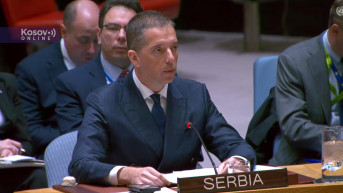
Serbia’s Minister of Foreign Affairs, Marko Djuric, stated today at a session of the United Nations Security Council on Kosovo that, under the policies implemented by Albin Kurti, Serbs in Kosovo and Metohija are increasingly being marked as “the others,” and that their identity is used as a basis for restricting their rights, limiting their freedom of movement, and targeting their homes, property, and religious sites. He emphasized that arrests, attacks, and administrative pressures are not isolated incidents, but rather constitute a systematic pattern of marginalization that must not be ignored. He also pointed out that it is particularly concerning that the report of United Nations Interim Administration Mission in Kosovo does not mention the quiet but continuous exodus of Serbs. He underlined that UNMIK’s role must not be diminished, but strengthened, stressing that the mission is not only relevant, but irreplaceable on the ground. He added that Kosovo Force must remain the only legitimate and credible security force on the ground, fully in line with its mandate.
At the outset of his address, Djuric thanked António Guterres and his Special Representative Peter Due for the presented report and their continued engagement in implementing UNMIK’s mandate in accordance with United Nations Security Council Resolution 1244.
He noted that Serbia remains particularly grateful to all members of the mission, as UNMIK’s presence serves as a key guarantee of peace, stability, and the protection of the fundamental human rights of Serbs in Kosovo.
“At a time when there are calls to reduce UNMIK’s budget and alter its mandate, Serbia sends a clear and unequivocal message: the presence and role of this Mission must not be weakened, but strengthened. Let me be absolutely clear—under the current circumstances, UNMIK is not only relevant, it is indispensable. Its mandate, based on Resolution 1244, has not been fully implemented. This is not a technical issue. It is an issue that directly affects the security, rights, and everyday lives of people on the ground. Serbia remains firmly committed to supporting such a role. Any discussion about its future must be strictly guided by realities on the ground—not assumptions that may not reflect the lived experience of communities,” Djuric stated.
He stressed that, at a time of growing global uncertainty and crises in various regions, it is particularly important for the Security Council to remain grounded in facts and clearly understand the situation on the ground. He noted that UNMIK continues to play a stabilizing role, not only through reporting, but through its very presence, as its mandate under Resolution 1244 remains essential for ensuring impartial oversight, especially when unilateral actions risk undermining the balance achieved over the years.
“Today I address you not only as a representative of Serbia, but as a voice for those who live in fear, uncertainty, and constant pressure in Kosovo and Metohija. Repression of communities does not occur overnight—it unfolds in recognizable stages. And those stages are, unfortunately, clearly visible in the position of Serbs in Kosovo and Metohija today. I stand before you not to win an argument, but to contribute to solving a problem. Serbia is not part of the problem—we are part of the solution,” Djuric said.
He added that he also speaks on behalf of those who feel intimidated, mothers and daughters of those wrongfully detained, and individuals who are labeled, marginalized, and pressured simply because of who they are.
“What we are witnessing is not a series of isolated events. It reflects a broader and deeply troubling pattern. And this is a matter of principle,” Djuric emphasized.
He warned that, in many ways, such a pattern bears disturbing similarities to dynamics that preceded serious conflicts in the past, and that although circumstances are not identical, the trajectory should not be ignored.
“When rights are gradually eroded and pressure becomes normalized, instability does not appear suddenly—it is built step by step. As Martin Luther King Jr. reminded us, ‘injustice anywhere is a threat to justice everywhere.’ Therefore, what we are discussing today is not merely a regional issue. It directly concerns international norms, the protection of human rights, and the shared responsibility we all bear in preventing instability before it escalates. For decades, the international community has invested in building mechanisms to protect minorities and uphold the rule of law in post-conflict settings. Circumventing these mechanisms sets a dangerous precedent far beyond the Western Balkans,” he noted.
He pointed out that the reality today is one in which identity itself has become a source of insecurity.
“Under the policies implemented by Albin Kurti, Serbs in Kosovo and Metohija are increasingly labeled as ‘the others,’ and their identity is used as a basis for restricting their rights, their freedom of movement, and for targeting their homes, property, and religious sites. Arbitrary arrests, attacks, and administrative pressures are not isolated incidents—they form a systematic pattern of marginalization that we cannot and must not ignore. The United Nations were not created to remain silent in the face of injustice. Their role is to ensure respect for international law and to protect individuals and groups whose rights are denied. For that very reason, what is happening today in Kosovo and Metohija is not just a regional issue—it is a matter of shared responsibility and a test of the credibility of the rules-based international order,” Djuric stated.
He cited data which he described as deeply concerning, noting that since the beginning of the year, arrests and attacks have continued, indicating not coincidence but a pattern of pressure and a climate of impunity.
He stated that Serbs face restrictions on freedom of movement, arbitrary arrests, attacks on property, and the desecration of religious sites, while attacks on the Serbian Orthodox Church strike at the core of cultural and spiritual identity.
“Particularly concerning are attempts to enter social, healthcare, and educational institutions, as they directly threaten the basic functions necessary for the survival of the community. Restrictions on freedom of movement are systemic, not incidental. Humanitarian worker Milorad Arlov from Banja Luka is just one of countless individuals who have been denied entry to Kosovo and Metohija. Even the Patriarch of the Serbian Orthodox Church was prevented from visiting the seat of his Church. These are not merely administrative obstacles—they represent deliberate signals that certain identities are unwelcome or subject to conditional approval. This is not about procedure—it is about principle,” Djuric stressed.
He added that such actions send a message that rights are conditional and that identity determines access, and that even humanitarian work and religious duties can be obstructed.
He also recalled the shooting of Serbian boys in Strpce on Orthodox Christmas as a deeply disturbing act that still resonates, noting that responsibility has yet to be clearly established and that such incidents undermine not only individual security but also the collective sense of belonging.
He further highlighted a series of coordinated measures affecting the daily lives of Serbs:
“The unilateral ban on the Serbian dinar disrupts economic life and forces pensioners, families, and small businesses to live in uncertainty, struggling to access funds or conduct everyday transactions. Many elderly citizens now face long journeys to the administrative boundary just to receive their pensions, turning what should be routine into a source of humiliation. There is systematic pressure on Serbian institutions in healthcare, education, and social services, leaving patients without reliable care and students uncertain about education in their mother tongue. Arrests raise serious concerns regarding due process and proportionality. Land in northern Kosovo and Metohija has been seized for mono-ethnic special police bases, often without transparency and outside agreed frameworks.”
He emphasized that these are not isolated decisions, but a continuous pattern of pressure.
“For many, this is not about politics—it is about whether they can live normally, raise their children, and remain in their homes. When the basic conditions for a dignified life no longer exist, people leave—not by choice, but out of necessity. This gradual demographic change, driven by sustained pressure rather than voluntary migration, risks fundamentally altering the multiethnic character of Kosovo and Metohija. And this does not affect only Serbs—the Gorani community faces increasing marginalization, while the Bosniak community is sidelined, with growing concerns about quiet assimilation. This is becoming a structural issue that threatens the very fabric of coexistence. I repeat—this is a matter of principle,” Djuric stated.
He stressed that the situation has further deteriorated over the past six months, as instead of progress toward normalization, developments have deepened distrust and intensified insecurity.
“This raises a fundamental question: what kind of future can we expect in a society where people are targeted because of who they are and where there is no justice? Without accountability, there can be no trust; without trust, there can be no stability; and without stability, there can be no lasting peace,” Djuric said.
He pointed out that it is particularly alarming that the report fails to mention the quiet but persistent exodus of Serbs.
“In a very short period of time, around 20 percent of the Serbian population has left Kosovo and Metohija under pressure. This is not a statistic—it is an exodus. And it is our shared responsibility to stop it,” Djuric stated.
He noted that legislative initiatives, such as the draft Law on Foreigners, have caused deep concern among Serbs in Kosovo, as there was a real risk that people who had lived and worked there for decades could be treated as foreigners, losing their right to residence, work, and even to remain in their homes. Such measures, he said, are not only legally questionable but reflect a broader pattern of attempting to reshape reality through administrative means, while Serbs face increasing legal and administrative barriers in everyday life.
“In such circumstances, justice must be administered in a consistent, impartial manner firmly grounded in the rule of law. However, we are witnessing numerous cases of arbitrary and legally questionable arrests of Serbs, often based on unreliable testimonies related to alleged war crimes. In such proceedings, not only is the legal basis often doubtful, but the fundamental rights of detainees are seriously undermined. Instead of contributing to justice and reconciliation, such practices create fear, hinder the return of displaced persons, and undermine legal certainty,” Djuric said.
He emphasized that previously reached agreements are not being respected, noting that more than 13 years have passed since the First Brussels Agreement was signed, yet it remains unimplemented, and that a key obligation undertaken by Pristina “has not come close to being fulfilled.”
“The establishment of the Association of Serb-majority Municipalities has been delayed for nearly a decade and a half. This is not merely a matter of time—it is a matter of credibility, trust, and respect for commitments formally undertaken. Without implementing what has already been agreed, it is difficult to speak of genuine progress or sustainable normalization. In this way, Kosovo Serbs remain without the institutional framework guaranteed to them through dialogue, which undermines both trust and the credibility of the process,” the minister warned.
He also pointed to the Washington Agreement, brokered by Donald Trump, stating that its approach was visionary as it placed economic cooperation at the center, offering a pragmatic path forward based on connectivity rather than confrontation.
“That spirit must not be lost—reviving elements of economic integration, freedom of movement, and practical cooperation could bring tangible benefits to all communities,” Djuric said.
He further noted that, in addition to difficult security and living conditions, Serbia must express particular concern over the continuous targeting of Serbian cultural and religious heritage, as the desecration of religious sites and cemeteries is not merely vandalism but a direct attack on identity, dignity, and fundamental human rights.
He also mentioned the stoning of a bus carrying Serbian Orthodox pilgrims in southern Kosovska Mitrovica in September last year, stating that it was not a random act but a targeted attack on individuals exercising their basic right to freedom of religion.
“The continued targeting of cultural and religious heritage remains deeply concerning. This is not vandalism—it is an attempt to erase identity and continuity. When churches are attacked, cemeteries desecrated, and pilgrims targeted, it undermines coexistence itself,” Djuric said.
He also drew attention to the accelerated process of militarization in Kosovo, noting that the strengthening of the Kosovo Security Forces, accompanied by the acquisition of modern weaponry, cannot be viewed as a neutral process.
“Especially in the context of a stalled dialogue, this alters the security balance, increases uncertainty, and raises the risk of escalation. Such developments, particularly when carried out without transparency and without full respect for international obligations, undermine efforts to maintain stability and call into question the credibility of existing security mechanisms. Let me therefore be clear: KFOR must remain the only legitimate and credible security force on the ground, fully in line with its mandate. At a time of growing global uncertainty and transformation of the international order, the fragile stability in Kosovo and Metohija must not be jeopardized. Under such circumstances, only KFOR can guarantee security on the ground. Combined with non-transparent cooperation with certain regional actors, these developments raise serious concern,” Djuric stated.
He concluded by saying that all these phases clearly illustrate a pattern of actions pursued by Albin Kurti.
“We are witnessing a deliberate approach in which crises are not accidental—they are created. Red lines are continuously pushed further by fueling tensions on the ground. And then those same crises are only partially de-escalated, just enough to present an illusion of restraint. But let us be clear: red lines are never returned to their original position—they are only pulled back a few steps, while the new reality remains altered,” Djuric said.
He added that this can be addressed by reaffirming the central role of the United Nations.
“For the Republic of Serbia, the United Nations remain the most relevant forum for ensuring justice and international order. We need more—not less—UN engagement. And we need full respect for binding decisions, including Resolution 1244. This resolution is not merely a document—it is one of the most important legal frameworks for resolving the issue of Kosovo and Metohija. Its provisions must be implemented, not merely invoked,” Djuric stressed.
He concluded by emphasizing the need to look to the future, overcome outdated divisions, and focus on opportunities for cooperation.
“But let me be equally clear: instead of insults and accusations, we extend a hand of cooperation—to the Albanian people. We do not believe our peoples are destined for conflict. We believe that through dialogue, economic cooperation, and mutual respect, a different future is possible. Once again—Serbia is not part of the problem; we are part of the solution. Serbia remains committed to dialogue. Serbia remains committed to peace. Serbia remains committed to international law and the full implementation of all agreements reached. The United Nations, including UNMIK, have an important role in ensuring accountability and objective reporting—but sustainable normalization must be built through implementation, dialogue, and trust. Serbia is ready to work constructively with all partners to find a comprehensive, mutually acceptable, and lasting solution that respects the rights and security of all communities. The Republic of Serbia remains firmly committed to peace, dialogue, and international law. But let us be clear: without accountability there is no justice; without justice there is no trust; and without trust there is no lasting peace,” Minister Djuric concluded.

0 comments