
Djuric: Serbia committed to stability, peace and dialogue; Gerapetritis: Greece firm on non-recognition of Kosovo
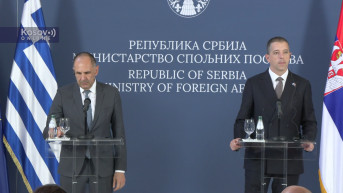
Serbia remains committed to stability, peace and the rational pursuit of solutions through dialogue, while at the same time firmly safeguarding its national interests, the rights of the Serbian people, and the rights of the Serbian Orthodox Church, Serbian Foreign Minister Marko Djuric stated today. Greek Foreign Minister Giorgos Gerapetritis reiterated that Greece remains steadfast in its policy of non-recognition of Kosovo and firmly anchored in international law.
Speaking at a joint press conference with Minister Gerapetritis, Djuric said he had briefed his Greek counterpart on the situation and position of the Serbian community in Kosovo.
“Today, we expressed our gratitude to our Greek friends for their consistent support for Serbia’s territorial integrity and sovereignty. I took the opportunity to inform our guests about the situation and position of the Serbian people in Kosovo and Metohija. It is very important to understand that Serbia is committed to stability, peace, and the rational pursuit of solutions through dialogue, while at the same time remaining firmly dedicated to preserving its national interests and protecting the rights of the Serbian people and the Serbian Orthodox Church,” the Serbian foreign minister said, noting that Orthodox Christianity, as the majority religion in both countries, is one of the bonds connecting the two nations.
Djuric added that discussions with his Greek counterpart also covered key regional issues.
“At the meeting we held with President Aleksandar Vucic, we underlined the historic friendship between our two nations and states, marked by centuries of mutual support and understanding across different eras. We discussed a future that is European for both Serbia and Greece, with Serbia counting on the strong support of its Greek friends as it seeks to take its rightful place at the table of European nations in Brussels as soon as possible. We are grateful for Greece’s support for Serbia’s European path, just as we are grateful for our excellent economic relations,” Djuric said.
He recalled that bilateral trade over the past 12 months had exceeded €2.2 billion, benefiting the budgets, citizens, and institutions of both countries.
“At the beginning of our meetings, we noted that nearly a quarter of Serbia’s population spends its holidays in Greece. We want that number to continue growing, and we are proud of the friendship we share. I encourage as many Serbian and Greek tourists as possible to visit each other’s countries, to visit Belgrade, a city of two million people and a historic capital that is home to monuments dedicated to Rigas Feraios,” Djuric emphasized.
He also thanked Greece for being among the participating countries at Expo 2027 in Belgrade.
“For us, this exhibition is an opportunity to change the paradigm through which Serbia is perceived in the world. We expect around 137 countries that have already confirmed their participation. This will certainly be the largest Expo ever held, and Greece will have a special place at the exhibition,” Djuric stressed.
The two ministers also discussed ways in which Serbia and Greece could contribute to strengthening regional cooperation.
“Serbia is always ready to contribute to regional cooperation and good relations, including through joint efforts to improve infrastructure. We hope to achieve further progress in mobility and easier border crossings in the near future, which our two governments are working on together,” Djuric added.
He emphasized that the visit was particularly significant in light of the friendship between Serbia and Greece, noting that there is hardly a Serbian citizen who does not view Greece with special affection.
Gerapetritis: Our Position on Kosovo Remains Consistent and Firmly Anchored in International Law
Greek Foreign Minister Giorgos Gerapetritis reaffirmed that Greece remains consistent in its position of not recognizing Kosovo and firmly anchored in international law.
“Today, I reaffirmed Greece’s position regarding the status of Kosovo, which remains unchanged. We support the Belgrade–Pristina dialogue under EU facilitation. Greek foreign policy remains firmly grounded in international law, the principles of which we will continue to uphold as a non-permanent member of the United Nations Security Council,” Gerapetritis said.
He noted that one of the main topics of discussion was Serbia’s European perspective, which Greece regards as a geopolitical imperative for the stability and prosperity of Europe as a whole.
“We recognize the significant progress Serbia has made in fulfilling its obligations, and we would like to emphasize the importance of accelerating reforms. We place great hope in Serbia, in the future, and in the peace and prosperity of the region,” Gerapetritis said, stressing his strong support for the European perspective of the Western Balkans based on merit, respect for the EU acquis, international law, and good-neighborly relations.
He recalled that the Thessaloniki Agenda, adopted in Greece in 2003, envisaged the integration of the region into the European Union, based on the conviction that this process represents a strategic investment in the security and stability of the European continent.
“The signing of the Delphi Declaration in Athens this April further underscored that the path toward EU membership is irreversible and that enlargement must regain momentum and credibility. During Greece’s presidency of the Council of the European Union in the second half of 2027, regional European integration will be among our priorities, and we will work toward tangible progress,” Gerapetritis emphasized.
He noted that Serbia-Greece relations are already at a high level, thanks in part to the High-Level Cooperation Council, and that today’s talks contributed to efforts aimed at further deepening bilateral ties.
According to Gerapetritis, cooperation between Serbia and Greece continues to show remarkable momentum, with trade reaching record levels.
He also highlighted the strategic importance of the Thessaloniki–Skopje–Belgrade railway connection, which has the potential to transform the region and strengthen its connectivity with the rest of Europe. In addition, he pointed to the significance of gas interconnections among Greece, Bulgaria, and Serbia, which contribute to energy security, diversification of supply sources, increased resilience, and enhanced collective capacity to respond to external threats.
He recalled that Greece has already signed an agreement confirming its participation in Expo 2027 in Belgrade.
The ministers also exchanged views on current geopolitical developments, including the conflicts in Ukraine, the Middle East, Gaza, Lebanon, and Iran. Gerapetritis expressed condolences over the death of a member of the Serbian Armed Forces serving in the UNIFIL mission in Lebanon.
“Greece calls for respect for international law, including international humanitarian law, and for intensified efforts toward diplomatic solutions. The peoples of the Balkans understand better than anyone the value of peace, dialogue, and cooperation. We will continue to draw strength from the timeless vision of cooperation among the nations of the Balkans and work together toward a region defined by stability, prosperity, and shared progress,” Gerapetritis stated.
Thanking Minister Djuric for his hospitality, he described him as an outstanding foreign minister who has contributed to improving Serbia’s image abroad and told his Serbian counterpart that he is always welcome in Greece.
Europe Needs the Western Balkans
Asked by a journalist why now is the right time for EU enlargement in the Western Balkans, Djuric replied that bringing the region closer to the European Union is a geopolitical necessity.
“It is a decision that will strengthen Europe and unlock enormous potential. Facilitating the movement of people, goods, and capital across borders creates new added value. It will also make Europe more secure, because the region still faces many historical issues that are best addressed within a European framework. There is so much talent and economic potential in the region that will make Europe more consolidated and stronger,” Djuric said.
He argued that the only way to ensure lasting peace and consolidate Europe’s geopolitical position is to integrate the entire Balkans into the European project.
“For both Serbia and Europe, this would be a win-win situation,” Djuric said, thanking Greece for supporting Serbia’s and the region’s accession to the EU.
Minister Gerapetritis added that it is important for a region historically marked by turbulence and nationalism to remain firmly oriented toward Europe.
“There are many threats and risks across the world, and wars surrounding Europe. Under such circumstances, it is important that we remain united and strengthen ourselves. Europe needs the Western Balkans. It is not only a question of the Western Balkans benefiting from EU membership; it is equally important to understand that, in challenging times, we must strengthen new regions, particularly this one, which has historically been at the heart of Europe. We cannot imagine Europe without the Western Balkans,” Gerapetritis concluded, recalling that Greek Prime Minister Kyriakos Mitsotakis had called for the opening of Cluster 3 in Serbia’s EU accession negotiations.

0 comments