
Djuric: Serbia is ready for the EU; It is important that we also heard from officials of member states a renewed commitment to EU enlargement
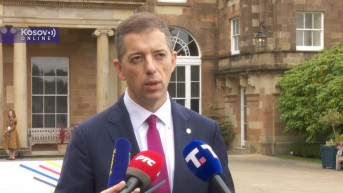
The Minister of Foreign Affairs of Serbia, Marko Djuric, stated today, following the meeting of foreign ministers participating in the Berlin Process at Hillsborough Castle near Belfast, that Serbia sent a strong message that it is ready for the European Union—but on an equal footing—and emphasized that it is positive that from some of the highest officials of EU member states there was a reiterated commitment to the Union’s enlargement. Djuric said that discussions covered the European integration of the region, as well as, in detail, the situation in Bosnia and Herzegovina and relations between Belgrade and Pristina, along with a range of other issues, stressing that, as always, he took the opportunity to present the facts.
Djuric told reporters that, behind the closed doors of the castle, foreign ministers from the Balkans, the EU, and the host, the United Kingdom, discussed a number of topics, above all European integration, noting that it is very important for Serbia to have the prospect of obtaining an equal place at the European table.
He added that, in the run-up to the visit of European Commission President Ursula von der Leyen to the Western Balkans, there was also discussion of how to accelerate the European integration of the region.
Djuric said that the sensitive topic of reconciliation in the region was also discussed.
“Many of us carry the pain of past wars; there is no family that has not been touched by what happened. But it is very important that we seek a path to cooperation. We have tried to proceed in a different way—not with the idea of quarreling or pointing fingers, but with a responsible focus on the future of the region, which must safeguard the younger generation and harness its potential,” the Serbian foreign minister underlined.
Recalling that Serbia has managed to double its economy in less than a decade, he stated that it is crucial for the country to have open channels of cooperation with its neighbors.
“There was also discussion of the challenges of the future. I spoke about our chairmanship of the Global Partnership on Artificial Intelligence (GPAI) and about the challenges that AI will bring to the economy, as well as to the information sphere and political processes in the region. We must anticipate all of this in advance and address it in an orderly manner,” Djuric said.
He noted that there was extensive discussion of concrete regional problems and topics, but that not all of his colleagues adopted a constructive, future-oriented approach.
“I am not here to call anyone out publicly, as that would not serve the purpose and objective of the gathering. What citizens should know is that Serbia adopted a responsible, forward-looking approach. Our hosts did an exceptional job of bringing us closer to the peace process in Northern Ireland that led to power-sharing between what were once completely and unimaginably distant communities—Protestants and Catholics—and their political representatives. Today, the walls of this castle are adorned with images of political leaders who, until 1998, were literally warring parties in a conflict that claimed thousands of lives. I hope this can serve as an example for resolving some of the problems in our own region,” Djuric said.
Responding to the observation that the host, UK Foreign Secretary Yvette Cooper, mentioned the 30th anniversary of the Dayton Agreement, Djuric said that there was, in detail, discussion of the situation in Bosnia and Herzegovina and of relations between Belgrade and Pristina, as well as of a host of other issues, emphasizing that he always takes the opportunity to present the facts.
“There was a great deal of passion in some of the interventions, but we confined ourselves to the facts and a constructive approach,” the Minister added.
He went on to say that he, like the President of Serbia, Aleksandar Vučić, and every member of the Government of Serbia, not only defends Serbian national interests at every turn, but also keeps in mind the responsibility to contribute to preserving stability in the region as a key precondition for economic development and for safeguarding the younger generation—seeking, as it were, to forge ‘a kind of marriage’ between pragmatism and values.
“In that sense, I am satisfied that Serbia has indeed sent from here a strong message that it is ready for the EU—but for an equal place at the table. We do not want to be in the last carriages; rather, we deserve, and belong, to sit as equals at the table where decisions are made on security, political and other issues in Europe,” Djuric stressed.
Commenting on the statement by German Foreign Minister Johan Wadeful that the EU must take concrete steps and that the Western Balkans belong in the EU, Djuric emphasized that it is encouraging that from some of the highest officials of EU member states one could hear a renewed commitment to the Union’s enlargement, as they recognize that global turbulence is such that, without greater European unity, not only will the Balkans remain the “Achilles’ heel” of the continent, but—should Europe fail to become more united and more tightly gathered—the continent risks becoming a chessboard for the geopolitical contest of the great powers.
He pointed out that Serbia lies at the central crossroads of Southeast Europe and that, without Serbia as an equal at the table, there can be no completion of Europe’s unification process.
“We are an old and proud people; we accept only an equal place—not the second or third row. We gave millions of lives for Europe’s freedom in the 20th century, and today we contribute economically, culturally, and in other ways. We are a dignified, responsible, and serious nation that contributes to the stability of the region,” Djuric stated.
He added that he is always pleased when Serbia is invited, as it was today, to participate on an equal basis in discussions on European issues.
“I am satisfied that today’s summit was attended by the foreign ministers of Germany, the United Kingdom, and a number of EU member states from the neighborhood. I discussed with them the results that Serbia is achieving in the economy and in reforms. Serbia not only does not lag behind the countries of the region, but—in terms of the economy, external debt, and even living standards—is at the level of, and in some respects ahead of, countries that became EU members more than 15 years ago,” Djuric noted.
0 comments