
Djuric: Serbia supports the work of the OSCE, we expect it to support the rights of Serbs in Kosovo
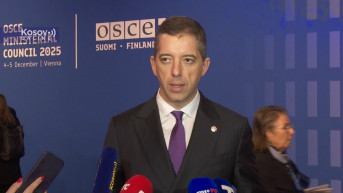
Serbia supports the work of the OSCE, supports peace and all peace initiatives, as well as adherence to the fundamental principles of the Helsinki Final Act—because it is better to preserve the OSCE, multilateralism, and respect for the territorial integrity of states today, than for future generations to be forced to rebuild these principles on the ruins of conflict, said Serbia’s Foreign Minister Marko Djuric today from Vienna, where the OSCE Ministerial Council is taking place.
Djuric told reporters that, in his address before his colleagues, he drew attention to the position of Serbs in Kosovo, calling on the OSCE to uphold the human rights of the Serbian people, who, he stressed, are the most endangered community in that territory.
“The OSCE Ministerial Council is extremely important for us. The OSCE was founded to preserve stability, security, and a cooperative environment in Europe. It established rules, instruments, and institutions intended to ensure Europe’s security architecture,” Djuric said.
He emphasized that we are all witnesses to the fact that security in Europe has been seriously undermined and that peace has become a distant concept—something unimaginable for generations born in Europe, outside the Balkans, after the Second World War.
“Because of this, and because of everything happening in the world, and because of our Kosovo and Metohija, Serbia strongly supports the OSCE’s work. It is necessary to preserve the OSCE as a cooperation mechanism and to ensure that the Helsinki Final Act and other documents guaranteeing territorial integrity and equality in cooperation are upheld. It is better to safeguard these principles today than to force new generations to rebuild them after conflicts and wars. That is why our message here is that we support peace, the OSCE, and all peace initiatives—just as I have supported President Donald Trump’s peace initiative—and that we remain committed to principles,” Djuric underscored.
He added that he presented facts at the meeting about the difficult situation of Serbs in Kosovo.
“They are being denied even the right to vote, among other rights, and Serbia today is a victim of this. We expect the OSCE missions in Belgrade and Pristina to support human rights for all, and especially for Serbs in Kosovo and Metohija, as they are the most endangered community,” the Serbian Foreign Minister said.
Asked whether Serbia’s European path and the opening of Cluster 3 were among the topics discussed with numerous officials in Vienna, Djuric replied that this is indeed one of the most important issues.
“We are discussing Serbia’s European path here. I met with the French and British ministers, and we have additional meetings ahead with a number of other officials, as well as many informal meetings with European ministers. It is important that Serbia’s efforts in carrying out reforms over the past years be recognized—the very efforts that led the European Commission to recommend, for five years in a row, the opening of Cluster 3,” he said.
Djuric emphasized that Serbia needs a positive political signal, as it has made consistent efforts over the years—especially in recent months—to fulfill what was agreed with the Commission and deliver on what was requested.
“It would be good to send a positive signal to Serbian society that it is welcomed, accepted, and treated equally in Europe—that ideology or political criteria will not, God forbid, outweigh merit, the strength of our economy, which has doubled under President Aleksandar Vucic, or our infrastructure and institutions, which—despite all shortcomings—are stronger than those of some states when they joined the EU,” Djuric said.
Satisfied With Washington Visit: Serbia–U.S. Relations Are Steadily Developing
Speaking about his recent meetings with U.S. officials in Washington, Djuric said he was very pleased with the visit and that Serbia–U.S. relations are steadily improving.
“Some self-appointed critics who wouldn’t even know how to order a can of Coca-Cola in Washington are the ones worrying about Serbian–American relations,” Djuric remarked. “I am very satisfied with the visit, which took place at a time when several other foreign ministers were also in Washington. Yet I was the only one to have a meeting with the Deputy Secretary of State, since Marco Rubio was not even in Washington—he was dealing with issues related to Ukraine, Venezuela… I am happy that in just three months I met Secretary Rubio twice, and especially pleased with the close cooperation with Christopher Landau, thanks to which we were able to make progress in the interest of the Serbian people, including regarding the Republic of Srpska and Bosnia and Herzegovina.”
He added that he met with nine or ten key members of Congress, from different parties.
“We reached agreement on some issues, disagreed on others, but Serbia–U.S. relations are being steadily built. Many people are working seriously to advance them. I am pleased to say that our relations are growing significantly and I expect the coming period to be marked by strategic dialogue, as Rubio and I announced. This is in everyone’s interest, regardless of political affiliation,” Djuric said.
One of the topics discussed, he noted, was the situation involving the Petroleum Industry of Serbia (NIS).
“The situation surrounding NIS is complicated. Our request and expectation is that Serbian interests be more strongly taken into account. We must build and strengthen the Serbian lobby, the Serbian caucus, and Serbia’s positions. That work never ends. It is a mistake to think that relations can be built without continuous presence in Washington,” Djuric noted.
On Helez’s Statements: Uncultured and an Enemy of Bosniak, Serb, and Croat Interests
Responding to a question about the latest statement from Bosnia and Herzegovina’s Defense Minister Zukan Helez regarding the so-called “Sarajevo Safari” and alleged participation of Serbia’s President, Djuric said Helez is “uncultured in his statements” and acts as an enemy of the Bosniak, Serb, and Croat peoples alike.
“I do not understand why Helez uses hatred as a political tool—it harms his own country. I will not respond in the same manner, but I will say that Helez is an enemy of the interests of all three peoples, he is uncultured in his remarks, and he does not contribute to improving or normalizing relations in the region,” Djuric said.
Serbia, he emphasized, acts differently—but he will propose to President Vucic that Helez also be included in the lawsuits being prepared for spreading falsehoods.
“President Vucic is targeted with lies as a means to diminish Serbia’s standing. Helez and all those who spread such falsehoods should be sued, because this is an offense against the interests of reconciliation, normalization, and stability, and deeply contrary to the interests of all three peoples in Bosnia and Herzegovina. No nation is our enemy, but I will raise my voice against harmful policies. I hope Helez will recognize how improper and damaging his conduct is,” Djuric added.

0 comments