
Djuric: Serbia's global diplomatic campaign for the survival of Serbs in Kosovo has begun
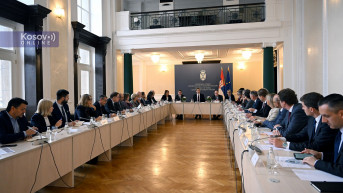
Serbian Foreign Minister Marko Djuric met today with ambassadors of European Union countries in Serbia, informing them about the violations of human and political rights of Serbs in Kosovo and the abuses by Albin Kurti's ethnonationalist regime, as well as about the steps Serbia plans to take, as announced by President Aleksandar Vucic in his recent address.
After the meeting, Djuric stated that a global diplomatic campaign has begun today for the salvation, survival, and rights of the Serbian people in Kosovo, with dialogue being the instrument for achieving this survival.
"Last night's address by President Vucic marked a new era and phase in the fight for Serbian interests in Kosovo and Metohija, as well as the fight for the rights of our people. It highlighted new investments by the Serbian government in the economic sustainability of our community through special assistance for our people living in Kosovo and Metohija, who cannot exercise their employment rights on a monthly basis," said Djuric.
He mentioned that there has been a final "filtering" of various forms of aid that hadn't reached Serbs in Kosovo because some individuals, registered as living in Kosovo, were actually residing in central Serbia and benefiting from the aid.
"This will correct a long-standing injustice toward our people, which is of great significance," Djuric said.
He also reminded that a decision has been made to adopt a law establishing a special prosecutor's office that will prosecute and punish those who violate the human rights of Serbs in Kosovo in the most brutal way.
"Particularly those representatives of Kurti's regime who have, in recent months and the past two years, been involved in the torture and mistreatment of our people," the minister said, recalling the more than 80 people imprisoned for peaceful political and democratic activism, many of whom are, in the true sense of the word, political prisoners.
"This will bring justice to those who have had no other means of seeking help for the infringement of their property or human rights. It is a critical step in applying pressure on a regime that has shown no respect for its own institutions or laws," Djuric said.
He emphasized that Serbia has risen to defend the legacy of the dialogue between Belgrade and Pristina, focusing primarily on the urgent establishment of the Community of Serbian Municipalities, which remains a central point, but includes several other aspects as well.
"We demand that Serbs in Kosovo and Metohija be allowed to have their own police region in the north, as provided for by the Brussels Agreement, with over 700 police officers who had to leave those institutions under difficult circumstances, and that they be allowed to return to work," Djuric said.
He added that Serbs have the right to their own regional police directorate and a regional police commander, appointed by representatives of the Serbian people, democratically elected.
"We demand free, democratic elections in the north of Kosovo and Metohija. We no longer want Kurti's mayors, from the Albanian community, in municipalities that are 98% Serbian. They not only damage inter-ethnic relations but also threaten the survival of the Serbian people in Kosovo and Metohija," noted the Serbian foreign minister.
Djuric said that Serbia's demands are rational, serious, and carefully formulated.
"I had a good conversation with the ambassadors of European countries, and I heard many words of support for Serbia's decision to stand up for its people, their human rights, and for the wise decision to protect the dialogue from Kurti's regime, its one-sidedness, and irrational, uncoordinated actions," Djuric said.
According to him, the measures presented by President Aleksandar Vucic aim to protect Serbs in Kosovo and Metohija, preserve dialogue as the key instrument for normalizing the situation on the ground, remove the catastrophic consequences of Albin Kurti's actions, which have trampled on the collective human, political, and economic rights of Serbs, and make it easier for our people to remain in the southern province.
"A special session of the Serbian government on Kosovo and Metohija today aims to ensure that these measures reach the people as soon as possible, that additional material support quickly arrives for the people in Kosovo and Metohija, and that the legislative process is initiated for a special prosecutor’s office which will finally prosecute and punish those associates of Kurti who were involved in torture, mistreatment, and severe abuses in Kosovo and Metohija, holding them criminally responsible in accordance with international law and the principle of complementarity," Djuric explained.
According to him, Serbia will prosecute those who tortured and abused Serbs, as well as those who assisted them, regardless of whether they are Serbs—since, unfortunately, there were some—or Albanians.
"I believe that, amid all the heavy and bad news coming from Kosovo and Metohija for months and years, this decision and these measures from President Vucic and the Serbian government finally represent good news for the Serbs," the Serbian foreign minister said.


comments