
Djuric: Serbs must teach Kurti’s regime a lesson in the local elections
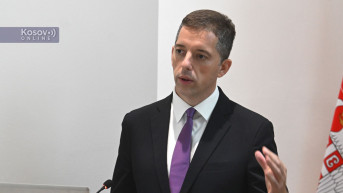
The local elections in Kosovo on October 12 are an opportunity for Serbs in the north to regain control over the municipalities with a Serbian majority and to prevent the regime of Albin Kurti from taking over municipalities with a Serbian majority in the south of the province, said Serbian Foreign Minister Marko Djuric, calling on Serbs to go to the polls and “teach Kurti’s regime a lesson.”
“These elections are of vital importance for the survival of the Serbian people in Kosovo and Metohija. Therefore, taking part in them is both a national and patriotic duty of every citizen — and a family obligation for anyone who wants to see their basic interests and those of their family protected. I am firmly convinced that Kurti does not want the Serbs to vote on October 12 — he wants them to stay home, allowing people like Hetemi and Atiqi to retain control. That’s why we must go to the polls, to teach Kurti’s regime a lesson in Serbian defiance, unity, solidarity, and love for our homeland,” Djuric said in an interview for Politika.
He added that he often points out to European partners that the attitude of certain countries toward Kosovo is “not the best advertisement for the European project.”
When asked whether, in the event of EU enlargement, he sees Serbia “on that train,” Djuric said that the European Union is a “beautiful idea” that needs to evolve politically, economically, and in terms of security in order to meet the continent’s needs.
“I am completely certain that the Union cannot be successful unless it becomes truly united — and that includes the membership of Serbia and other countries in the region,” he emphasized.
Djuric noted that global turbulence is now so great that Europe cannot afford to waste time on bilateral political disputes that some member states continue to provoke, thereby slowing the enlargement process.
He pointed out that Serbia is often accused of having “divided opinions” about the EU, while Eurobarometer and Eurostat findings show that in some EU member states there is no full readiness to admit the Western Balkan countries — even if they were to meet all requirements.
“That’s a challenge we must face together. Serbia has a lot to offer — above all, seven million hardworking, capable people deeply rooted in European culture and identity,” Djuric said.
He stressed that the EU’s treatment of the Kosovo issue has indeed affected public support for EU membership in Serbia, and he frequently tells European partners that the attitude of certain countries toward Kosovo “is not the best promotion for the European project — especially not for Serbs, for whom Kosovo is not merely 13 percent of the territory, but the cornerstone of their statehood and national identity.”
“If the EU fails to adopt a clear enlargement strategy with concrete timelines and tangible results — and if it fails to consolidate its governance system — it risks falling out of the game, ceasing to be a global actor and instead becoming an arena for great-power rivalry. Europe’s former economic, scientific, and cultural power will be jeopardized unless there is greater unity. That’s why I believe Serbia deserves proper respect, an equal seat at the European table, and recognition for the contributions our people have made to Europe for generations,” Djuric stated.
Relations with the United States
The foreign minister emphasized that Serbia–U.S. relations have seen “significant and tangible progress” in recent years, with a change both in the U.S. administration’s approach and Serbia’s own, which has become “much more active,” no longer allowing others to dominate lobbying and influence in the region.
“We have made substantial progress in building a critical mass of people in Washington who see strategic opportunities in relations with Belgrade. Our bilateral ties are incomparably better than just a few years ago, and they’re on track to return to the traditions of friendship and cooperation that have characterized most of the 143 years of our relations,” Djuric said.
He added that with the arrival of Donald Trump as U.S. president, the paradigm of Washington’s approach to the Balkans changed, creating a strategic opportunity to rebuild relations on new, more positive foundations.
“Serbia today has more friends in Washington than at any point since the 1990s,” Djuric stressed.
Relations with Russia and China
Asked whether Serbia’s good relations with Russia are in conflict with its relations with the West, Djuric replied that Serbia’s interest lies in maintaining all key relationships.
“Serbia’s relations with Russia have withstood the test of time — not only in this era, but through far more difficult historical periods — and there is no country or individual in Europe who can question that,” he said.
Regarding China, he noted that Serbia enjoys “great respect and trust” in Beijing, as evidenced by President Xi Jinping’s 2024 visit to Belgrade, during which Serbia was accepted into the “Community of Shared Future for Mankind,” a key global initiative of the Chinese leader.
He also pointed out that the Free Trade Agreement between Serbia and China has since come into force.
“I have no doubt that Beijing trusts Serbia’s leadership and our genuine commitment to maintaining good relations. Our economic cooperation is mutually beneficial, while our political relations are grounded in reciprocal support for territorial integrity and sovereignty. The global balance of power will not be decided by Serbia’s position — and we expect all our partners to respect our right to cooperate freely with all major global actors,” he said.
Cooperation with Africa
Djuric highlighted the growing importance of cooperation with African countries, calling Africa “the continent of the future,” with rapidly growing populations and economies and vast reserves of rare minerals and energy resources.
“Serbia is positioning itself as one of Europe’s gateways to cooperation with Africa — a relationship that dates back to the era of decolonization, when our country made a significant contribution to the emancipation of African nations. This historic friendship provides a solid basis for future cooperation, benefiting both our economy and Serbia’s international standing as a bridge between Europe and Africa,” he said.
Serbia at the UN General Assembly
Djuric described Serbia’s participation at the recent UN General Assembly as one of the most substantial in the past fifteen years, both in scale and in the quality of meetings held by President Aleksandar Vucic and the Serbian delegation.
“We met with representatives of key countries in both economic and security domains. Serbia hosted several important events, such as the Non-Aligned Movement evening and the Central European Initiative ministerial summit. High-level meetings were held with the Israeli Prime Minister and the Israeli Foreign Minister, among many others,” he stated.
He added that Vucic’s address to the General Assembly presented an “independent foreign policy based on principle.”
“The speech was free of emotional bias, rejected polarization, and clearly depicted the state of the world today. It was a call for dialogue and a warning that continued escalation could lead humanity into tragedy. It reflected the essence of the UN Charter on its 80th anniversary, highlighted the plight of Serbs in Kosovo and Metohija, and offered an objective analysis of Europe’s crises aimed at solutions rather than deepening divisions,” Djuric said.
Serbia’s Long-Term Foreign Policy
When asked whether Serbia’s current foreign policy is sustainable, Djuric replied that it carries the “eight-century-old DNA” of Serbia’s statehood, rooted in the vision of the Nemanjic dynasty — that Serbia is “the West in the East and the East in the West.”
“In recent years, we have worked to preserve our old friendships and build new ones — even while war rages on the European continent and while pressure has mounted on Serbia to break traditional alliances or avoid building new ones. We’ve based our policy on an objective analysis of national and state interests, not on what is politically convenient or popular,” he said.
He emphasized that Serbia’s foreign policy is conducted independently and in the interest of its citizens, which has become a hallmark of Serbia’s international reputation.
“Serbia is the only European country that has free trade agreements with both the EU and the Eurasian Economic Union, as well as several African countries — and now an active agreement with China. This comparative advantage benefits not only our generation but generations to come,” Djuric concluded.
He added that maintaining such a policy depends on preserving internal unity and social cohesion.
“If we allow ourselves to become prey to propaganda and external political influences aimed at pulling Serbia into one geopolitical camp or another, our foreign policy capacity — and our ability to achieve national goals — would be gravely weakened,” Djuric warned.
Finally, he acknowledged that Serbia is under constant pressure to abandon its independent path but stressed that the country’s foreign policy remains firmly grounded in its national interests and enjoys broad public support.
“Even in this era of polarization, there is remarkably little domestic criticism of Serbia’s foreign policy — which shows that our people recognize it as balanced, principled, and in their best interest,” Djuric concluded.


0 comments