
Djuric: The U.S. has made a positive step forward regarding Serbian interests in the region
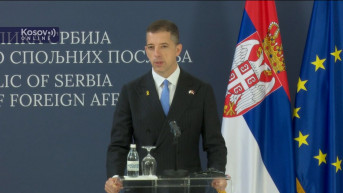
Serbia’s Minister of Foreign Affairs Marko Djuric stated that Serbia and the United States hold differing positions on Kosovo, but that Washington has made a certain positive step forward when it comes to Serbian national interests in the region and its approach toward Pristina, adding that Belgrade seeks to further improve relations with Washington, RTV reports.
“We must look at things objectively and say that the Trump administration suspended the strategic dialogue with Kurti’s government and withheld several hundred million dollars in development assistance. This is a consequence of their assessment of the endangered position of Christians, that is, Serbs in Kosovo and Metohija,” Djuric said in an interview with Tanjug.
The head of Serbian diplomacy emphasized that his job is to strive to analyze matters objectively and to speak the truth and facts in public appearances.
“The fact is that the new U.S. administration has taken certain positive steps toward Serbia. And when I say that, I mean taking Serbian national interests in the region into account,” Djuric said, adding that Serbia’s goal is the further improvement of relations with the United States.
Speaking about the internal situation in Serbia, Djuric said it is evident that the U.S. policy of financing various political activities that existed in the previous period no longer exists in that form.
“When it comes to energy, we are currently in a period in which there is a suspension of sanctions against the Russian share of capital, which is the result of talks and initiatives by President Vucic and us in the government, with the aim of preventing Serbia from unfairly facing the consequences of relations among major powers,” Djuric said.
He added that for ten months Serbia’s position had been taken into account, but also that sanctions against NIS had been in force for more than two and a half months, which had negative consequences for Serbia. Djuric noted that Serbia was not pleased with such moves and actions, but, for the sake of truth, oil is now flowing and the refinery will resume operations in a few days.
“We hope that a solution will be found soon. And as President Vucic has said, as a state and as a system we prepared very seriously for such a scenario. At no point was the security of market supply, nor even the price level, brought into question. And I believe that is what matters most,” the head of Serbian diplomacy added.
He specified that, when it comes to the U.S. approach toward the Republic of Srpska—an important issue for the Serbian people—it is highly significant that sanctions against many the Republic of Srpska officials have been lifted, as well as that there has been a fundamental change in the approach to the issue of Bosnia and Herzegovina.
“There is no insistence or pressure regarding the unitarization of Bosnia and Herzegovina when it comes to Washington’s policy, which was not the case with some previous administrations,” he said.
Djuric further explained that Serbia has two strategic priorities in 2026: preserving stability and peace in the country, and continuing economic growth.
“In 2026, Serbia will stand firmly on its own feet and will primarily take care of its own interests. Our motto is in line with the times we live in—Serbia first—and Serbian state and national interests are the basic criterion and benchmark for our positioning on the international stage,” Djuric said.
As he added, within this framework Serbia will continue to support international public law and the United Nations Charter, but the priority will be the preservation of Serbian interests, both state and national, because Serbs do not live only in Serbia, RTV reports.
Djuric said that work on rapprochement with the European Union will continue, while Serbia will also firmly strive to preserve traditional friendships and to achieve further progress in relations with the United States.
He also noted that efforts will be made to ensure that no opportunity is missed to build economic and political relations with countries in Africa, Asia, and Latin America that will secure Serbia a comparative advantage over others, both as a market and as a country.
According to him, in order to successfully realize key national priorities for 2026—namely preserving stability domestically and internationally, and continuing dynamic economic development—Serbian diplomacy will have to play an even more active and vigorous role.
In that regard, Djuric specified, the strengthening of the ministry’s capacities will continue.
“The public call ‘Become a Serbian Diplomat’ is open. We want to significantly enhance the quality and capacity of our ministry, and in that sense, in 2026 we will also work on opening new diplomatic and consular missions. The government has already approved the opening of a new embassy that will cover the Baltic states, headquartered in Riga, Latvia, and we expect this year to open embassies in Georgia, Tanzania, and several other countries as well,” Djuric said.
When asked about European integration and the non-opening of Cluster 3, Djuric emphasized that Serbia has been ready for the fifth consecutive year to open that cluster, but that the dynamics depend on how EU member states decide.
“If we look at the chapters within that cluster, Serbia has already opened three out of five chapters under the old methodology within that cluster. What depends on us is how well we carry out the administrative and technical preparatory process. That has long been completed and was even assessed positively by the European Commission five years ago. We must do what we can politically to win over those member states that are skeptical, but there are things that do not depend on us,” the head of Serbian diplomacy said.
Djuric added that if in certain member states there is deeply entrenched public opinion against enlargement, Serbia cannot easily change that.
He stressed that this is not a short-term task and that Serbia can influence and persuade, but that in some member states attitudes toward opening clusters depend on Serbia’s relations with the Russian Federation, and in some even on relations with Kosovo—though primarily on relations with Russia.
Noting that EU membership is not only Serbia’s national interest, Djuric added that it is in Serbia’s interest to participate in decision-making on European policy in all areas, from culture and security to foreign policy and agriculture.
He also pointed out that the EU would greatly benefit from admitting the Western Balkan countries into its membership, as global events and their dynamics have accelerated so dramatically that the European Union cannot and should not allow itself to lose the potential it would gain by consolidating and uniting in the Balkans as well.
“We must not allow the Balkans to remain Europe’s ‘Achilles’ heel,’ nor for Europe itself to become a chessboard for geopolitical power struggles,” Djuric emphasized.
Noting that within the EU there is a diverse chorus of views and ideological approaches, Djuric expressed the expectation that there will be greater unity in 2026.
Djuric also noted that Serbia has not neglected relations with other major powers, but has continued to develop them.
“There is an intense dynamic of visits from other major centers, as well as economic growth and growing cooperation in all areas with other major powers. We are therefore striving to preserve what we have and to improve new relationships,” Djuric said.
When it comes to the economy, Djuric noted that Serbia recorded record inflows of investment up to last year, which was affected by internal developments and blockades.
“Now it is important to turn toward economic progress and the growth of our economy, because that will, on the one hand, reduce overall social contradictions and tensions, and on the other, create the preconditions for Serbia to continue strengthening institutionally, militarily, and in every other way,” Djuric said.
Asked how much the Specialized Expo Exhibition to be held in Belgrade in 2027 will affect Serbia’s positioning in the international community, Djuric emphasized that Expo is a major opportunity for Serbia, a country that needs to be heard about for positive reasons.
“Expo will be an exhibition that will bring together representatives of, we can now freely say, over 140 countries that will have their pavilions in Belgrade at the Expo site. Millions of tourists will come to Serbia for Expo. Infrastructure, tourism services, and many segments of our society will experience development thanks to the Expo project. I am therefore pleased by this and must admit that it is a positive vision that has unexpectedly brought a development opportunity not only to Belgrade but, I would say, to Serbia as a whole,” Djuric said.
He added that Expo has also provided Serbia with a positive political narrative, as many world leaders and representatives of various countries will gather in our country.
“I do not need to explain that this is beneficial even for some of the activities we are conducting related to Kosovo and Metohija,” Djuric said.
Asked what he expects to happen in the world in 2026 and what can be expected if international public law and the international order established by the UN collapse, Djuric said that the old world order is dead.
“The old world order is dead. That is a fact. What we are witnessing is absolute social and political Darwinism in international relations. This situation will last until the formation of a new world order is completed and a new balance is established, after which those who emerge as winners from this ongoing reconfiguration will write new rules,” Djuric said.
Until then, he added, the most important thing is not to be drawn into the vortex of global unrest and conflicts.
“The most important thing is to continue, exactly as President Vucic has defined it, to work on preserving internal and regional stability on the one hand, and on dynamic economic growth and development on the other, because that is what can enable us, as Serbia, to be among the winners in this global reconfiguration that is now taking place—without being drawn into various forms of, for now, political conflicts, which we hope will remain only that,” the head of Serbian diplomacy emphasized.
Congratulating everyone on the upcoming Orthodox New Year, Djuric said that the Serbian New Year represents a distinction and a specific feature for the Serbian people.
He added that it is an important characteristic of our culture and stated that he would like it to become an official state holiday in the future, in order to help preserve it.
“We do not, contrary to common belief, have too many non-working days. I believe we have around 13 non-working days in the calendar, which is at or even slightly below the average for European countries. I think the government made an important step forward this year by recommending that Christmas Eve be a non-working day. In that way, we have given somewhat greater attention to Christmas as well,” Djuric said.
On the occasion of the Orthodox New Year, the head of Serbian diplomacy is hosting a reception for the diplomatic corps accredited in Belgrade.
“We expect several dozen foreign ambassadors, heads of mission, and a large number of foreign diplomats, precisely because we are promoting our culture and tradition. Happy Serbian New Year—may this be a year of success on the economic, political, and overall social fronts, a year of peace, love, and unity, because that is something we desperately need,” Djuric wished the citizens.
0 comments