
Djuric from Washington: Horrific situation in Kosovo; Kurti wants to expel the Serbs - it's time to react
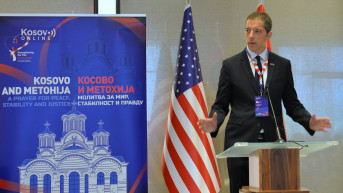
Ambassador of Serbia to the United States Marko Djuric opened the conference "Prayer for peace, stability, and justice" in Washington today, dedicated to Kosovo, emphasizing that Serbia has faced an unprecedented situation in the last 20 months - with the ethnic cleansing of the Serbs from Kosovo and that the fundamental values advocated by the international community are under attack by Albin Kurti, which is why it’s time to react.
"The idea of this conference is to meet, to hear what is happening in Kosovo and Metohija. At the same time, we call for action from the Serbian community in the US because our brothers and sisters, our country, and the church in Kosovo and Metohija need you at this time," Djuric said.
He points out that after 1999, 247,000 Serbs were expelled from Kosovo, which is an unprecedented situation in post-war history. The vast majority did not return to their homes - only 1.7% of the Serbs returned, which is the lowest return rate anywhere in the world according to the official data of the United Nations.
For example, he said that some cities, such as Prizren, the former capital of Serbia, were now without Serbs.
"There were 42,000 Serbs, and today there are only 20 elderly citizens. If it weren't for our church, there wouldn't be a single Serb in Prizren," Djuric said.
He emphasized that Serbia had changed its political direction after 2000, turning towards Europe, but violence against the Serbs had continued, recalling the 2004 Pogrom.
"The violence that lasted for days was not prevented. Thirty-five churches and monasteries were set on fire. Kosovo was rewarded with another one-sided declaration of independence in 2008. Kosovo declared independence in a situation where Serbia had a democratic government, on the European path, a member of the Council of Europe, the OSCE, and numerous organizations... A referendum was never held, only the decision of a mono-ethnic group, without the support of the Serbian community. Unfortunately, many countries have recognized it," Djuric said.
He also reminded that in 2010, the UN General Assembly had adopted a decision to support the dialogue process with the aim of creating peace, stability, and normal relations within Kosovo, in accordance with UN Security Council Resolution 1244.
"The dialogue process has had its ups and downs. We agreed on the Brussels Agreement in 2013, with the key elements being that it was status-neutral, without prejudicing the parties on the status but allowing the Serbs to integrate into the institutions, with a multi-ethnic unit to protect monasteries. Although it was not ideal, it brought some stability," the Ambassador said.
He pointed out that things had started to deteriorate quickly in Kosovo 20 months ago, with the election of Albin Kurti as the Prime Minister.

"Within 20 months, we have faced an unprecedented situation with ethnic cleansing. In the last few months, the number of the Serbs has decreased by 11 percent, in just 12 months, and we assume the number is even higher. When Kurti took office, he came to power with a promise that his main agenda was to create jobs and justice for citizens, regardless of their ethnic background. However, when he came to power, he began to implement a radical national agenda, which he has always followed," Djuric noted.
He emphasizes that he changed the structure of the Serbs in the police.
"In accordance with the Brussels Agreement, the Serbs had their commander in the north, which was Nenad Djuric. But Kurti dismissed him and started sending hundreds of special unit members to the north, violating all agreements, even the constitution. He changed the ethnic structure of the police and took land in the north to build mono-ethnic paramilitary police forces," Djuric said.
The result of all this, he warned, was a large number of ethnically motivated attacks.
"In 20 months, there have been 450 ethnically motivated attacks on the Serbs, 61 Serbs have been arrested, and we have dozens of them detained as political prisoners in Kurti's prisons without judgments and trials," Djuric stated.
All of this has been condemned by the international community, the United States, and the EU, sometimes with strong words. Even the US Secretary of State had sharp comments about Kurti's behavior, but on the ground, KFOR and EULEX do not prevent his actions.
Therefore, the Serbs had tried to protest, first with barricades in the north, Djuric noted, adding that even Jarinje had been closed for entry into Kosovo, and citizens had to go through several checks to get there.
"The situation in Kosovo is horrifying. We had shots fired at children on Christmas Eve, which were carried out by a KSF member, a force that represents a violation of all international agreements. He shot an 11-year-old boy, and he was recently released. The message of Kurti's regime is that even if you shoot Serbs, you won't be punished. Now we had the deportation of the abbot of a monastery," he emphasized.
Kurti’s goal is nothing but to carry out a complete ethnic cleansing of the Serbs and the SOC from Kosovo and Metohija, the Ambassador stated.
"When he finishes expelling the Serbs and the SOC, I'm sure he will try to erase all physical evidence of their existence. He is implementing a fascist agenda in Kosovo. I know it's a harsh word, but if you analyze everything he does, you can't come to a different conclusion. I want us to discuss this today," Djuric said.
He pointed out that the situation was such that the action of our entire community was needed because now was the time to react.
"We want greater US involvement in resolving the situation. We are aware that 1999 is still present in our relations. But the citizens want the United States to get involved in solving the Kosovo issue. It's up to you to talk to your elected political representatives to explain what is happening in Kosovo," Djuric said.
He reminded that the US administration had condemned Kurti's behavior, but further steps were needed.
"The basic values advocated by the international community in Kosovo have been attacked by Kurti," Djuric warned, adding that a large number of conference participants showed that they cared about their homeland and Kosovo.

comments