
Former member of the Verification Mission, Schifanelli: In Racak, there was a strong stronghold of the KLA
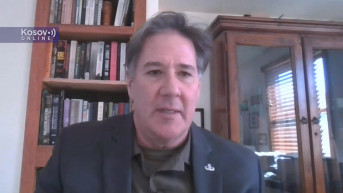
Former member of the US Special Forces and member of the Verification Mission in Kosovo, Marc Schifanelli, tells Kosovo Online that the events in Racak were never fully clarified. He mentions that there were solid pieces of evidence in 1998 and 1999 that Racak was a strong KLA stronghold where at least 20-25 captured Albanians, previously kidnapped by the KLA, were held.
Schifanelli worked from October 1998 to March 1999 at the Logistic Center (Fusion Center) of the Kosovo Verification Mission (KVM) in Pristina, where he, along with several colleagues, daily analyzed all the data collected by verifiers from all parts of Kosovo. They compiled daily and weekly reports based on that information.
Speaking about January 15 when police and military forces initiated the action in Racak, Schifanelli says that the specific trigger was an event that occurred five days earlier when the KLA ambushed Serbian police officers near Suva Reka, resulting in the killing and injuring of multiple policemen.
Schifanelli notes that the Verification Mission already had information that in that area, including Racak, there was a strong KLA stronghold from which actions, including kidnappings, were carried out, and where captured Serbs and disloyal Albanians were held.
"We had previously learned that in the area of Shtime, as well as Racak, and in several other villages, the KLA had been kidnapping and abducting people. Not only Serbs but also Albanian civilians who were believed to be sympathetic to Yugoslav authorities. They considered them traitors, and sympathizers. The KVM interviewed some young men who had been abducted by the KLA. They reported that if the KLA had determined they were not supporters of the Serbs, they would release them. They reported to our observers that there were at least 20-25 people in the Racak area who were captured by the KLA and labeled as sympathizers of the government. They were all sentenced to forced labor. So, there were people in those villages, including Racak, who were abducted by the KLA", Schifanelli says.
According to him, the Ministry of Internal Affairs of Serbia and the Yugoslav Army reported the action in Racak to the Verification Mission, which, according to that information, concluded in the late evening hours of January 15.
Schifanelli says that, based on all the reports, he "connected the dots" of what happened that day and unequivocally determined that there was a battle between the KLA and Serbian Armed Forces.
He states that around 7 a.m. on January 15, Racak was surrounded, and the Yugoslav Army had tanks, artillery, and soldiers on the surrounding hills.
He says that observers were forbidden from approaching the center of the village, but throughout the day, battles between Serbian forces and the KLA were registered. It was clear to everyone that it was a stronghold of the KLA.
"The police were supposed to enter Racak, and I believe it is now entirely clear that it was a strong KLA stronghold; they encountered resistance upon entering. The KLA admitted that eight fighters were killed in those battles. The fight lasted the whole day. As far as I understood, KVM members on the ground could not observe that action, but during the evening, the police withdrew, and the army also retreated from the surrounding hills encircling the village. One KVM patrol managed to enter the town and encountered the residents; I think there were only half of the total number in the town. They placed them in vehicles and took them to hospitals because they were injured. They saw at least one body on the ground and reported it. And that was it. When the sun went down, the army returned to the garrison; there were only a few patrols. But the action was over", Schifanelli says.
According to him, the next day, the head of the Verification Mission appeared in Racak accompanied by members of the KLA and journalists with cameras that recorded dozens of dead bodies.
Schifanelli says that some of the victims were in uniforms, but most were in civilian clothing, and based on the injuries, it is undoubtedly a committed crime because many were shot in the head.
Schifanelli emphasizes that the crucial question is - who committed this crime, and he fears that the answer will never be found.
"It is a tragedy, without a doubt. Who did what is a question that I think we will never get an answer to. I know that when Walker said what he said, it was very quick. In investigations, you can come to data quickly and without verification or slowly but documented. He did as he did. I know there is an interest in why he made that statement. I cannot speak on behalf of Ambassador Walker; I don't know. Maybe he is right. I cannot come to the conclusion and point a finger at any side as responsible for what happened in Racak", Schifanelli emphasizes.
He says it was strange to him why Walker immediately blamed the Serbian side but does not believe that there was any intention behind it.
"I don't think the Racak case was planned. The incident called a massacre is a crime. Who did it, how it happened, I don't know. To this day, I don't have an answer. Over the years, I've seen many investigations, and this is an unresolved crime for me. But I sincerely believe that Walker reacted emotionally. What he saw obviously shook him, and he accused the Serbian Armed Forces of those murders because some of the dead people were indeed killed. That is beyond doubt. But I don't believe he did it intentionally to provoke a NATO reaction or create greater pressure from the international community for NATO intervention", Schifanelli believes.
He says that the Racak case definitely served for stronger pressure on the then FR Yugoslavia and Serbia and initiated two meetings between representatives of FR Yugoslavia and the KLA in Rambouillet.
He emphasizes that the crucial decision for the later bombing of FR Yugoslavia came after representatives of the KLA, led by Hashim Thaci, during the second set of negotiations, at the urging of Bob Dole and Madeleine Albright, signed a ceasefire agreement.
"They convinced Hashim Thaci and the Albanian delegation to sign the agreement, and then there was a turning point when the Yugoslav Government refused. There were very clear signals that if the Yugoslav Government did not sign that document, there would be only one consequence, and that is NATO bombing, which obviously happened", Schifanelli says.
Speaking about the work of the Verification Mission, he says that its initial, key mission was to register violations of the agreement previously signed by Richard Holbrooke and Slobodan Milosevic, under which part of the Yugoslav forces had to withdraw from Kosovo, and the remaining units could only respond with fire in the event of an attack.
"There were about 1,200 verifiers in the field, in January maybe even more, and they all sent information from their sectors. We processed them and created daily and weekly reports", Schifanelli says.
He notes that the Verification Mission soon faced constant conflicts between the KLA and Serbian and Yugoslav security forces upon arriving in Kosovo. It quickly changed its primary mission and became a kind of peace mission trying to cease the conflicts.
"Many things were never reported, like the major conflict in Podujevo in December 1998. Ambassador Walker managed to enable a brief ceasefire, but such forms of conflict were happening daily across Kosovo. It is very important to emphasize that the KVM eventually turned into a peace mission. It was not the intention, but it turned into that. On many occasions, the KVM was criticized for not being able to maintain peace, but that was not its task", Schifanelli says.
He explains that due to the extent of the conflict, his job evolved into attempts to predict in which part of Kosovo there could be major conflicts between the KLA and Yugoslav security services.
"In one of the reports before January, I stated that Shtime could be a possible site of violence in the future due to what was happening there. The KLA had come there and strengthened its position, and there were reports of the kidnapping of ethnic Albanians as well as Serbs, being held as prisoners and sentenced to forced labor for their alleged allegiance to the authorities. In such places, like Racak, in the hills around Shtime", he notes.
Schifanelli denies claims that the Verification Mission, besides monitoring the implementation of the Holbrooke-Milosevic agreement, had a secret intelligence character.
"You have to know that this was a mission made up of representatives of several countries: the United States, Great Britain, France, Russia... However each of the countries in the Contact Group had its missions in Kosovo. Perhaps some had 'secret tasks', but I didn't see or hear about that", Schifanelli emphasizes.
According to him, there was nothing secret in the Operational Center where he worked.
"The center was an open source of intelligence data. So, there were no classified documents, strictly confidential secrets, or secrets at all. In fact, based on the Holbrooke-Milosevic agreement, the Yugoslav Army could see every document we had. Nothing was protected", Schifanelli says.
Marc Schifanelli spent 22 years in the Special Forces of the United States Armed Forces.
Throughout his career, he served in Asia, the Middle East, and South America.
Two months ago, he published a book in the United States titled "Verified - On the Ground with the Kosovo Verification Mission". This book has not yet had a promotion, and Schifanelli explains that it is based on documents he collected during his time in Kosovo.
In it, he extensively discusses all known and lesser-known events leading up to the bombing of the Federal Republic of Yugoslavia in 1999.
He emphasizes that the book does not serve any side in Kosovo.
"I do not work for any government, I am not a lobbyist, and I have no connections with any group. My book 'Verified' is neither 'pro-Serbian', 'pro-Albanian', nor 'pro-American'. I have been a lawyer for about twenty years, and that is my preoccupation. This is simply a book about what happened while I was in Kosovo in 1998 and 1999", Schifanelli emphasizes.
comments