
Gervalla: Progress in dialogue possible by spring; Dacic: We cannot continue without the CSM
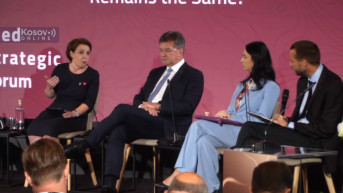
At the Bled Strategic Forum, the panel "Western Balkans: Everything is changing but everything remains the same?" was held, where the heads of diplomacy of the region and the EU's Special Envoy for Dialogue, Miroslav Lajcak, debated the perspectives and joining the European Union.
Dacic: We would like to, but we don't believe in Michel's date - when we do one thing, new conditions follow
The Minister of Foreign Affairs of Serbia, Ivica Dacic, said today in Bled that he would like the date mentioned by the President of the European Council, Charles Michel, to be fulfilled, when he marked 2030 as a possible year for the membership of the Western Balkans in the Union, but that he did not believe in it, because, he said, there was no political decision for that to happen, and as soon as one criterion was met, a new one was set before the countries of the region.
Dacic asked the EU Special Representative Miroslav Lajcak on the panel within the "Bled Strategic Forum" whether Michel meant today what he had said yesterday.
"Did he say it as himself, or on behalf of the EU? Are all member states behind it? I would be happy if that were true. But, also, it seems to me that for 10, 11 years, we have all been participating in such gatherings, and at every conference, there is a famous topic - the European integration of the Western Balkans," Dacic stated.
He pointed out that he did not believe that Michel's words would come true, because there was no political decision that it should be so.
"There is no (decision) because there are changing conditions. What are the criteria? You do one thing, they set up another. The signed agreements are not respected," Dacic emphasized.
He reminded that 10 years ago, he had signed the Brussels Agreement with Hashim Thaci and Catherine Ashton.
"And what? What is the authority of the European Union, which is the guarantor of that agreement? We are at the beginning again," the head of Serbian Diplomacy said.
He added that all the ministers on the panel knew each other from Yugoslavia and were not new people.
"No matter who you are, you who are sitting next to me, you are mine, you are ours and you are the best. We are not peoples and countries of the second category in Europe, but let's respect ourselves a little more. I am ready to work together in whatever way we can because we would be happy if Michel fulfilled what he said," Dacic said.
He added that he would have been happy if the Union had paid so much attention to the region in the 1990s, before the war, because then it might not even exist, and if it had then offered it as an alternative to European integration.
"Why didn't we organize such gatherings, international conferences then? And now there is talk - 'after the war in Ukraine'... We don't need anything after; we need it before the war. The European idea could have been a substitute for the Yugoslav idea. But we didn't deal with that, the EU didn't offer that alternative at the beginning of the 90s," Dacic added.
Lajcak: We must be serious about the Western Balkans because we can lose it
The Special Envoy of the European Union for the Dialogue between Serbia and Kosovo, Miroslav Lajcak, said that the European Union had to be serious towards the Western Balkans because otherwise, it could "lose" it, stating that Charles Michel's statement about 2030 as the year when the EU could receive region to membership, was a statement behind which the EU stood.
Lajcak, answering Dacic's question, said that what Michel had said was an official statement, which he had made in his capacity as President of the European Council, so it was an official statement of the European Union.
"The fact that he said that the EU would be ready by 2030 did not mean that the Western Balkans should not do anything. It takes two to tango," Lajcak said.
He added that his impression, as someone who had been dealing with the situation in the region for 20 years, was that there had never been as much readiness of the European Union for the Western Balkans as it was at this moment.
"We have to take advantage of this moment," Lajcak appealed.
He added that earlier there had been a feeling that the region could wait and that we should reform our own house first, which, he said, was wrong because these were all European issues.
"We have to be serious about the region because we can lose it," Lajcak said.
He stated that last year had been successful for enlargement, as Bosnia and Herzegovina had received candidate status, North Macedonia had begun the negotiation process, and Kosovo had received visa liberalization.
"There was no enthusiasm in the region because it was long awaited. That is what the EU should have done. That is why we should take advantage of this moment that is available to us. I think that now we have a moment where the rule applies - if you do your part, we will do what we have to do," Lajcak said.
Gervalla: Kosovo is ready to go the way of the European Union
Kosovo's Minister of Foreign Affairs, Donika Gervalla, said that sovereign and independent countries should decide for themselves who they belonged to and with whom they wanted to be and that the example of Ukraine showed how important it was not for the neighborhood or the region to decide.
"We, in Kosovo, believe that we are ready and prepared to go on the road to the EU," Gervalla said.
She reminded that Pristina applied for EU membership in December last year and was now waiting for the Union's next step.
"We are very optimistic that it will follow soon. It must follow soon. My optimism is based on the European idea and the development of Kosovo. That should be the first measure of whether the country is ready," the Kosovo Minister said.
According to her, Kosovo is ready to take all necessary steps to join the European family.
Gervalla also said that there were four key questions that had to be answered concerning the integration of the Western Balkans into the EU.
"The first question is - where, and that is the EU, an economic community, but above all a political union, based on values and principles, the rule of law, democracy, respect for minority rights... The second question is - when, and the answer was given yesterday - The year 2030 is a goal we can work with. The third is who? The EU belongs to states that are ready to identify with the principles and basic values of the EU. And the last question is why. If we see the EU only as a source of money, then the Union is the wrong place. The benefits of membership should be felt by the citizens, we must be clear about the motivation why we want to join," Gervalla said.
As she stated, the most important thing was the feeling of belonging to the EU, which existed.
The closer we were to 2030, the more prepared we should be, she added.
Gervalla added that there were insecurity and challenges in the region, which was why Pristina, apart from the EU, wanted to join the NATO Alliance, in order to ensure political and economic progress, as well as security because everything went "hand in hand".
She expressed her belief that the EU seriously understood not only the chances of the Western Balkans joining the EU but also the benefits that the EU itself could have from the membership of democratic countries.
"Both sides have to work for it, for full membership for democratic countries that are ready to join the Union," Gervalla said.
Gervalla also said that she was convinced that progress in the dialogue between Belgrade and Pristina could be reached by next spring, to which Dacic replied that, without the formation of the Community of Serb-majority Municipalities - further progress was not possible.
When asked what the date mentioned yesterday by the President of the European Council Charles Michel, the year 2030, meant for the dialogue between Serbia and Kosovo, that is, did it mean that a result had to be achieved by this date; Gervalla replied that it did not depend only on Kosovo.
"I believe we have a good chance to make progress in the dialogue much earlier and we are committed to that. Prime Minister Kurti yesterday mentioned next spring, we were working on it," Gerwall said.
The EU's Special Representative for dialogue, Miroslav Lajcak, agreed with her.
"We know what we need to do, we have a basic agreement and an annex, which should be implemented," Dacic said.
Moderator Peter Grk asked Dacic the same question, who replied:
"First, someone should answer me what about the previous agreement?".
He reminded that 10 years ago he had signed the Brussels Agreement with Catherine Ashton and Hashim Thaci.
"What's going on with that?" Or does that not apply? Let Lajcak say, he also participated in all that," Dacic said, "calling out" Lajcak, who replied:
All signed agreements must be fully fulfilled."
Dacic also pointed out that the dialogue between Belgrade and Pristina was not about the status of Kosovo, but about the normalization of relations.
"Each agreement with Pristina was status neutral. Dialogue is about normalization, not about status. We are constructive, we want to participate, but - first the Community of Serb-majority Municipalities. Before that - nothing further can be done. We have an agreement from 10 years ago, how long will it be avoided?" Dacic concluded the "triple discussion", on a panel within the Forum in Bled.


0 comments