
Hasani: Albania closely aligned with US and EU policies, Kosovo has chosen confrontation
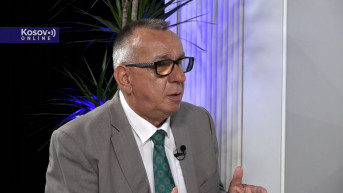
Political disagreements between Albanian Prime Minister Edi Rama and Kosovo Prime Minister Albin Kurti do not represent a struggle for leadership among Albanians in the region, but are primarily the result of their differing political orientations, international law professor Enver Hasani says. According to him, Albania is closely aligned with US and European Union policies, while Kosovo has chosen a path of confrontation.
In an interview with the Montenegrin daily Dan, Hasani said that none of the leading Albanian politicians—Edi Rama, Albin Kurti, Sali Berisha or Ali Ahmeti—was in a position to establish himself as the leader of all Albanians living in different parts of the Balkans. According to him, such an idea is illusory and has no basis in the region’s political realities.
Speaking about the current political situation in Albania, Hasani said that the recent protests had significantly weakened Edi Rama’s position and expressed doubt that the Albanian prime minister would be able to weather the protests and unrest politically. Hasani said Rama’s reluctance to resign and accept the formation of a caretaker government that would organize new elections stemmed from fear of the Special Structure against Corruption and Organized Crime (SPAK).
He argued that corruption and drug trafficking had reached enormous proportions during Rama’s time in power and represented a problem that had to be brought under control, as otherwise it could jeopardize other regional processes. A similar situation, in his assessment, could also be observed in Serbia.
Hasani believes that Edi Rama’s influence in the region is not based on pan-Albanian nationalism but on his consistent support for Euro-Atlantic policies in the political, security, military, economic and cultural spheres. By contrast, he argues that Albin Kurti pursues the opposite policy in these areas.
Hasani also attributed the differences between the two prime ministers to their personal relationship.
“By fighting Ali Ahmeti, Albin Kurti is fighting an ally of Edi Rama, whom he has never had the courage to confront openly. Rama, thanks to his artistic talent and knowledge in various fields, creates a sense of intellectual inferiority in Kurti. During their meetings, Rama treated Kurti as inferior and immature, which is why the Kosovo prime minister avoids him,” Hasani said.
Hasani also believes that there are other left-wing currents in Kosovo that attack Rama and that he describes as strongly neo-Yugoslav and pro-Serbian. In his assessment, these currents exert significant influence on the domestic and foreign policies of the Kurti government.
Turning to the idea of a “Greater Albania” and the national unification of Albanians, Hasani said that today it was largely a matter of political rhetoric rather than an actual political project.
“Albin Kurti has used that card fictitiously, just as he has used and continues to use the nationalism of the extreme left toward the local community as a means of preserving votes and political power. Since coming to power, he has never expressed in his political discourse any desire to pursue a project of national unification,” he said.
In contrast to the rhetoric of national unification, Hasani recalled that in Ohrid in 2023 Kurti had accepted political-territorial autonomy for Serbs in Kosovo, which, in Hasani’s view, constituted an international obligation that Kosovo would sooner or later have to implement.
“In that sense, the project of Albanian national unification continues to exist as an idea, as is the case with other peoples in the Balkans, but it remains in the background, outside the framework of local political power. It survives more as demagogic discourse, as something cultivated in the absence of other concrete ideas to offer citizens. Reviving the idea of Albanian national unification would take decades. At present, no one takes it seriously,” Hasani said.
Speaking about relations between Albania and Kosovo, Hasani stressed that their foreign policy orientations differed.
While Albania, in his assessment, is closely aligned with all aspects of US policy and with European Union policy, Kosovo has chosen a path of confrontation.
Regarding regional relations, Hasani said that security and stability were the fundamental criteria for understanding them.
“The starting point and the criteria for everyone in the Balkans are security and stability. In that respect, relations among the Balkan countries, with the exception of Serbia, are excellent. Even Serbia, in its foreign policy, has not demonstrated strong military or security aggressiveness that would threaten the survival of a neighboring state or broader regional stability. The reason for this is NATO’s presence in the region. It provides a security and military umbrella that has enabled the overall development of the Balkans,” Hasani said.
0 comments