
Hill: De-escalation is now crucial, a political solution is needed for Kosovo
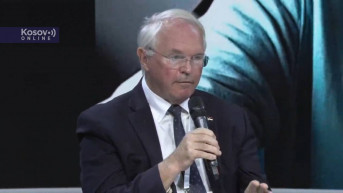
US Ambassador in Belgrade, Christopher Hill, emphasized today that de-escalation of the situation in Kosovo was crucial at this moment and that regardless of who was considered responsible for the events of September 24, ultimately, a political solution was needed for the Kosovo issue.
"Kosovo is a difficult issue. I know that many would say that Serbia needs to overcome it because everything has passed and it must understand that Kosovo is independent and move on to think about the future... I wish I could say that, but it's more complex than that," Hill noted during the panel discussion at the Belgrade Security Forum "The Western Balkans in the global (dis)order: a joint approach to regional instability and external threats".
He added that both sides need to be encouraged to listen to each other.
He stated that the Banjska case was now an issue that must be resolved.
"We need to understand everything that happened on September 24. Those responsible must be held accountable. We must prevent something like this in the future. We must ensure de-escalation. This is crucial. When you have escalation, you have emotions, and that is dangerous. That's why de-escalation is necessary,“ the US Ambassador emphasized.
He also stated that, regardless of who was considered responsible for that event, a political solution to the Kosovo issue was ultimately needed.
He emphasized that dialogue needed to be restored now, as this issue could only be resolved through political mechanisms.
"We need to look at what is fair. European negotiators have put together something good, which includes the status of the Serbs and greater internationalization of Kosovo. That is the right way for now," Hill believes.
He also added that everyone should support what the EU was doing in the region.
"Those who think that issues in the Western Balkans are easy should come for five minutes and see that it is not so. I saw those issues in Dayton and Rambouillet. At that time, it was considered that the Balkans were a key part of the puzzle, or the architecture of security in Europe. Today, we see that there are many difficult situations in the global disorder, so we shouldn't focus solely on the Balkans. It is important that the EU and the USA work together and make the Balkans a part of Europe, to which it geographically belongs," Hill said.
Hill pointed out that it was impossible to give one side everything it wanted while leaving the other aside, and that EU Special Representative Miroslav Lajcak was not doing that; he had good ideas.
When asked by Edward Joseph if the political leadership of Serbia was still a partner for dialogue after the events in Banjska, Hill said that the US was trying to find a solution.
"You have your view of where the problem lies. I have mine. I don't use the 'X' network to express them. Problems should be addressed diplomatically, which we clearly do, and we say that it's necessary to renew the dialogue. De-escalation and commitment to dialogue are necessary. This is not an easy issue, but it must be resolved through a political agreement," Hill reiterated.
He also emphasized that he didn’t interfere in who led Serbia politically and that the US's stance was clear to those in power.
Regarding external threats to the region, he stated that Russia had nothing to offer the Balkans.
"They offer nothing and have no serious stance on Kosovo. There is no doubt that Serbia and other countries in the region should join two organizations - the EU and NATO - which have high standards that are difficult to achieve, but it is important to do so. There is no alternative, and there is no path to Moscow," the US Ambassador said.
When asked about the increase of NATO troops in the region, he said that every time NATO troops were present, it reduced tensions.
According to him, NATO often contributes to a solution and is very active in the region, especially in Kosovo.
Special Advisor to the EU Special Representative for the Belgrade-Pristina Dialogue, Jozsef Pandy, stated that the European Union had put together a good agreement - the Ohrid Agreement, and now its implementation was needed.
"Pristina must form the Community of Serb-majority Municipalities. We expect Serbia to implement its part. Unfortunately, we have returned to crisis management instead of implementing the agreement, especially after September 24. We need to know what happened. We expect those who committed it to be brought to justice," Pandur said.
He stressed that it was important that the US was ready to accept that the dialogue was a European issue that they should support. He pointed out that everyone knew that Lajcak had been to the region with Eskobar on several occasions, and there was a new joint visit coming up soon. "Close cooperation with the US is essential for achieving results in the dialogue, which we have had, although it doesn't seem that way now," Pandur said.
Germany's Western Balkans Envoy, Manuel Sarrazin, noted that the region had chosen Europe but still looked in other directions.
"We, as Europe, need to make an effort to keep you in love with us and to return to us fully," Sarrazin said, adding that the Western Balkans was currently missing many opportunities.
He pointed out that it was true that the EU's focus had shifted to the East, but due to its geographical location, the Balkans remained a crucial region.
"If we want to be important in geopolitical competition, it's essential to deliver our values in Sarajevo and Belgrade. However, if the Mayor of Leposavic doesn't leave the municipality, then the EU is failing," he said.
Sarrazin noted that the biggest problem currently was the lack of political will in the region for a common path towards the EU, the rule of law, and pluralistic democracy.
When it comes to external threats to the region, he listed Russia, China, Turkey, Gulf states, and occasionally, as he added, Iran.
"Russian disinformation is strong, but Chinese investments are strong not only in this region. The discussion about BRICS is interesting for the region, and it shouldn't be underestimated. We must show that we are Bayern Munich in the league and that we have results," he said.
Sarrazin said that anyone who thought that Russia and Vladimir Putin would be with Serbia to the end if it was not in their interest was mistaken. He emphasized that it was dangerous that Serbian society, more than politics, was moving in the wrong direction.
He said the problem was that the majority of society in Serbia was against, as he said, a positive change regarding Kosovo, as Berlin saw it, while the majority in Kosovo was against the CSM.
"We need determined leaders who can deliver that. We will do everything to give them the opportunity, support, perspective, and sometimes money, but political readiness is up to them. We should use the momentum created by the Ohrid Agreement. Everyone says it's good, and we won't have a better one soon. Don't give up on it; stay committed to it," Sarrazin concluded.
When asked about expectations from the Berlin Process, he said that the arrival of German Chancellor Olaf Scholz and French President Emmanuel Macron showed how seriously the EU took the region.
He said that the conflict in Israel threatened to create divisions in European societies, primarily religious, which must be prevented, especially in the Western Balkans.
Romania's Western Balkans Envoy, Adrian Davidoiu, said that the EU did not want the region to fall into a "continuum of insecurity".
He said the Western Balkans should be on the right side with the EU.
The EU's doors have been open since 2003 and have never been closed, even though there have been ups and downs in the process.
He emphasized the importance of finding a way to overcome ethnic issues.
0 comments