
Hill: The USA and Serbia disagree on Kosovo, but they can work together
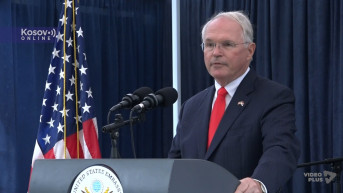
The U.S. Ambassador to Serbia, Christopher Hill, stated this evening that there are issues on which the United States and Serbia disagree, but he is confident that they can work together despite having differing views on important matters, such as Kosovo, as reported by RTV.
In an interview with TV K1, responding to a question about why the U.S., alongside Turkey and the UK, invests the most in transforming the Kosovo Security Force (KSF) into an army, despite Resolution 1244 stating that KFOR is the only armed force in Kosovo, Hill said that the U.S. has recognized Kosovo.
"The U.S. made a decision, and here we are. So, the question is whether we can work together despite having different views on some important matters—matters important to you and to us. My opinion is that we can continue working on these issues, even though we have disagreements. I'm not here to tell you that we can agree on everything, but I'm here to tell you that we will listen a lot. We will try to understand the situation and move forward," Hill emphasized.
When it was noted that no one has told Serbia that Resolution 1244 is no longer in effect, but that it is being ignored, and that the U.S., which advocates for the rule of law, is doing something against this resolution, Hill replied that he cannot rehash the past, but what he can do is look at where we are today and see if there is room for further cooperation.
"And I think there is, even though we have some disagreements," the U.S. ambassador said.
According to him, no one was satisfied with the events of 1999, but they happened, and ten years later, we found ourselves in a situation where none of the choices were great, and the U.S. chose to recognize Kosovo.
Hill added that Serbia made a different choice, but that doesn't mean the U.S. and Serbia can't talk about a million other issues.
When asked if he thinks Pristina faces a security threat from Serbia, as often claimed by Kosovo's Prime Minister Albin Kurti, Hill said he does not want to comment on what Kurti thinks, but emphasized that the U.S. wants to ensure it has a clear understanding with Serbia about what is being sought through these discussions.
"Our position is that Serbia has taken these talks seriously. This is a diplomatic process. Diplomacy involves dialogue. Dialogue takes time. I understand people's frustrations with this issue, but we are committed," Hill said.
He stressed that the U.S. is trying to help in this situation, to make the region better and safer, and to ensure that the situation in the Balkans is much better than it was in the past.
He added that he cannot promise any miracles or that he will change other people's minds about this, but he can promise that the U.S. is serious about trying to resolve these issues and serious about the process that leads to better U.S.-Serbia relations.
Responding to a question about President Vucic's speech at the UN General Assembly and whether "the powerful" like to hear criticism, Hill said he watched the speech and noted that in the era of modern communication, no speech is directed at just one audience.
"I understand that in Serbia there are frustrations about events from past decades, even centuries, but I think Serbia needs to understand that some people will get it, and some won't," Hill said.
As he added, you are never addressing just the Serbian audience, but also an audience unfamiliar with Serbia.
He emphasized that he tries to understand and has data to base his opinions on, but many people do not.
"When you look at the complexity of the Balkans today, it's just as complex as it was 25 years ago, but the world is not focused on it now. The world is dealing with serious problems in the Middle East, the terrible issue of Russian aggression against Ukraine, and there are significant economic problems worldwide," Hill said, adding that not everyone will stop and listen to everything happening in the Balkans.
"Those of us stationed here, tasked with working on these issues, need to understand them, and I’ve spent a lot of time trying to understand things," Hill said.
He also said that it is clear where Serbia wants to go—to be close to Western countries and part of modern economies, and that the U.S. will assist Serbia on its path to the European Union.
He understands the impatience of citizens but believes it is worth waiting and doing what is required for membership.
"I wish you didn’t have to wait, but I think it’s really worth the wait and worth doing what they ask of you to join them. And I don’t think you’ll ever regret it. If I were Serbian, I would be very impatient. You’re heading in the right direction. I want you to keep going, and you’ll get there," Hill said when asked about Serbia’s long wait for EU membership and the feeling of being left in the waiting room without much reason.
He also said that if Serbia aims to join the EU, it must understand that there are some things Europeans require, such as the rule of law or independent media.
In response to the question of whether Serbia's biggest problem is its neutrality and how the U.S. perceives Serbia, Hill said that he does not see Serbia as a neutral country, stating that Serbia has made a "civilizational choice" and that it is part of Europe.
"Whether you like it or not, you are in Europe," Hill emphasized, adding that Serbia also has ties with countries in Asia, Africa, and the Middle East, which is important for Serbia.
He further stated that the U.S. is not telling Serbia what to do, as that is a matter of choice, and he understands that because the U.S. also does not listen to other countries when they tell it what to do.
"I think it’s quite clear where Serbia wants to go. It wants to go with modern economies. It wants to be close to Western countries. But I don’t think Serbia wants to be told who it can or cannot talk to. So, if Serbia wants to have visitors from India or anywhere else, that’s Serbia’s decision," Hill said.
According to him, the U.S. is somewhat trying to shape the environment in which Serbia will see where it wants to go, but "ultimately, that is the choice of the Serbian people."
When asked whether he is implying that Serbia should distance itself from Russia, Hill said that Serbia should do so, as there are few countries in the world that are drawing closer to Russia.
"We’re maybe talking about Belarus, although they are already very close. Maybe we’re talking about North Korea... So, I think you can see where that’s going, what direction it’s taking," Hill said.
He added that instead of focusing on who Serbia should distance itself from, one should look at the direction it is moving, pointing out the extraordinary number of visits Serbia receives.
"I think it’s important that every foreign diplomat understands that Serbia will choose its friends," Hill said, adding that the U.S. does not want to dictate who Serbia can or cannot speak with.
Speaking about U.S.-Serbian relations, Hill said that the U.S. wants good relations with Serbia, and that Washington has certain expectations, just as Serbia has certain expectations from the U.S., but that they can work together.
"With Serbia, it's not that difficult, because I think we have a shared vision of what we want to see in this world. We want to see much more respect for each other. And we certainly want to see peace and security in this region, but also across the world," Hill said.
When asked about his relationship with Serbian President Aleksandar Vucic and how often they communicate, Hill described it as a good relationship.
"If you’re the U.S. ambassador to Serbia, it’s better for that relationship to be one in which you understand each other and try to discuss problems. We need to be better listeners," Hill said, adding that it’s not about how often they talk, but rather that if something urgent comes up, you must be able to reach the leadership of the country where you are accredited.
"You need to be able to have that kind of relationship, and you need to keep the lines of communication open, and you need to ensure that when Washington wants to know something, you can convey that," he said, stressing the importance of being able to reach people and have conversations.
Asked whether Serbia's future depends on the U.S. presidential elections, as is often highlighted in local media, Hill said that he does not like to talk about the internal political process in the U.S. and that he doesn’t see why people in Serbia would prefer one candidate over another, as they do not vote in U.S. elections.

0 comments