
Hovenier: I hope the Government of Kosovo will listen to what we're saying
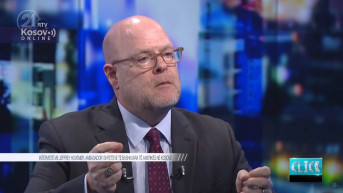
Ambassador of the United States in Pristina, Jeffrey Hovenier, reiterated the stance that the Government of Kosovo should postpone the implementation of the Central Bank regulation, expressing concern about the way it was being enforced, which affected the Serbian community in Kosovo. He added that Kosovo would face "consequences in the quality of partnership with the US" if Pristina did not heed their advice. He also pointed out that the government should approve the draft statute of the Community of Serb-majority Municipalities and submit it to the Constitutional Court.
Hovenier said in an interview for RTV21 that international partners did not dispute the authority of the Central Bank or the Kosovo Constitution, but he was concerned about how the regulation would be implemented.
"Our demand is very clear. We ask the government, not just me, there are also demands from Washington, but also the stance of my colleagues from the Quint, that the Government of Kosovo should postpone the implementation of the Central Bank regulation for now. We ask this because we believe that preparatory work is necessary for its successful implementation, in order to avoid unfair impact on vulnerable communities, including the Serbian community in Kosovo. The work that was supposed to be done to avoid the negative consequences of the regulation has not been completed," Hovenier said.
He added that the US did not dispute the Kosovo Constitution, nor did they seek to regulate the financial sector instead of the CBK.
"The US Government is proud of the role we have played in supporting the development of the Central Bank, Ministry of Finance, and other institutions. We welcome Kosovo's efforts, as well as those of any other country in the world, to implement regulations, laws, and procedures that reduce the possibility of financial crimes, such as money laundering, and terrorism financing... In theory, we have no problem with the Central Bank issuing regulations that would achieve these goals. However, we are concerned that the way this regulation is being implemented or planned to be implemented does not appropriately take into account certain realities that directly affect one of the most sensitive issues in the dialogue between Kosovo and Serbia, which we support, and that is minority communities, especially the Serbian one. That is the reason for our demands," Hovenier said.
He also emphasized that the issue was not about the use of the euro but rather that provisions that might affect citizens had not been enacted in a timely manner.
"Let's be honest and specific. We have two concerns. The first is that, for example, someone receives social assistance from Serbia. Someone receives a pension or child benefit. As I understood, according to the provisions of the Ahtisaari Plan, as well as the conditions accepted by Kosovo, it is accepted that Serbia has an absolute right to provide financial support to the Serbian ethnic community in Kosovo. This has been happening for a long time - dinars or cash are brought into the country, and then citizens go to the post office or bank to withdraw funds. New regulations prevent this from happening. And there was no prior effort to find alternative ways to enable the continued payment of social benefits. That is what concerns us. Pensioners, single mothers, and vulnerable groups who rely on this assistance. And we are surprised that no effort has been made to proactively address this issue and devise a strategy to mitigate this problem," Hovenier said.
Top of Form
The second concern, he says, revolves around practical matters.
"It is no secret that Serbia supports the healthcare and education system in Kosovo. We firmly believe that over time these systems should be integrated into the Kosovar system, in accordance with Kosovar law. But of course, Serbia will still have the right to finance and support them. We believe this should be done in a manner consistent with Kosovo's laws, and frameworks, and transparently. That's why we worked so hard in the dialogue for the Community of Serb-majority Municipalities, because in our opinion, it is a mechanism that will still enable the provision of these services, but in a manner that is legal and transparent," Hovenier said.
He asked how hospitals and schools would function under the recent decision.
"We are worried that in a week or two, there might not be enough money to support their operations. And again, we do not believe the government at this time has adequate plans for all the necessary resources to provide education for children and access to doctors or medication. We do not believe plans have been made. That's why we asked to postpone the implementation to allow time for the development of appropriate plans, which we hope are mutually acceptable for Kosovo and Serbia," Hovenier said.
For this reason, they advocate for discussions within the dialogue framework, along with "an effective campaign for informing the public".
He also emphasized that the international community had been surprised by this decision, as there had been no warning, despite it being made on December 27.
He reiterates that the US would like to discuss with the Government of Kosovo the challenges they are facing.
Commenting on the reactions of certain German and British parliamentarians to his statements, Hovenier said that he highly respected elected representatives in any parliament and welcomed the concerns of parliamentarians worldwide who shared the interest in Kosovo's progress on the European and Euro-Atlantic path, but with a reminder that this path had always been and remained conditioned by the obligations Kosovo had undertaken - to be a multi-ethnic democratic state.
"That remains a shared vision. So, I will just say that I'm not sure if balancing is the right way to think about this issue. There are many other issues where balancing might be an appropriate means of resolution. But I don't know what balance means when I ask the Government of Kosovo to be more careful in considering how its policies will affect vulnerable populations, especially on the very sensitive issue of the Serbian ethnic community in Kosovo," the US Ambassador noted.
He adds that his task, as the US Ambassador to Kosovo, is to speak about what Washington expects from Kosovo.
"Our goal is to see the country progress, to see the full implementation of the obligations Kosovo has undertaken. But the US Government has not been shy. It's not for me to speak about Serbia. However, we have not hesitated to talk about our expectations that Serbia will fully fulfill all the obligations it has received. That's our stance," Hovenier said.
He also recalls that he was perhaps one of the loudest voices on the Banjska case and insisted on the expectations of the US Government to find those responsible for that "terrible act", which was reiterated by Jim O'Brien.
"And that remains our stance, those who committed that crime must be held accountable. But that in no way absolves the responsibility of the Government of Kosovo to implement the Central Bank's decision in a manner that reduces the challenges and problems that the current implementation plans create for vulnerable populations," he reiterated.
He expressed hope that the Government of Kosovo would listen to what the US was saying and adjust accordingly.
"Our demand is obviously the postponement of implementation until a good strategy is established to mitigate the effects on vulnerable populations. And it is optimal for this to be done in a mutually acceptable manner, so we want this to be done through dialogue," Hovenier repeated.
When asked what if Kurti didn't heed what the US Ambassador was saying, he responded, without going into details, that to the extent the government responded to US concerns regarding sensitive issues, it would impact our partnership between Kosovo and the US.
"To the extent that the government decides not to consider our advice or listen to us, there are clear consequences for the quality of our partnership. As I said in my statement and as has been said from Washington, you know, it affects our ability to be effective advocates for Kosovo in the international arena," Hovenier added.
When asked if the US would stop being an advocate for Kosovo, he replied that they didn't want that, quite the opposite, because they believed in it, but, he said, he believed in it based on understanding Kosovo as a "democratic, multi-ethnic, and sovereign state".
Asked if this would affect arms procurement, he recalled that the US had supported the transition of the Kosovo Security Forces.
"We will continue to support these efforts regarding the Kosovo Security Forces, but I can say again, the strength of our partnership influences these matters. I expect the Government of Kosovo to work with us to improve and strengthen our partnership," the Ambassador reiterated.
When asked if he believed that Kurti understood the "urgency of establishing the CSM", he replied that he could not speak to what Kurti understood, but rather what the US stance was, and that was that it was an urgent and important issue, fulfillment of which was Kosovo's obligation according to the Brussels Agreement and its Implementation Annex, as well as a result of previous dialogues agreements since 2013, under which Kosovo had the responsibility to establish the Community of Serb-majority Municipalities.
He says that the CSM should not have executive power, but should fully comply with the Constitution of Kosovo, not as an additional level of government, but to have an important role in advancing the interests of the Serbian community in Kosovo.
"I think this last question underscores the urgency of it again, as a part of it relates to issues regarding support from Serbia to the healthcare and education systems. And these questions about how they will be integrated into Kosovo's laws and structures, and how their operations will be transparent to the Government of Kosovo, will be addressed within the CSM, so that has gained even greater urgency. The government should somehow approve the offered draft statute and submit it to the Constitutional Court, which could assess its constitutionality, which is an important step in this process," Hovenier said.
Regarding the mayoral elections in four municipalities in the north, Hovenier expressed hope that they would happen and emphasized the importance of citizens having the opportunity to exercise their right to remove elected officials if they wanted to.
He pointed out, however, that the US Government had fully accepted the outcome of last year's local elections in the north as legal because they had been held in accordance with the laws, but also acknowledged that "no one would be particularly pleased with an official elected with no more than four percent of registered voters".
He added that every community benefited more from elected officials who had "stronger" legitimacy, which was why he expected the government to fulfill its obligations.
"We know we're nearing an important step, which is the signing of petitions. There are indications that more than 20 percent of registered voters with the right to vote have signed these petitions, but only the Central Election Commission can confirm that. However, when that happens, it's very important for the authorities to do everything possible to ensure that the next step happens without delay. And we won't be very patient," the US Ambassador emphasized.
On the observation that Kosovo officials recently said that the dialogue process led by Miroslav Lajcak had failed, he noted that if something was happening and the dialogue had not been entirely successful, it had much more to do with the political will of the parties themselves than with any mediator or state supporting the moderator.
"I believe there is a vision and a way forward. From my perspective, we have a very good agreement reached in February last year and a very good Implementation Annex reached in March last year. The focus should be on both governments doing everything in their power to fully implement all their obligations from these agreements and not spending so much time worrying about what the other is doing. And in that way, everyone will advance their European and Euro-Atlantic future, which is what we want to see," Hovenier concluded.

comments